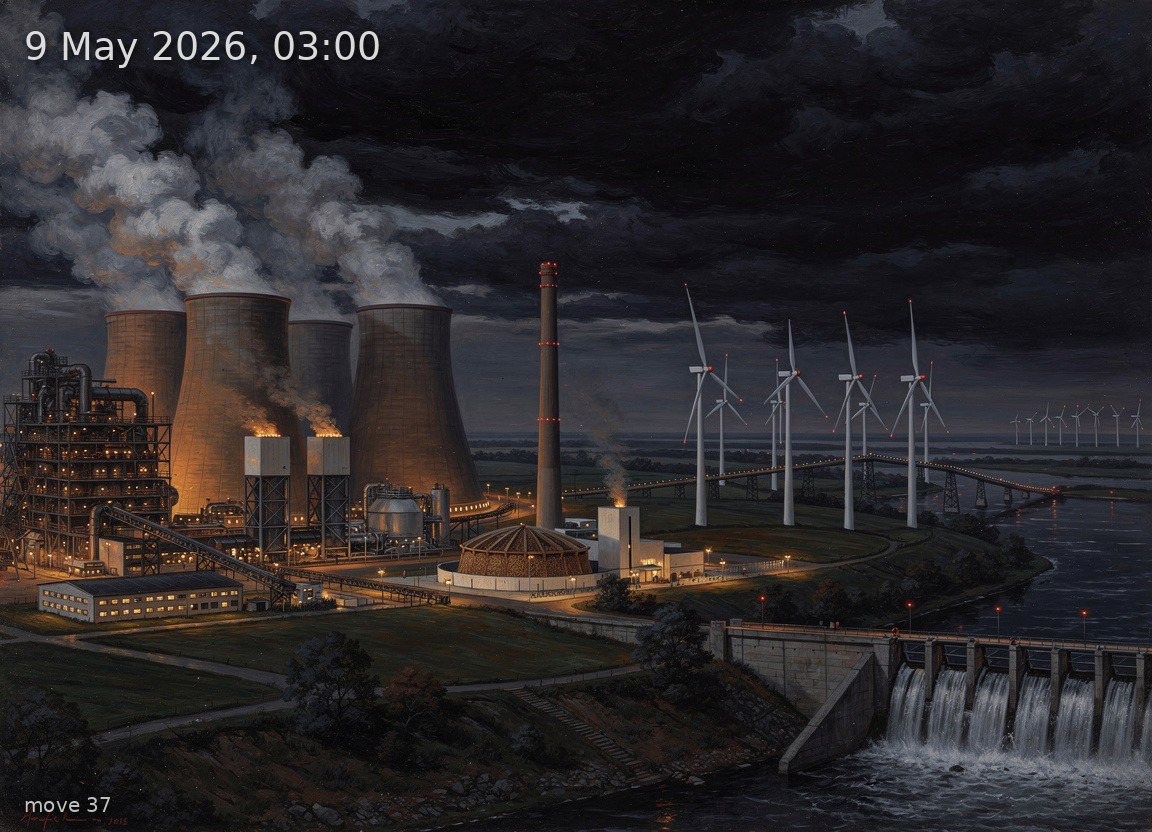
Brown coal and wind lead overnight generation as Germany imports 7.7 GW under full cloud cover at elevated prices.
Back
Generation mix
Wind onshore 22%
Wind offshore 5%
Biomass 13%
Hydro 4%
Natural gas 17%
Hard coal 11%
Brown coal 28%
44%
Renewable share
8.8 GW
Wind (on + offshore)
0.0 GW
Solar
32.8 GW
Total generation
-7.7 GW
Net import
124.4 €/MWh
Day-ahead price
4.5°C / 8 km/h
Temp / Wind speed
Open-Meteo, Kassel (51.3°N 9.5°E)
100.0% / 0.0 W/m²
Cloud cover / Radiation
398
gCO₂/kWh
Image prompt
Brown coal 9.1 GW dominates the left third of the scene as a massive lignite power station with four hyperbolic cooling towers emitting thick white-grey steam plumes lit from below by sodium-orange industrial lights; wind onshore 7.2 GW spans the centre-right as dozens of tall three-blade turbines on lattice and tubular towers, their red aviation warning lights blinking in the darkness, blades turning slowly in moderate breeze; natural gas 5.7 GW appears centre-left as two compact CCGT units with tall single exhaust stacks venting thin heat shimmer, their metal casings reflecting amber floodlights; biomass 4.1 GW is rendered as a mid-sized industrial plant with a wooden-chip storage dome and a single square smokestack with faint warm exhaust, positioned in the middle ground; hard coal 3.7 GW sits adjacent to the brown coal complex as a smaller conventional boiler house with a single large chimney and conveyor belt structures; wind offshore 1.7 GW appears as a distant row of turbines on the far-right horizon, their lights tiny points against the black sky; hydro 1.4 GW is a concrete dam spillway in the right foreground, water faintly catching reflected light. The sky is completely black and overcast at 03:00 in May — no stars, no moon, no twilight, only a deep navy-black cloud ceiling pressing down oppressively. The atmosphere is heavy and dense, conveying high electricity prices. Temperature is a cold 4.5°C; early spring vegetation is sparse and dark, bare-branched trees with only tentative new leaves. Ground is damp. All illumination comes from artificial sources: sodium streetlights casting orange pools, industrial floodlights on steel structures, red warning beacons. A German river flows through the foreground reflecting the industrial glow. Style: highly detailed oil painting in the tradition of 19th-century German Romantic landscape painters — Caspar David Friedrich meets industrial sublime — with rich, dark colour palette of deep blues, blacks, warm oranges, and cold greys, visible impasto brushwork, profound atmospheric depth and chiaroscuro, yet with meticulous technical accuracy on every turbine nacelle, cooling tower curve, and exhaust stack. No text, no labels.