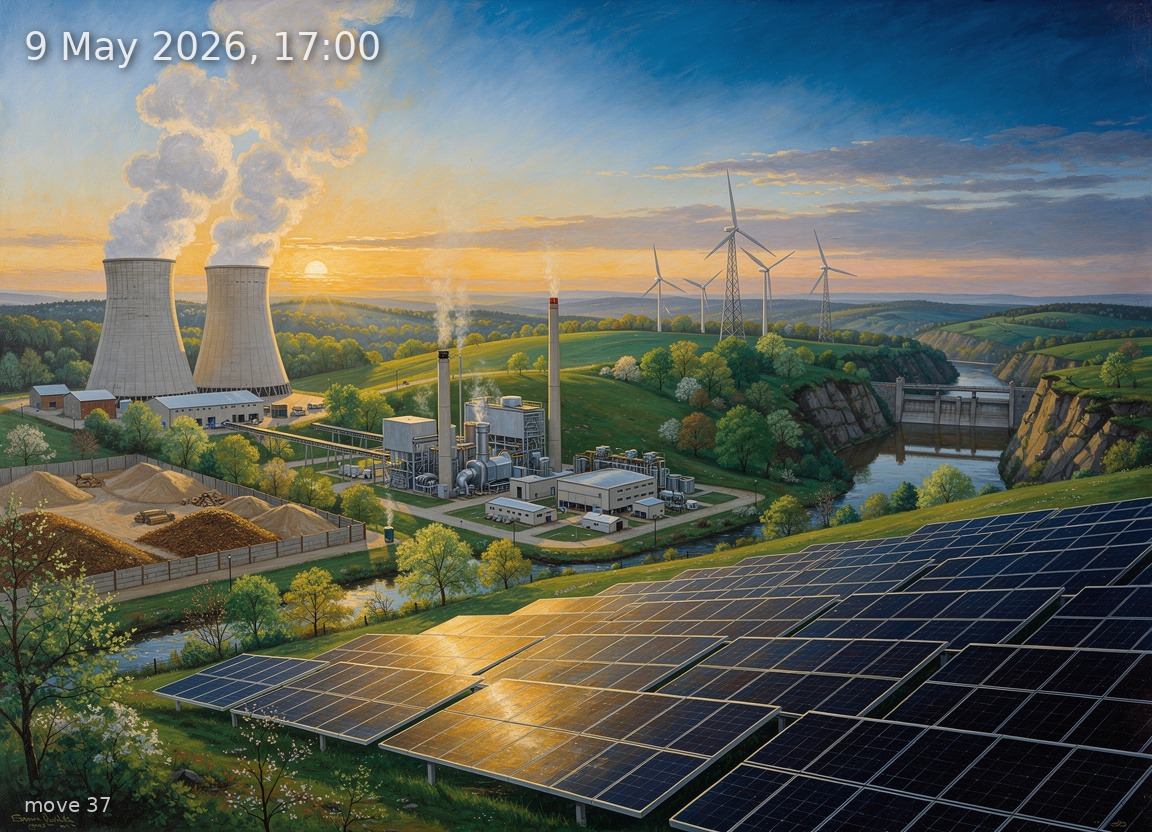
Solar dominates at 23 GW on a clear May evening, but 7.9 GW net imports are needed as consumption outpaces domestic supply.
Back
Generation mix
Wind onshore 6%
Wind offshore 1%
Solar 63%
Biomass 11%
Hydro 4%
Natural gas 5%
Hard coal 2%
Brown coal 8%
85%
Renewable share
2.6 GW
Wind (on + offshore)
23.0 GW
Solar
36.6 GW
Total generation
-7.8 GW
Net import
93.7 €/MWh
Day-ahead price
18.2°C / 4 km/h
Temp / Wind speed
Open-Meteo, Kassel (51.3°N 9.5°E)
10.0% / 340.0 W/m²
Cloud cover / Radiation
105
gCO₂/kWh
Image prompt
Solar 23.0 GW dominates the centre and right foreground as vast fields of aluminium-framed crystalline silicon photovoltaic panels stretching across rolling green hills, catching low-angle amber light. Brown coal 3.1 GW appears at the left as two hyperbolic cooling towers with thick white steam plumes rising against the sky. Biomass 4.1 GW sits in the left-centre as a cluster of industrial biomass plants with modest chimneys and wood-chip storage yards. Wind onshore 2.0 GW stands as a small group of three-blade turbines on a distant ridge, rotors barely turning in the still air. Natural gas 1.7 GW is rendered as a compact CCGT facility with a single exhaust stack and thin heat shimmer, tucked behind the biomass complex. Hydro 1.5 GW appears as a small concrete dam with a reservoir glinting in the background valley. Hard coal 0.6 GW is a single modest coal plant with a low stack near the far left edge. Wind offshore 0.5 GW is faintly visible as tiny turbine silhouettes on the far horizon line. The sky is a dusk scene at 17:00 in May: the sun hangs low in the west, casting long golden-orange light across the landscape, the upper sky transitioning from warm blue to deeper blue overhead. The atmosphere feels heavy and slightly oppressive despite the warmth, hinting at high electricity prices — a faint amber haze hangs over the thermal plants. Spring vegetation is lush, with bright green grass and leafy deciduous trees in full canopy. Temperature is pleasant at 18°C. Style: highly detailed oil painting in the tradition of 19th-century German Romantic landscape painters such as Caspar David Friedrich and Carl Blechen — rich saturated colour, visible confident brushwork, atmospheric aerial perspective with luminous depth. Each energy technology is rendered with meticulous engineering accuracy: three-blade rotors with nacelles on lattice towers, precise PV module grid patterns, hyperbolic cooling tower geometry with reinforced concrete ribbing, CCGT exhaust stacks with heat exchangers. The composition evokes a grand industrial pastoral, monumental yet contemplative. No text, no labels.