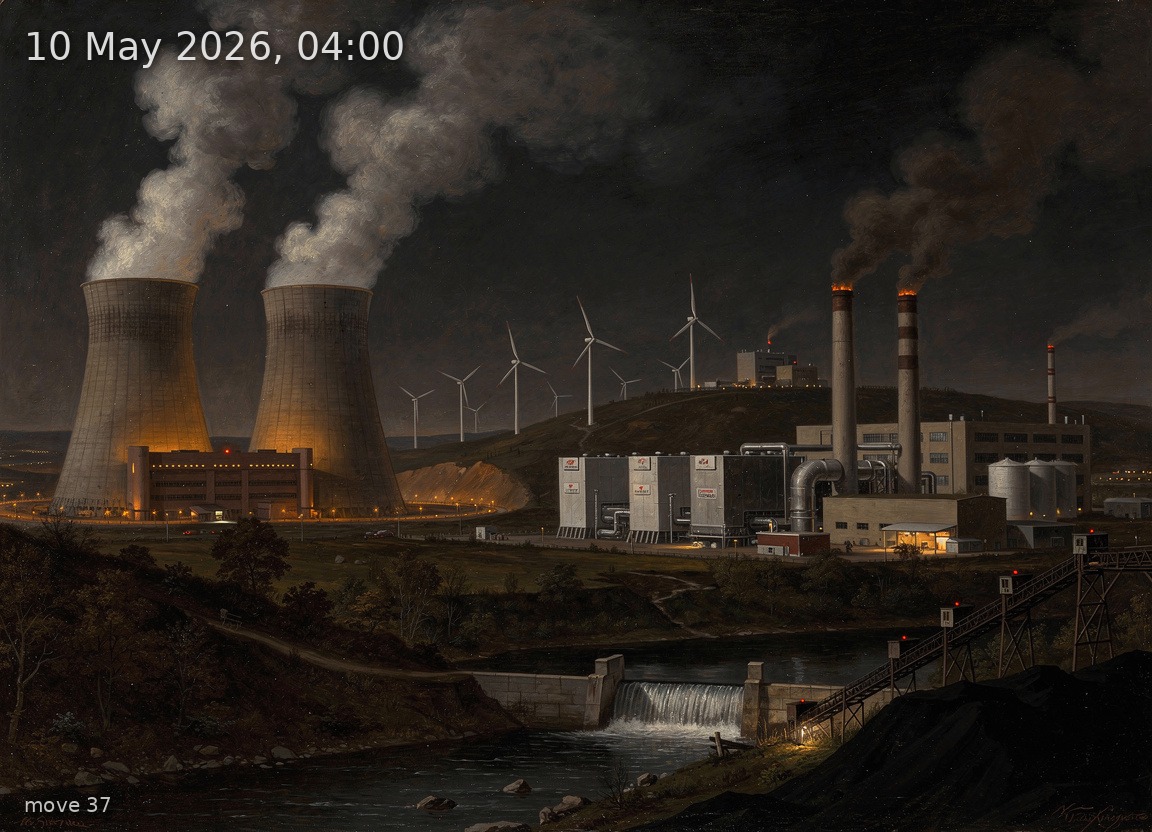
Brown coal and gas anchor a 25 GW supply against 37.9 GW demand, with 12.9 GW of net imports at elevated prices.
Back
Generation mix
Wind onshore 19%
Wind offshore 2%
Biomass 16%
Hydro 5%
Natural gas 17%
Hard coal 14%
Brown coal 27%
42%
Renewable share
5.1 GW
Wind (on + offshore)
0.0 GW
Solar
25.0 GW
Total generation
-12.9 GW
Net import
124.2 €/MWh
Day-ahead price
5.7°C / 6 km/h
Temp / Wind speed
Open-Meteo, Kassel (51.3°N 9.5°E)
54.0% / 0.0 W/m²
Cloud cover / Radiation
410
gCO₂/kWh
Image prompt
Brown coal 6.8 GW dominates the left quarter of the scene as a massive lignite power station with three hyperbolic cooling towers emitting thick white steam plumes into the dark sky; onshore wind 4.7 GW occupies the centre-left as a scattered line of tall three-blade turbines on a gentle ridge, rotors turning slowly in light breeze; natural gas 4.1 GW appears centre-right as two compact CCGT units with slender exhaust stacks and faint orange flare tips; biomass 4.1 GW is rendered as a mid-sized wood-chip-fired plant with a rectangular boiler building and a single modest smokestack releasing grey-brown exhaust; hard coal 3.6 GW sits at the far right as a traditional coal plant with a pair of large rectangular chimneys and conveyor belts leading to a coal pile; hydro 1.3 GW is suggested by a small dam and spillway in the lower-right valley; offshore wind 0.4 GW is barely visible as tiny turbine silhouettes on the far horizon. The scene is set at 04:00 in complete darkness — a black sky with no twilight, no sky glow, no moon visible, only sodium-orange streetlights along a rural road in the foreground, warm yellow-lit windows of a control building, and the red aviation warning lights blinking atop cooling towers and turbine nacelles. The atmosphere is heavy and oppressive, with low haze and a sense of industrial pressure reflecting the high electricity price. Spring vegetation is just emerging on the hillsides, still largely bare branches, with frost-tinged grass in the foreground suggesting the 5.7°C temperature. Partial cloud cover at 54% is implied by patches where a few dim stars peek through. Painted in the style of a highly detailed 19th-century German Romantic oil painting — rich, dark palette of deep navy, charcoal grey, warm amber, and burnt sienna, with visible impasto brushwork on the steam plumes and soft glazing on the night sky. Each technology rendered with meticulous engineering accuracy: lattice towers and nacelle housings on the wind turbines, aluminium cladding on the CCGT modules, hyperbolic concrete curves on cooling towers. The composition evokes Caspar David Friedrich's sense of sublime scale, with small human-made structures dwarfed by the vast dark landscape, yet every industrial detail precise and technically faithful. No text, no labels.