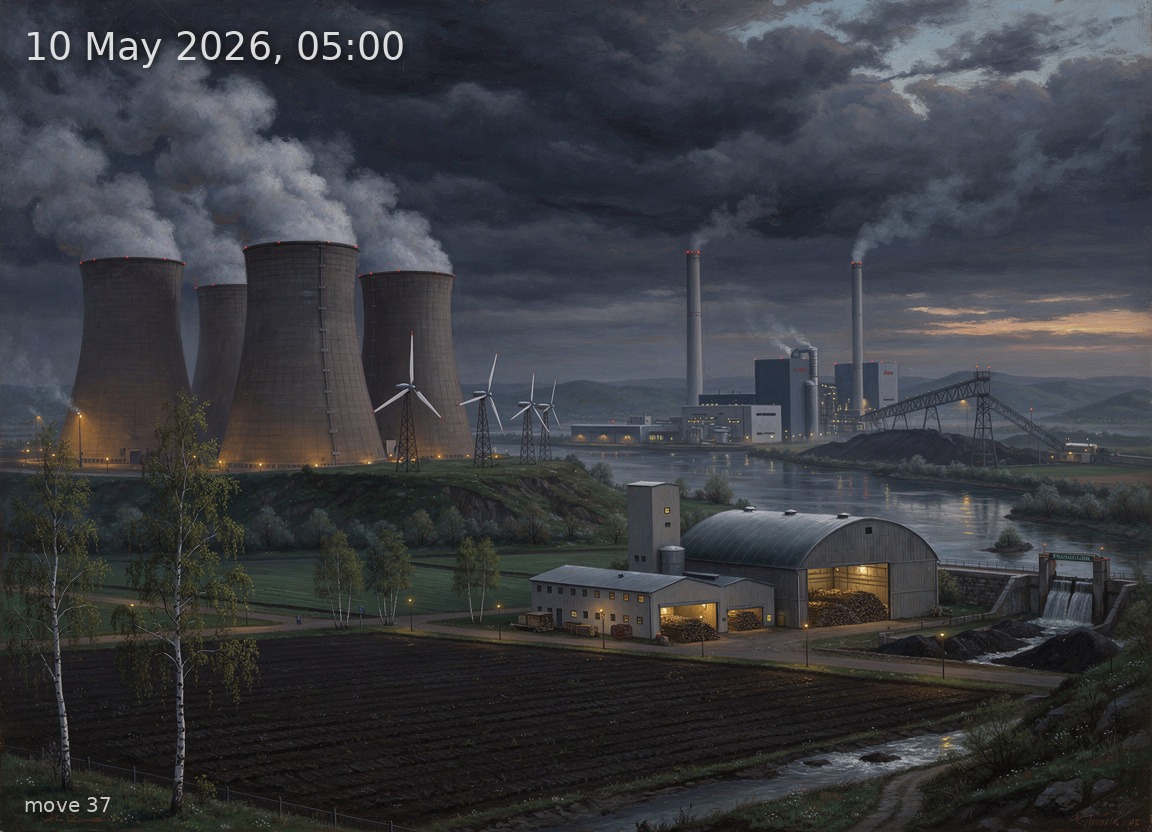
Brown coal and gas anchor a 25.1 GW supply against 38.4 GW demand, with 13.3 GW net imports filling the pre-dawn gap.
Back
Generation mix
Wind onshore 17%
Wind offshore 3%
Solar 1%
Biomass 17%
Hydro 5%
Natural gas 17%
Hard coal 14%
Brown coal 27%
42%
Renewable share
5.0 GW
Wind (on + offshore)
0.1 GW
Solar
25.1 GW
Total generation
-13.3 GW
Net import
123.9 €/MWh
Day-ahead price
5.2°C / 3 km/h
Temp / Wind speed
Open-Meteo, Kassel (51.3°N 9.5°E)
68.0% / 0.0 W/m²
Cloud cover / Radiation
410
gCO₂/kWh
Image prompt
Brown coal 6.8 GW dominates the left third of the scene as a massive lignite power station with four hyperbolic cooling towers emitting thick white-grey steam plumes, lit from below by amber industrial floodlights. Onshore wind 4.3 GW occupies the centre-left as a row of tall three-blade turbines on lattice towers standing nearly still on a low ridge. Natural gas 4.2 GW appears centre-right as two compact CCGT plants with slender single exhaust stacks releasing thin heat haze. Biomass 4.1 GW is rendered as a wood-fired combined heat and power station with a modest rectangular stack and a large fuel-storage dome, warm interior light spilling from open loading bays. Hard coal 3.6 GW sits in the right background as a conventional coal plant with a pair of tall chimneys and a gantry conveyor belt. Hydro 1.3 GW appears as a small dam structure in the far right valley, water faintly gleaming. Offshore wind 0.7 GW is suggested by distant turbines on the far horizon line over a sliver of sea. Solar is absent — no panels, no sunshine. The sky is deep blue-grey pre-dawn, 05:00 Berlin time: no direct sunlight, only the faintest pale luminance at the extreme eastern horizon behind heavy 68% cloud cover. The atmosphere feels heavy and oppressive, reflecting the high 123.9 EUR/MWh price — low-hanging clouds pressing down, a sense of density and weight in the air. Temperature is a chilly 5.2°C; vegetation is fresh spring green but muted in the darkness, with dew visible on grass. Wind is barely perceptible at 3.1 km/h — no motion in the turbine blades, no ripple in puddles. The foreground is a German lowland agricultural landscape with bare ploughed fields and scattered birch trees. Sodium streetlights line a small road in the middle distance, casting orange pools. Painted as a highly detailed oil painting in the tradition of 19th-century German Romantic landscape painters — Caspar David Friedrich meets industrial sublime — rich dark colour palette of navy, charcoal, amber, and burnt sienna, visible textured brushwork, atmospheric depth and sfumato in the steam and clouds, meticulous engineering accuracy on every turbine nacelle, cooling tower shell, and exhaust stack. No text, no labels.