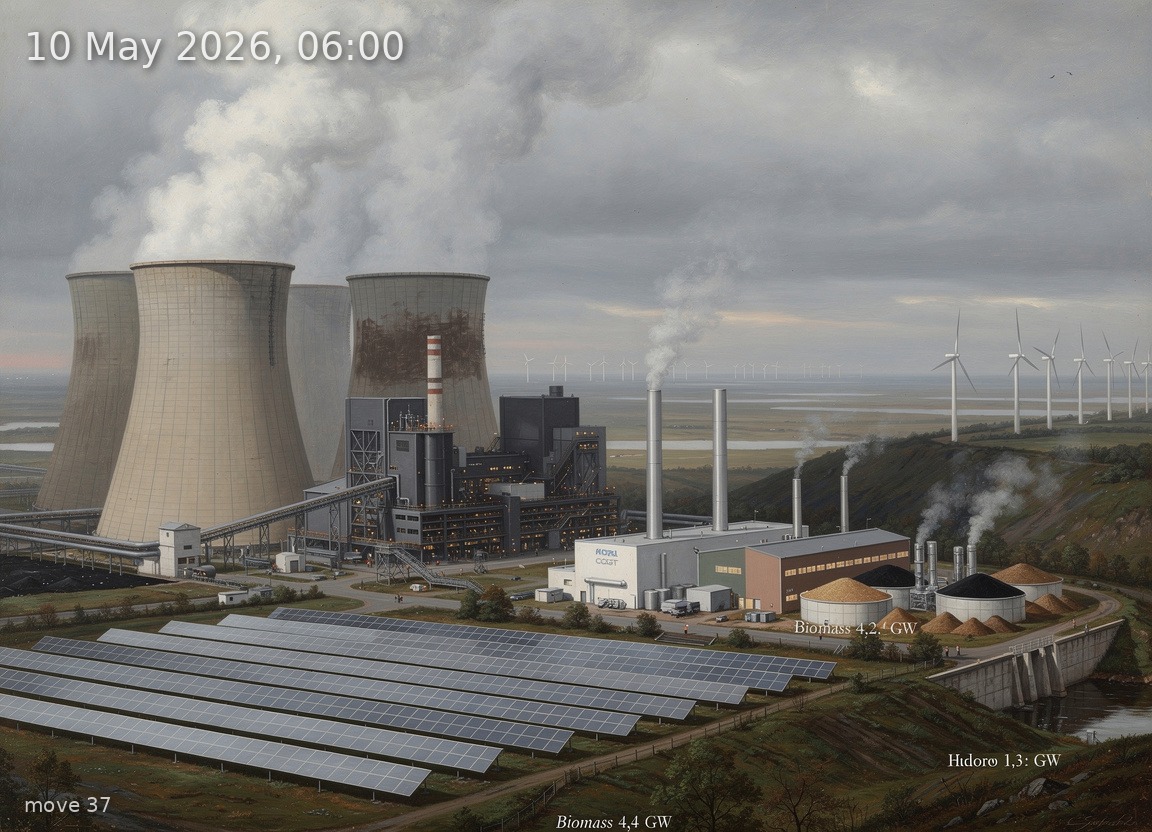
Brown coal, gas, and hard coal dominate early-morning generation as weak wind and overcast skies limit renewables, driving 12.3 GW net imports.
Back
Generation mix
Wind onshore 15%
Wind offshore 4%
Solar 10%
Biomass 15%
Hydro 5%
Natural gas 14%
Hard coal 13%
Brown coal 23%
49%
Renewable share
5.3 GW
Wind (on + offshore)
2.7 GW
Solar
27.4 GW
Total generation
-12.3 GW
Net import
115.1 €/MWh
Day-ahead price
4.8°C / 2 km/h
Temp / Wind speed
Open-Meteo, Kassel (51.3°N 9.5°E)
100.0% / 0.0 W/m²
Cloud cover / Radiation
360
gCO₂/kWh
Image prompt
Brown coal 6.4 GW dominates the left third of the scene as a massive lignite power station with four hyperbolic cooling towers emitting thick white steam plumes into the heavy sky; hard coal 3.6 GW appears just right of centre as a smaller coal plant with rectangular chimneys and conveyor belts feeding dark fuel; natural gas 3.9 GW occupies the centre-right as a compact CCGT facility with tall slender exhaust stacks venting thin vapour; biomass 4.2 GW is rendered as a cluster of medium-scale industrial buildings with wood-chip storage domes and low flue stacks emitting pale smoke; wind onshore 4.2 GW appears as a row of tall three-blade turbines on a ridge in the right background, their rotors barely turning in the near-calm air; wind offshore 1.1 GW is suggested by tiny distant turbines on a grey horizon line beyond a flat coastal plain; solar 2.7 GW is shown as a field of aluminium-framed crystalline silicon panels in the mid-ground, their surfaces dull and reflective only of the grey overcast, producing no glint; hydro 1.3 GW appears as a small concrete dam and powerhouse nestled in a wooded valley at the far right. Time of day is pre-dawn at 06:00 in May: the sky is deep blue-grey with the faintest pale luminance on the eastern horizon, no direct sunlight, all structures lit partly by their own industrial sodium lamps casting amber pools. The sky is completely overcast at 100% cloud cover, low and oppressive, conveying the elevated electricity price — heavy, brooding atmosphere pressing down on the landscape. Temperature is 4.8°C: spring vegetation is fresh green but covered in morning frost, bare patches of cool dew on meadows. Rendered as a highly detailed oil painting in the tradition of 19th-century German Romantic landscape painters — Caspar David Friedrich meets industrial sublime — with rich, sombre colour palette of slate blues, amber industrial light, grey-white steam, and muted greens, visible confident brushwork, deep atmospheric perspective with haze between the layered power stations, meticulous engineering accuracy on every turbine nacelle, cooling tower profile, and panel frame. No text, no labels.