Wind and fading solar lead generation but 16 GW net imports are needed to meet strong evening demand.
Back
Generation mix
Wind onshore 27%
Wind offshore 7%
Solar 30%
Biomass 13%
Hydro 4%
Natural gas 6%
Hard coal 2%
Brown coal 10%
82%
Renewable share
11.5 GW
Wind (on + offshore)
10.2 GW
Solar
33.6 GW
Total generation
-16.0 GW
Net import
110.9 €/MWh
Day-ahead price
20.4°C / 9 km/h
Temp / Wind speed
Open-Meteo, Kassel (51.3°N 9.5°E)
100.0% / 100.0 W/m²
Cloud cover / Radiation
130
gCO₂/kWh
Image prompt
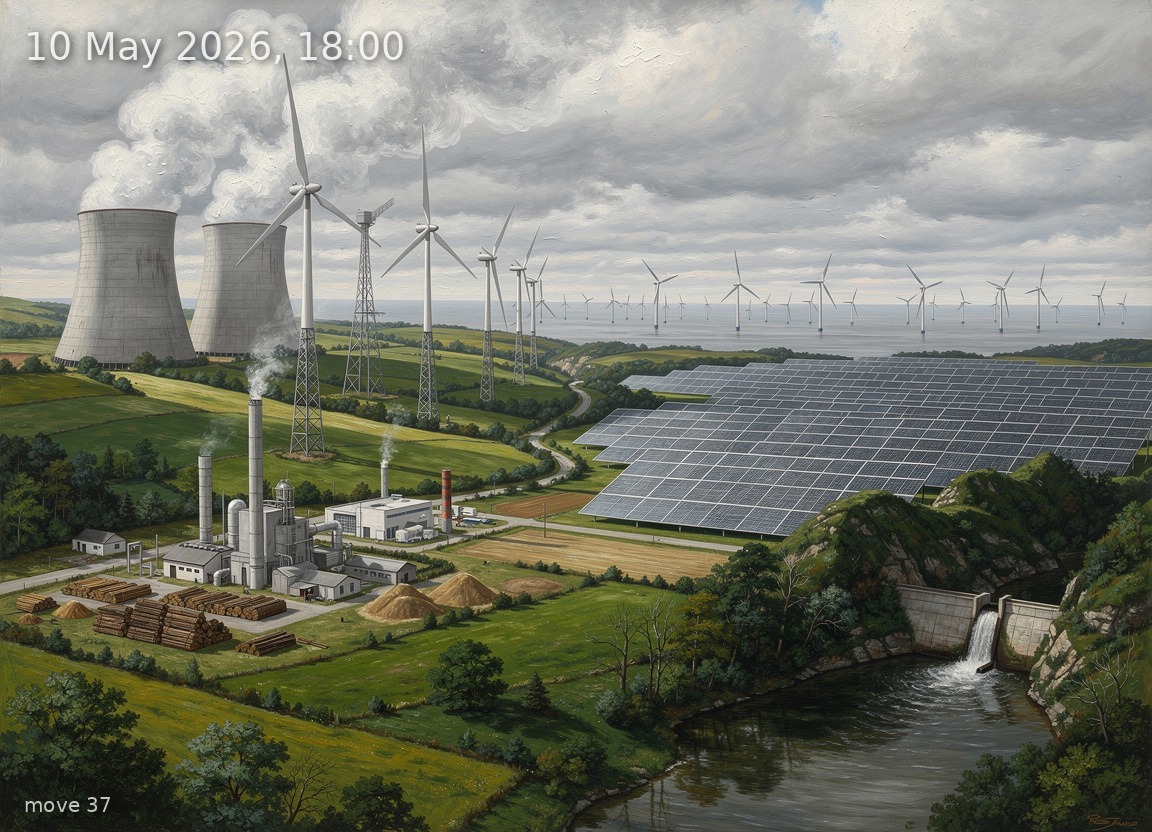
Solar 10.2 GW occupies the right third of the scene as vast fields of aluminium-framed crystalline silicon PV panels stretching toward the horizon, catching only flat diffuse light under overcast skies. Wind onshore 9.2 GW dominates the centre-left as dozens of tall three-blade turbines on lattice and tubular towers, blades turning gently in light wind across rolling green hills. Wind offshore 2.3 GW appears in the far background as a line of turbines on a grey sea visible through a gap between hills. Biomass 4.3 GW is rendered as a cluster of wood-fired power stations with modest stacks and stored timber piles in the left-centre foreground. Brown coal 3.5 GW appears at the far left as two large hyperbolic cooling towers with thick white steam plumes rising into the overcast. Natural gas 2.2 GW sits beside them as a compact CCGT plant with a single tall exhaust stack and a thin heat shimmer. Hydro 1.4 GW appears as a small dam and spillway nestled in a wooded valley at far right. Hard coal 0.6 GW is a single smaller smokestack barely visible behind the biomass plant. The sky is entirely overcast with a uniform heavy grey-white cloud blanket; the sun, low in the west at roughly 18:00 dusk, creates only a warm amber-orange glow concentrated along the lower western horizon, the rest of the sky darkening to slate grey above. The atmosphere feels heavy, oppressive, weighted — reflecting the high electricity price. Vegetation is lush late-spring green: full canopy on deciduous trees, wildflowers in meadows, fresh grass. Temperature is mild, no frost, no haze. The overall composition is a sweeping panoramic German landscape rendered as a highly detailed oil painting in the tradition of 19th-century German Romantic masters — Caspar David Friedrich's atmospheric grandeur combined with meticulous industrial-engineering accuracy. Rich, layered colour palette of muted greens, steel greys, warm amber near the horizon, deep cloud shadows. Visible impasto brushwork in the clouds and steam plumes, fine precise strokes on turbine nacelles, PV cell grids, and cooling tower ribbing. Atmospheric perspective deepens toward the distant offshore turbines. No text, no labels, no people.