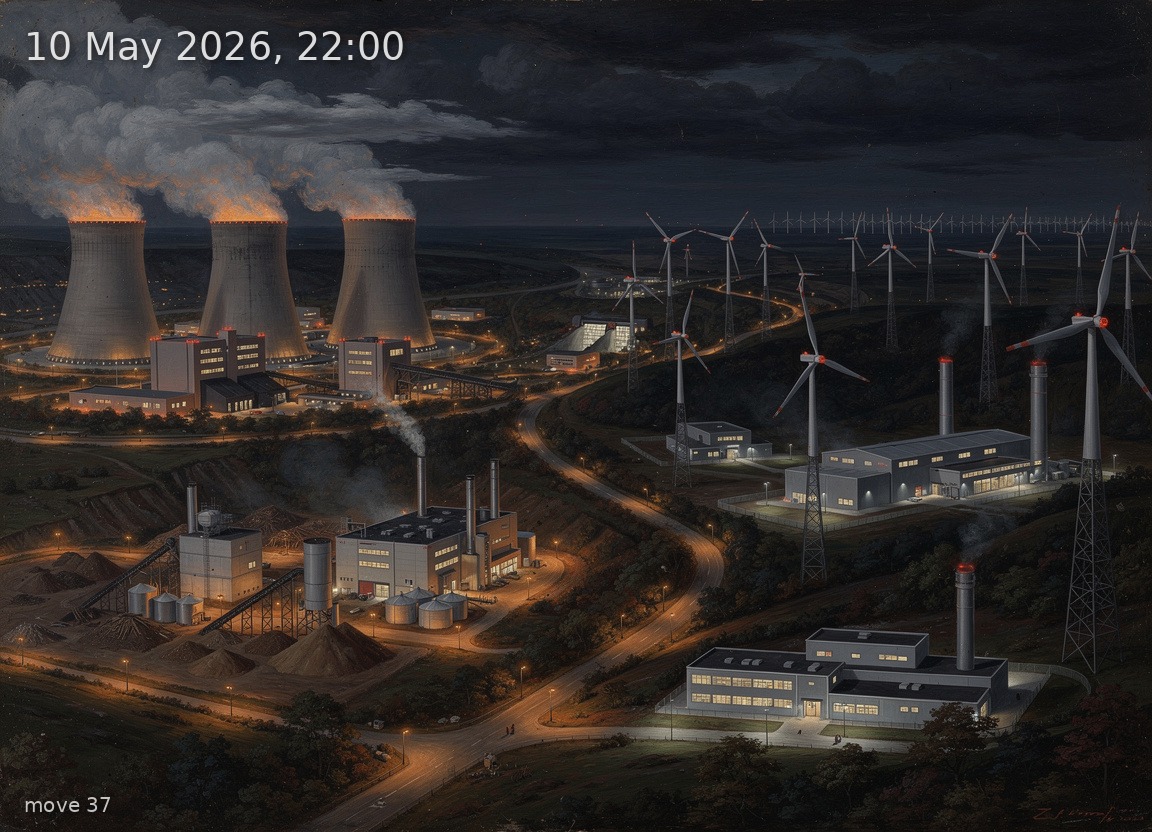
Wind leads at 13.3 GW but 11.9 GW of net imports are needed as nighttime demand outstrips domestic supply.
Back
Generation mix
Wind onshore 34%
Wind offshore 4%
Biomass 13%
Hydro 4%
Natural gas 13%
Hard coal 10%
Brown coal 23%
54%
Renewable share
13.3 GW
Wind (on + offshore)
0.0 GW
Solar
35.3 GW
Total generation
-12.0 GW
Net import
124.1 €/MWh
Day-ahead price
15.5°C / 13 km/h
Temp / Wind speed
Open-Meteo, Kassel (51.3°N 9.5°E)
100.0% / 0.0 W/m²
Cloud cover / Radiation
325
gCO₂/kWh
Image prompt
Wind onshore 12.1 GW dominates the right half of the scene as dozens of tall three-blade turbines on lattice and tubular towers arrayed across rolling central German hills, rotors turning steadily in moderate wind; brown coal 8.0 GW occupies the left quarter as a massive lignite power station with four hyperbolic cooling towers emitting thick white steam plumes lit from below by sodium-orange industrial lights; biomass 4.5 GW appears in the centre-left as a cluster of compact biomass CHP plants with short stacks and wood-chip conveyor infrastructure, warmly lit; natural gas 4.4 GW sits centre-right as two sleek CCGT units with single tall exhaust stacks venting thin heat shimmer; hard coal 3.6 GW is rendered behind the lignite station as a smaller coal plant with rectangular cooling towers and coal conveyors; hydro 1.4 GW appears as a small dam and powerhouse nestled in a valley in the far background; wind offshore 1.2 GW is suggested by a distant row of turbines on the far horizon. The sky is completely dark — a black-to-deep-navy overcast ceiling at 100% cloud cover, no stars, no moon, no twilight glow — it is 22:00 at night. The only light sources are sodium streetlamps casting orange pools along roads, the red aircraft warning lights blinking atop the wind turbines, the glowing windows and floodlights of the power stations, and the incandescent orange glow inside cooling tower rims. The atmosphere is heavy and oppressive, reflecting the high electricity price — low haze clings to the valleys, and the steam plumes spread and flatten against the overcast ceiling. Spring vegetation is present: fresh green grass and leafy deciduous trees just visible at the edges of the lamplight, temperature mild at 15.5°C. Painted in the style of a highly detailed 19th-century German Romantic oil painting — rich, dark palette of deep navy, burnt umber, warm amber, and cool grey — with visible expressive brushwork, atmospheric depth and chiaroscuro, yet every turbine nacelle, cooling tower, CCGT stack, and conveyor belt is rendered with meticulous engineering accuracy. No text, no labels.