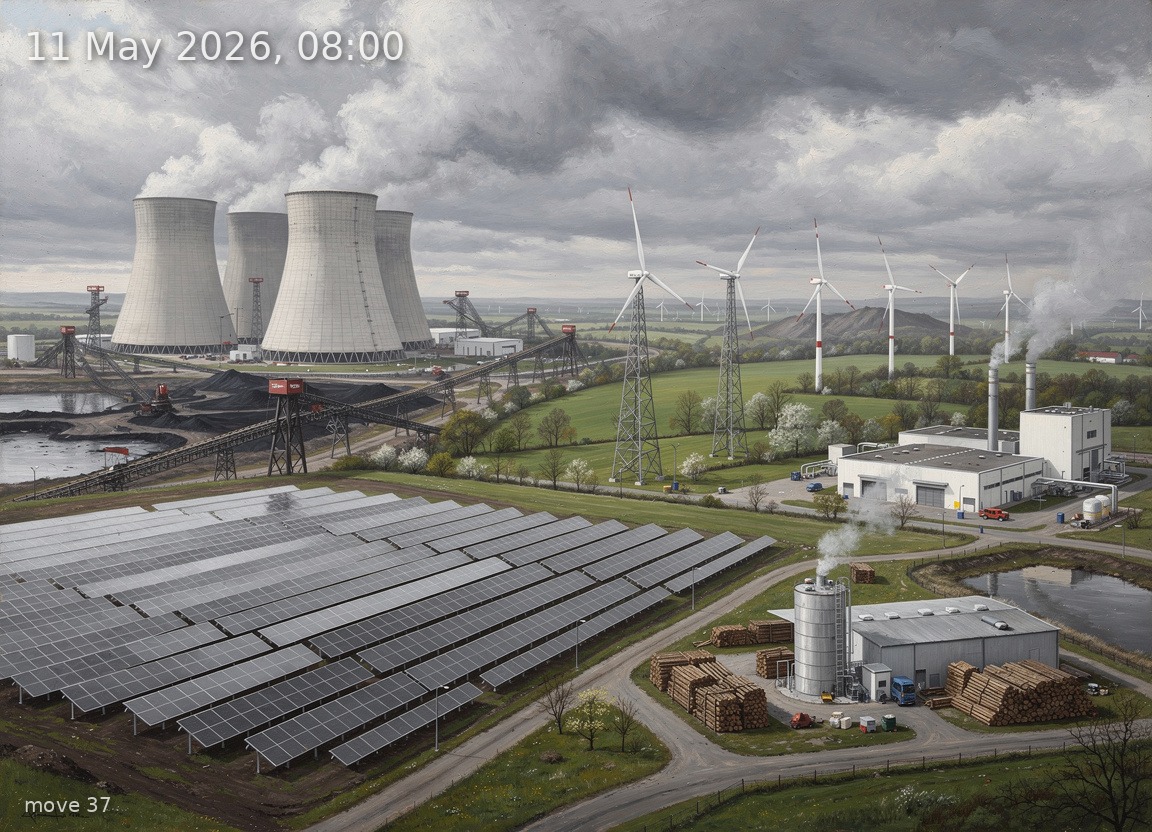
Brown coal, solar, wind, and gas share generation under full overcast, with 22.6 GW net imports meeting high demand.
Back
Generation mix
Wind onshore 21%
Wind offshore 2%
Solar 22%
Biomass 11%
Hydro 3%
Natural gas 13%
Hard coal 9%
Brown coal 19%
59%
Renewable share
9.5 GW
Wind (on + offshore)
9.0 GW
Solar
41.0 GW
Total generation
-22.6 GW
Net import
150.0 €/MWh
Day-ahead price
8.8°C / 10 km/h
Temp / Wind speed
Open-Meteo, Kassel (51.3°N 9.5°E)
100.0% / 0.0 W/m²
Cloud cover / Radiation
286
gCO₂/kWh
Image prompt
Brown coal 7.9 GW dominates the left quarter of the scene as a cluster of four massive hyperbolic cooling towers with thick white-grey steam plumes merging into the overcast sky, surrounded by conveyor belts of dark lignite and ash-coloured settling ponds. Solar 9.0 GW occupies the centre-left as an expansive field of aluminium-framed crystalline silicon panels stretching across flat farmland, their surfaces dull and reflective-grey under the cloud layer, receiving no direct sunlight. Wind onshore 8.5 GW spans the centre as dozens of three-blade turbines on tall lattice and tubular towers turning slowly across rolling green spring hills. Natural gas 5.2 GW appears centre-right as two compact CCGT plants with slim exhaust stacks venting thin heat shimmer. Biomass 4.5 GW is rendered as a mid-sized industrial facility with a cylindrical silo and a single smokestack releasing pale vapour, set among timber yards. Hard coal 3.6 GW occupies the right side as a traditional power station with a large rectangular boiler house and twin chimneys. Wind offshore 1.0 GW appears as a small group of turbines on the distant horizon line. Hydro 1.3 GW is visible as a concrete dam with a thin curtain of white water nestled in the far background valley. The sky is completely overcast at 100% cloud cover—flat, heavy, pewter-grey from horizon to zenith—with no blue sky or sunlight breaking through, creating an oppressive, high-price atmosphere. The lighting is diffuse May morning daylight at 08:00, soft and shadowless, with cool colour temperature. The landscape is early-spring central German terrain: fresh green grass, budding deciduous trees, patches of bare soil, at 8.8°C. High-voltage transmission pylons with sagging conductor lines recede into the misty distance, underscoring the import-heavy grid. Highly detailed oil painting in the tradition of 19th-century German Romantic landscape painters—Caspar David Friedrich's atmospheric depth merged with Adolph Menzel's industrial precision—rich colour, visible impasto brushwork, dramatic scale contrasts between technology and nature. Meticulous engineering detail on every turbine nacelle, every cooling tower's parabolic curve, every PV module's cell grid pattern. No text, no labels.