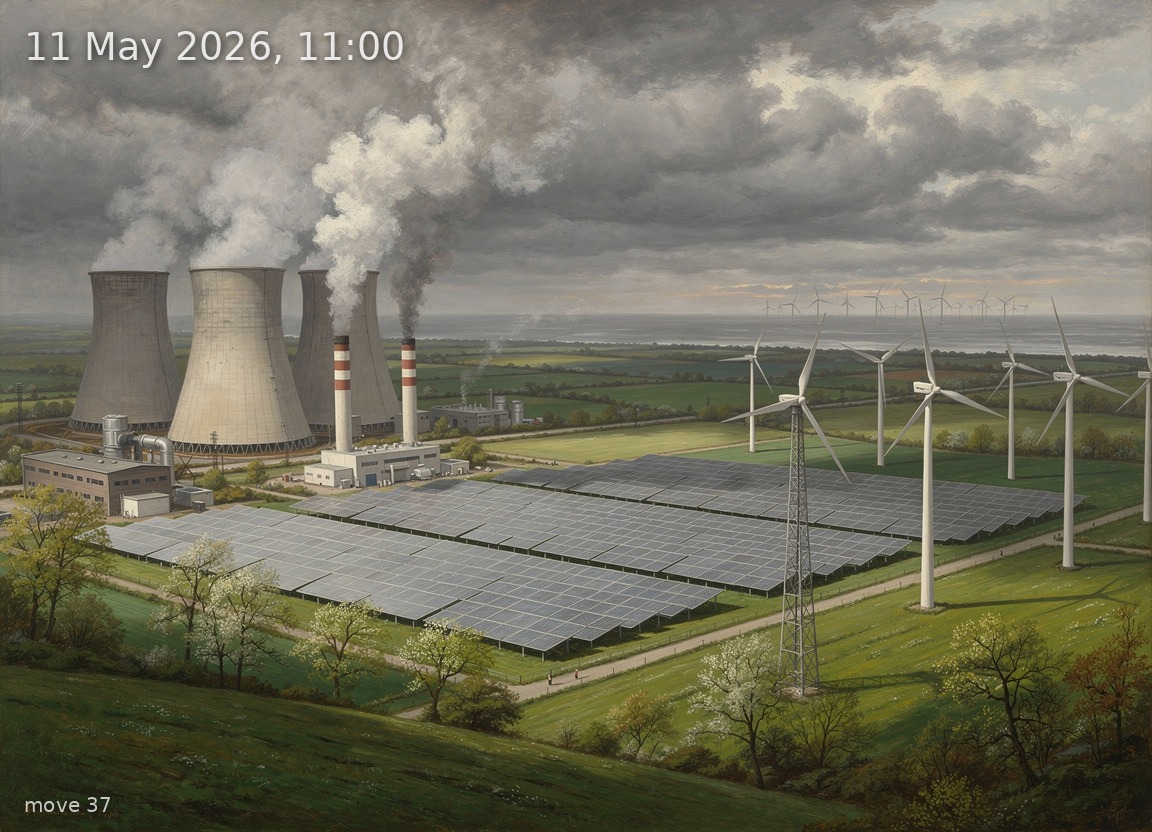
Diffuse solar and wind lead at 73% renewables, but full overcast and 12 GW net imports drive prices above 113 EUR/MWh.
Back
Generation mix
Wind onshore 20%
Wind offshore 5%
Solar 37%
Biomass 8%
Hydro 3%
Natural gas 6%
Hard coal 6%
Brown coal 14%
73%
Renewable share
13.0 GW
Wind (on + offshore)
19.5 GW
Solar
52.2 GW
Total generation
-12.0 GW
Net import
113.4 €/MWh
Day-ahead price
8.2°C / 16 km/h
Temp / Wind speed
Open-Meteo, Kassel (51.3°N 9.5°E)
100.0% / 2.0 W/m²
Cloud cover / Radiation
196
gCO₂/kWh
Image prompt
Solar 19.5 GW dominates the centre-right as vast fields of aluminium-framed crystalline silicon PV panels stretching across flat farmland, their surfaces reflecting only dull grey light under total overcast — no sun visible, no shadows, no glint. Wind onshore 10.4 GW fills the right third as dozens of tall three-blade turbines on lattice and tubular towers, rotors turning at moderate speed across rolling green spring fields. Wind offshore 2.6 GW appears in the far-right background as a cluster of turbines on a grey horizon over a flat sea. Brown coal 7.4 GW occupies the left foreground as a massive lignite power station with three hyperbolic concrete cooling towers emitting thick white steam plumes that merge into the overcast ceiling. Hard coal 3.3 GW sits adjacent as a smaller coal plant with rectangular boiler house and tall chimney stacks trailing grey smoke. Natural gas 3.4 GW appears as a compact CCGT facility with a single slender exhaust stack and smaller vapour plume, positioned between the coal plants and the solar fields. Biomass 4.2 GW is rendered as several modest industrial buildings with wood-chip silos and low stacks emitting faint wisps, nestled among trees at the left-centre. Hydro 1.4 GW appears as a small run-of-river weir and powerhouse along a river in the mid-ground. The sky is entirely blanketed in heavy, low, uniform stratiform cloud at 100% cover, casting flat diffused daylight with no directional shadows — an oppressive, leaden atmosphere reflecting the high electricity price. The temperature is a cool 8.2°C in mid-spring: trees show fresh pale-green leaves, grass is lush but the air feels chilly and damp. The landscape is northern German lowland with gentle hills. Painted in the style of a highly detailed 19th-century German Romantic oil painting — rich, moody colour palette of greys, muted greens, and industrial ochres, with visible confident brushwork, atmospheric depth and haze, meticulous engineering detail on every turbine nacelle, every panel frame, every cooling tower's parabolic curve, every rivet on the gas turbine housing. The scene conveys the weight of an industrial nation's energy system working under a sullen spring sky. No text, no labels.