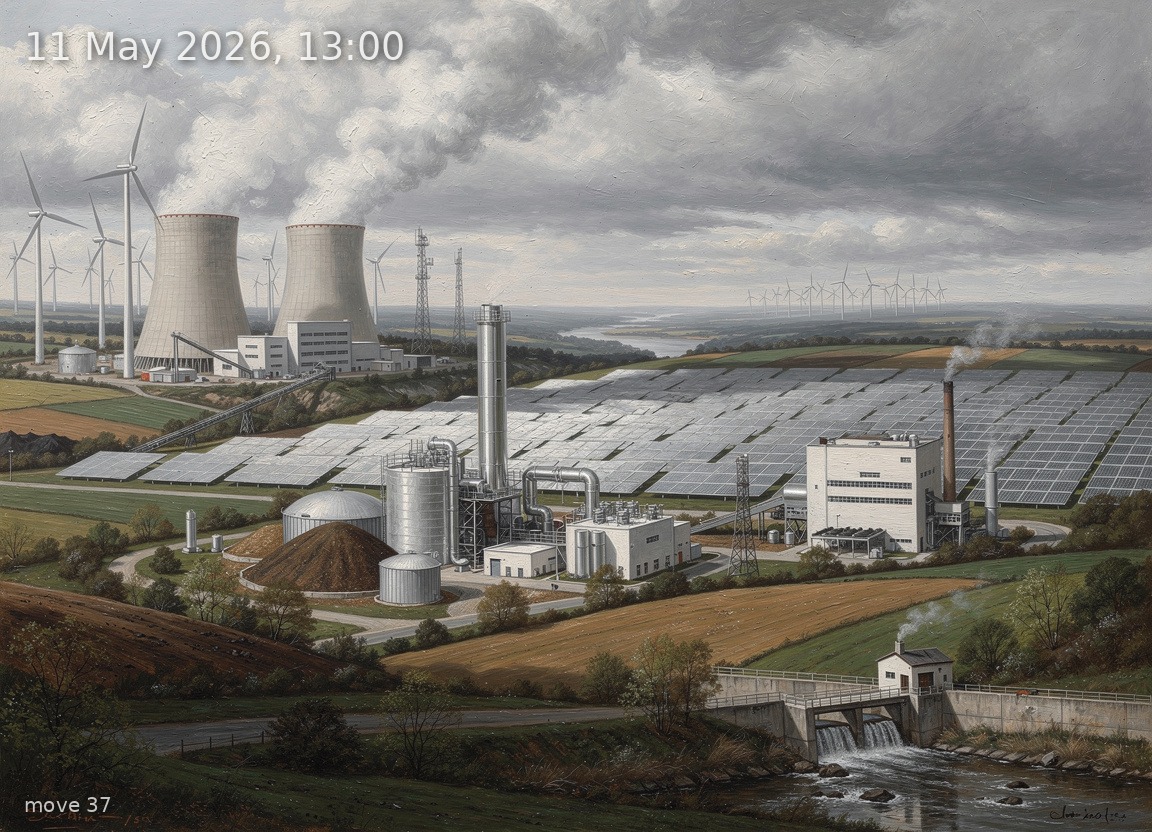
Wind and diffuse solar dominate under full overcast, with brown coal and net imports bridging a 5.2 GW gap.
Back
Generation mix
Wind onshore 26%
Wind offshore 6%
Solar 37%
Biomass 7%
Hydro 3%
Natural gas 5%
Hard coal 4%
Brown coal 11%
79%
Renewable share
18.1 GW
Wind (on + offshore)
21.1 GW
Solar
56.3 GW
Total generation
-5.2 GW
Net import
98.8 €/MWh
Day-ahead price
8.5°C / 19 km/h
Temp / Wind speed
Open-Meteo, Kassel (51.3°N 9.5°E)
100.0% / 12.0 W/m²
Cloud cover / Radiation
150
gCO₂/kWh
Image prompt
Solar 21.1 GW fills the broad centre-right as vast fields of aluminium-framed crystalline silicon PV panels stretching across rolling farmland, their surfaces reflecting flat white-grey light under complete overcast; wind onshore 14.9 GW dominates the left half and middle distance as dozens of tall three-blade turbines on lattice and tubular towers, rotors turning briskly in moderate wind; wind offshore 3.2 GW appears as a distant cluster of turbines on the far horizon above a grey sea glimpsed through a low valley; brown coal 6.4 GW occupies the left foreground as a massive lignite power station with three hyperbolic concrete cooling towers emitting heavy white-grey steam plumes that merge into the overcast; biomass 4.0 GW sits as a mid-sized industrial plant with a tall cylindrical stack and wood-chip storage silos near the coal station; natural gas 2.8 GW appears as a compact CCGT facility with a single polished exhaust stack and slim heat-recovery unit beside the biomass plant; hard coal 2.5 GW shows as a smaller conventional station with a single rectangular boiler building and squat chimney with faint grey exhaust; hydro 1.4 GW is a small concrete run-of-river weir and turbine house nestled along a stream in the lower right foreground. The sky is a uniform dense blanket of stratiform cloud at 100% cover, bright but sunless, casting flat shadowless midday daylight across the scene—no blue sky visible anywhere. The landscape is early-May central German countryside: fresh green grass, young beech leaves, scattered wildflowers, cool 8.5 °C atmosphere with a slight chill suggested by mist clinging to low ground. The mood is heavy and oppressive, reflecting a high electricity price—the cloud ceiling feels low and pressing. Highly detailed oil painting in the tradition of 19th-century German Romantic landscape painters such as Caspar David Friedrich and Carl Blechen, with rich impasto brushwork, atmospheric aerial perspective, and meticulous engineering accuracy on every turbine nacelle, PV module frame, cooling tower shell, and exhaust stack. No text, no labels.