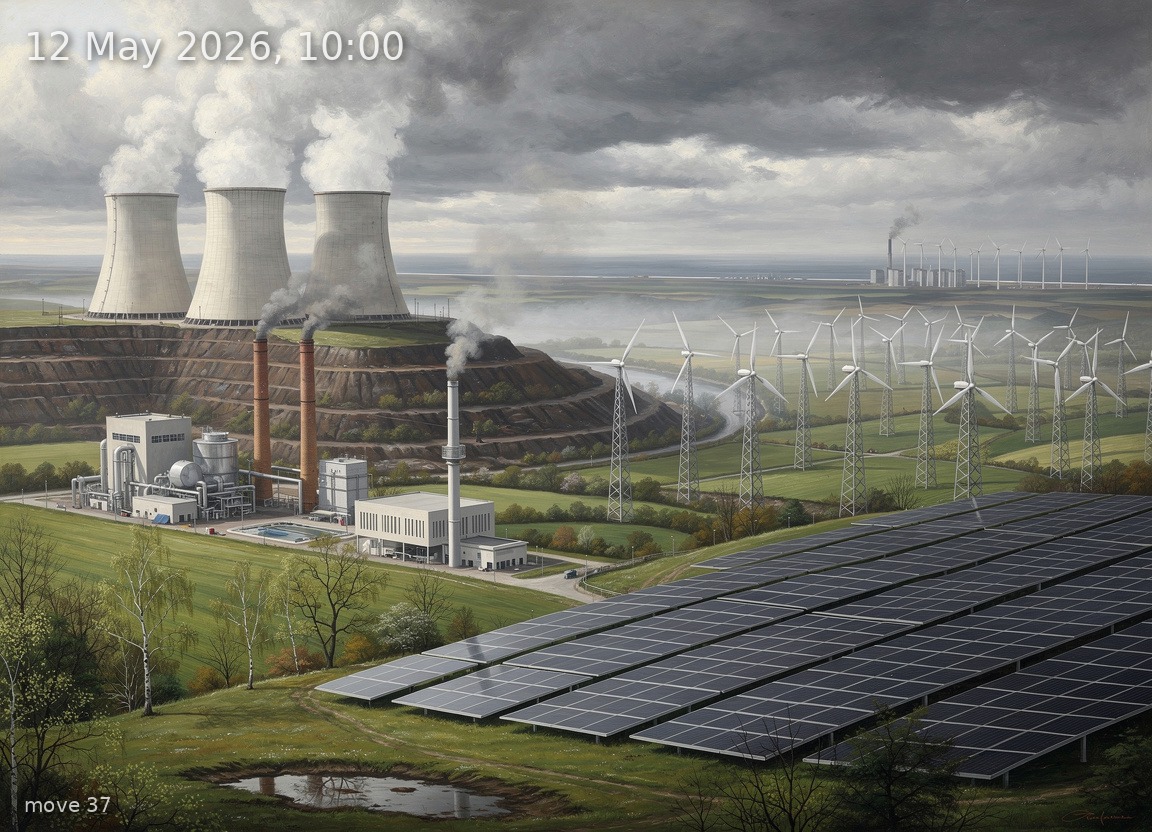
Wind and diffuse solar dominate at 80% renewables, driving 10.3 GW net exports despite persistent coal and gas dispatch.
Back
Generation mix
Wind onshore 30%
Wind offshore 6%
Solar 36%
Biomass 5%
Hydro 2%
Natural gas 6%
Hard coal 6%
Brown coal 9%
80%
Renewable share
26.7 GW
Wind (on + offshore)
27.0 GW
Solar
74.1 GW
Total generation
+10.3 GW
Net export
79.6 €/MWh
Day-ahead price
5.7°C / 24 km/h
Temp / Wind speed
Open-Meteo, Kassel (51.3°N 9.5°E)
97.0% / 61.0 W/m²
Cloud cover / Radiation
142
gCO₂/kWh
Image prompt
Wind onshore 22.1 GW dominates the right half of the scene as vast ranks of modern three-blade turbines on lattice and tubular steel towers stretching deep into the misty distance across rolling green spring fields, their rotors spinning vigorously in strong wind. Wind offshore 4.6 GW appears as a cluster of larger turbines visible on a grey horizon line at far right, rising from a sliver of North Sea. Solar 27.0 GW fills the centre-right foreground and middle ground as enormous arrays of aluminium-framed crystalline silicon photovoltaic panels covering gently undulating farmland, their surfaces reflecting the flat grey-white overcast light — no direct sun, only diffuse illumination. Brown coal 6.4 GW occupies the left quarter as a massive lignite power station with three hyperbolic concrete cooling towers emitting thick white steam plumes that merge into the low cloud ceiling, beside open-pit terraces of dark brown earth. Hard coal 4.3 GW sits just left of centre as a smaller coal plant with a tall rectangular boiler house and two brick chimneys trailing grey smoke. Natural gas 4.1 GW appears centre-left as a compact modern CCGT facility with a single slender exhaust stack and smaller vapour plume. Biomass 4.0 GW is rendered as a mid-sized industrial plant with cylindrical wood-chip silos and a modest smokestack near centre. Hydro 1.6 GW is suggested by a small run-of-river weir with white spillway water in the left foreground along a river that winds through the composition. The sky is 97% overcast — a heavy, oppressive blanket of unbroken stratus cloud in tones of pewter and slate, pressing low, consistent with 79.6 EUR/MWh pricing tension. Full mid-morning daylight at 10:00 Berlin time diffuses evenly with no shadows, the illumination flat and cool. Temperature is only 5.7°C so spring vegetation is tentative — pale green buds on bare-branched birches and beeches, fresh grass emerging but no lush foliage. Wind at 24 km/h bends the grass, ripples puddles, and drives the turbine blades with visible energy. Rendered as a highly detailed oil painting in the tradition of 19th-century German Romantic landscape painting — rich impasto brushwork, atmospheric perspective with misty depth, dramatic tonal range from dark coal infrastructure to luminous cloud layers — combining Caspar David Friedrich's sublime vastness with meticulous industrial-engineering accuracy in every turbine nacelle, PV cell grid, cooling tower curvature, and smokestack detail. No text, no labels.