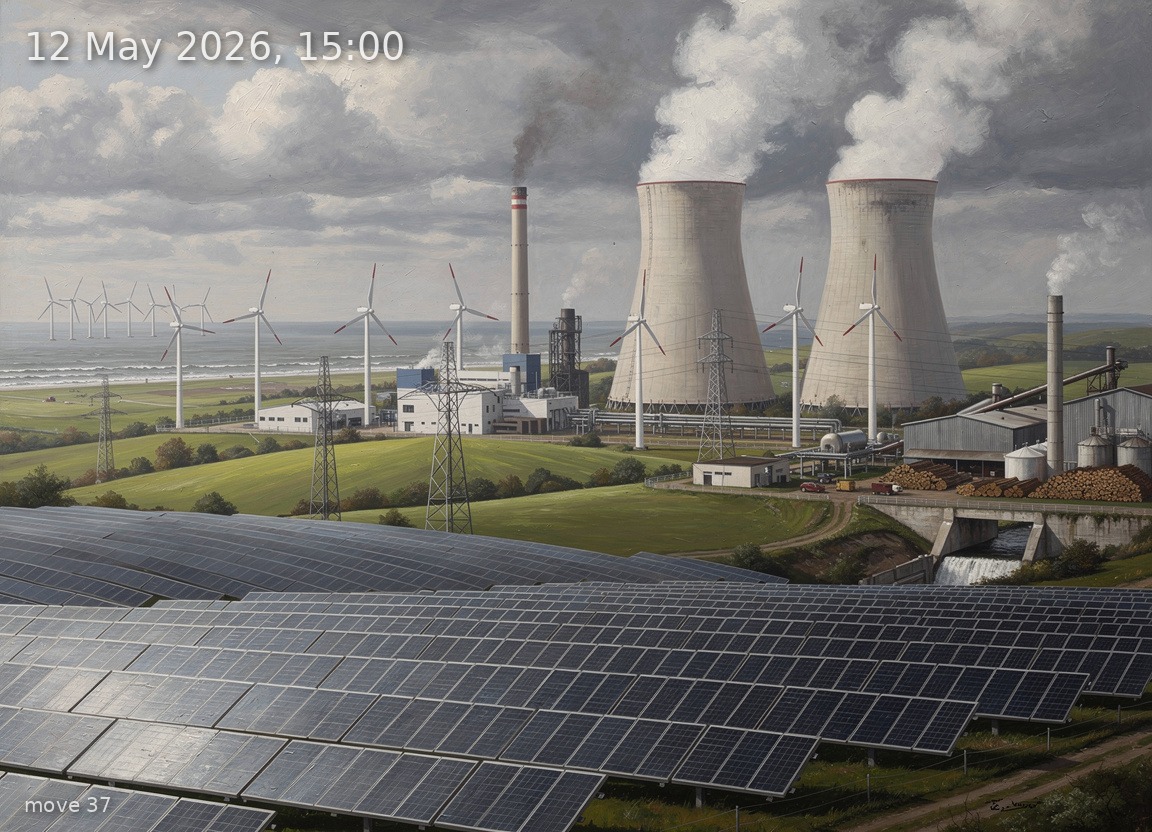
Overcast solar (29.3 GW) and strong onshore wind (21.8 GW) dominate, driving 7.9 GW net exports at moderate prices.
Back
Generation mix
Wind onshore 32%
Wind offshore 4%
Solar 43%
Biomass 6%
Hydro 2%
Natural gas 4%
Hard coal 2%
Brown coal 6%
88%
Renewable share
24.4 GW
Wind (on + offshore)
29.3 GW
Solar
67.4 GW
Total generation
+7.9 GW
Net export
44.8 €/MWh
Day-ahead price
8.4°C / 22 km/h
Temp / Wind speed
Open-Meteo, Kassel (51.3°N 9.5°E)
100.0% / 26.0 W/m²
Cloud cover / Radiation
88
gCO₂/kWh
Image prompt
Solar 29.3 GW dominates the foreground as vast rolling fields of aluminium-framed crystalline silicon PV panels stretching across the entire lower third of the canvas, their glass surfaces reflecting a flat pewter sky with no direct sunlight; onshore wind 21.8 GW fills the middle distance as dozens of three-blade turbines on tall lattice and tubular towers, rotors spinning briskly in strong wind, spread across green spring hills; offshore wind 2.7 GW appears as a small cluster of larger turbines on the far-left horizon above a sliver of grey North Sea; brown coal 4.3 GW occupies the right-centre background as two large hyperbolic cooling towers emitting thick white steam plumes; natural gas 2.4 GW sits just left of the cooling towers as a compact CCGT plant with twin exhaust stacks and thin heat shimmer; hard coal 1.5 GW is a smaller single stack with a modest dark plume behind the gas plant; biomass 3.9 GW appears as a mid-sized industrial facility with a timber yard and low chimney releasing pale vapour, set among trees at the right edge; hydro 1.4 GW is a small dam and spillway visible in a valley at far left. The sky is 100% overcast—a uniform heavy grey cloud layer with no blue patches and no visible sun disc, casting flat diffuse daylight typical of early afternoon under full cloud; the light is bright but completely shadowless. Temperature is cool at 8.4°C: spring vegetation is fresh bright green but trees are not yet fully leafed out, some bare branches remain. Wind is evident in bending grasses, fluttering flags on industrial buildings, and fast-moving turbine blades. The atmosphere is calm and unoppressed, consistent with a moderate electricity price. Highly detailed oil painting in the tradition of 19th-century German Romantic landscape painters—Caspar David Friedrich meets industrial realism—rich layered colour, visible impasto brushwork, atmospheric depth with haze softening distant cooling towers, meticulous engineering accuracy on every turbine nacelle, PV module busbar, and cooling tower profile. No text, no labels.