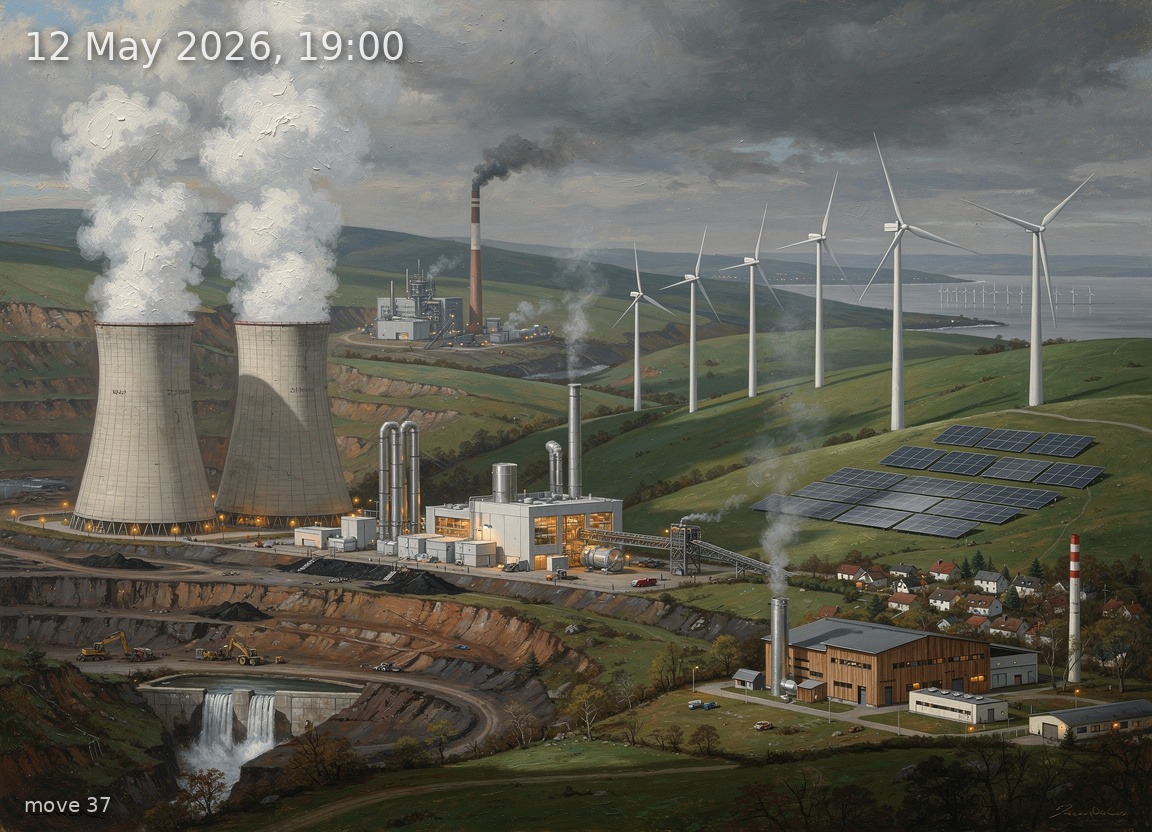
Strong wind and fading solar meet high evening demand; 12 GW net imports and thermal dispatch push prices to 136 EUR/MWh.
Back
Generation mix
Wind onshore 37%
Wind offshore 8%
Solar 9%
Biomass 9%
Hydro 3%
Natural gas 10%
Hard coal 8%
Brown coal 16%
66%
Renewable share
21.6 GW
Wind (on + offshore)
4.3 GW
Solar
48.2 GW
Total generation
-12.0 GW
Net import
136.3 €/MWh
Day-ahead price
9.8°C / 18 km/h
Temp / Wind speed
Open-Meteo, Kassel (51.3°N 9.5°E)
93.0% / 29.0 W/m²
Cloud cover / Radiation
239
gCO₂/kWh
Image prompt
Wind onshore 17.7 GW dominates the right half of the scene as dozens of tall three-blade turbines with white tubular towers and detailed nacelles stretching across rolling green hills into the distance, their blades visibly turning in moderate wind. Brown coal 7.6 GW occupies the left foreground as a massive lignite power station with three hyperbolic cooling towers emitting thick white steam plumes, connected to a sprawling open-pit mine with terraced brown earth. Natural gas 5.0 GW appears centre-left as a compact combined-cycle gas turbine facility with slender exhaust stacks and a smaller vapour trail. Wind offshore 3.9 GW is visible on the far-right horizon as a cluster of turbines standing in a grey sea barely visible through haze. Solar 4.3 GW appears as a modest field of aluminium-framed crystalline silicon panels in the centre-right middle ground, their surfaces dull and reflective only of grey sky, catching no direct sunlight. Hard coal 3.9 GW sits behind the gas plant as a conventional coal station with a single large chimney and coal conveyors. Biomass 4.4 GW is rendered as a wood-clad biomass plant with a modest smokestack near the village edge. Hydro 1.5 GW appears as a small concrete dam with water flowing in the far background valley. TIME OF DAY: late dusk at 19:00 in May — the sky is dominated by a heavy 93% overcast layer in dark slate-grey and muted purple-grey tones, with only a thin band of fading amber-orange glow along the western horizon beneath the clouds; the upper sky is darkening rapidly toward deep blue-grey; all structures are lit partly by the last ambient twilight and partly by warm sodium-yellow industrial lights beginning to glow at the power stations. The atmosphere is oppressive and heavy, reflecting the high electricity price — low thick clouds press down on the landscape. Spring vegetation is fresh green but muted in the fading light, with grass and young leaves on scattered trees. Temperature around 10°C suggests cool air with a slight dampness. Style: highly detailed oil painting in the tradition of 19th-century German Romantic landscape painters such as Caspar David Friedrich and Carl Blechen — rich impasto brushwork visible in the clouds and steam plumes, atmospheric depth with sfumato haze between the layers of infrastructure, dramatic chiaroscuro between the glowing industrial facilities and the darkening sky, meticulous engineering accuracy in every turbine blade, cooling tower curvature, and panel array. No text, no labels.