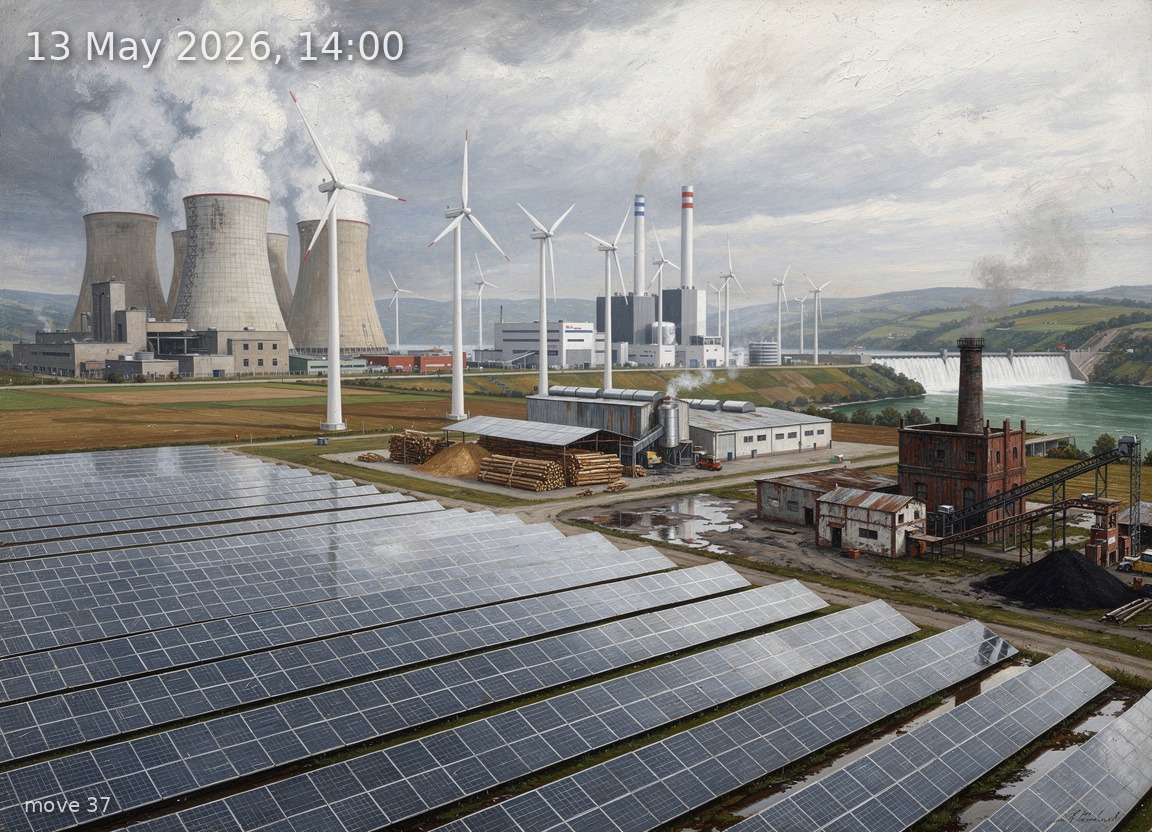
Solar (28 GW) and onshore wind (18 GW) dominate under full overcast, with coal and gas providing persistent thermal baseload.
Back
Generation mix
Wind onshore 29%
Wind offshore 1%
Solar 45%
Biomass 6%
Hydro 2%
Natural gas 5%
Hard coal 4%
Brown coal 8%
83%
Renewable share
18.8 GW
Wind (on + offshore)
28.1 GW
Solar
63.1 GW
Total generation
+2.4 GW
Net export
70.2 €/MWh
Day-ahead price
11.0°C / 17 km/h
Temp / Wind speed
Open-Meteo, Kassel (51.3°N 9.5°E)
100.0% / 72.0 W/m²
Cloud cover / Radiation
118
gCO₂/kWh
Image prompt
Solar 28.1 GW dominates the foreground and right half of the scene as vast fields of aluminium-framed crystalline silicon PV panels stretching across flat farmland, their blue-grey surfaces reflecting a uniformly overcast white-grey sky; onshore wind 18.3 GW fills the middle distance as dozens of tall three-blade turbines on lattice and tubular towers, rotors turning steadily in moderate wind; brown coal 4.9 GW occupies the far left as a cluster of massive hyperbolic cooling towers emitting thick white steam plumes that merge into the low cloud ceiling; biomass 4.0 GW appears as a mid-sized industrial plant with a timber yard and a single tall stack releasing thin grey exhaust; natural gas 3.4 GW sits beside the coal complex as two compact CCGT units with sleek exhaust stacks and smaller rectangular cooling structures; hard coal 2.3 GW is rendered as a single older power station with a prominent boiler house and conveyor belt feeding from a dark coal pile; hydro 1.5 GW appears as a small concrete dam with a green reservoir visible in a valley in the distant right background; offshore wind 0.5 GW is barely suggested as tiny turbine silhouettes on a grey horizon line at the far back. Full midday daylight at 14:00 but entirely diffuse — no shadows, no direct sun, a flat milky-white sky pressing low over the landscape. Spring vegetation: fresh bright green grass and young crops, some rapeseed patches, deciduous trees in full new leaf. The atmosphere feels heavy and slightly oppressive, reflecting the 70 EUR/MWh price — a faint humid haze hangs over the industrial sections. Temperature 11°C gives a cool dampness; puddles on paths between solar rows. Style: highly detailed oil painting in the tradition of 19th-century German Romantic landscape painters — Caspar David Friedrich meets industrial realism — rich saturated colour, visible textured brushwork, dramatic atmospheric depth, meticulous engineering accuracy on every turbine nacelle, PV cell grid pattern, cooling tower concrete texture, and CCGT exhaust detail. No text, no labels, no human figures prominent.