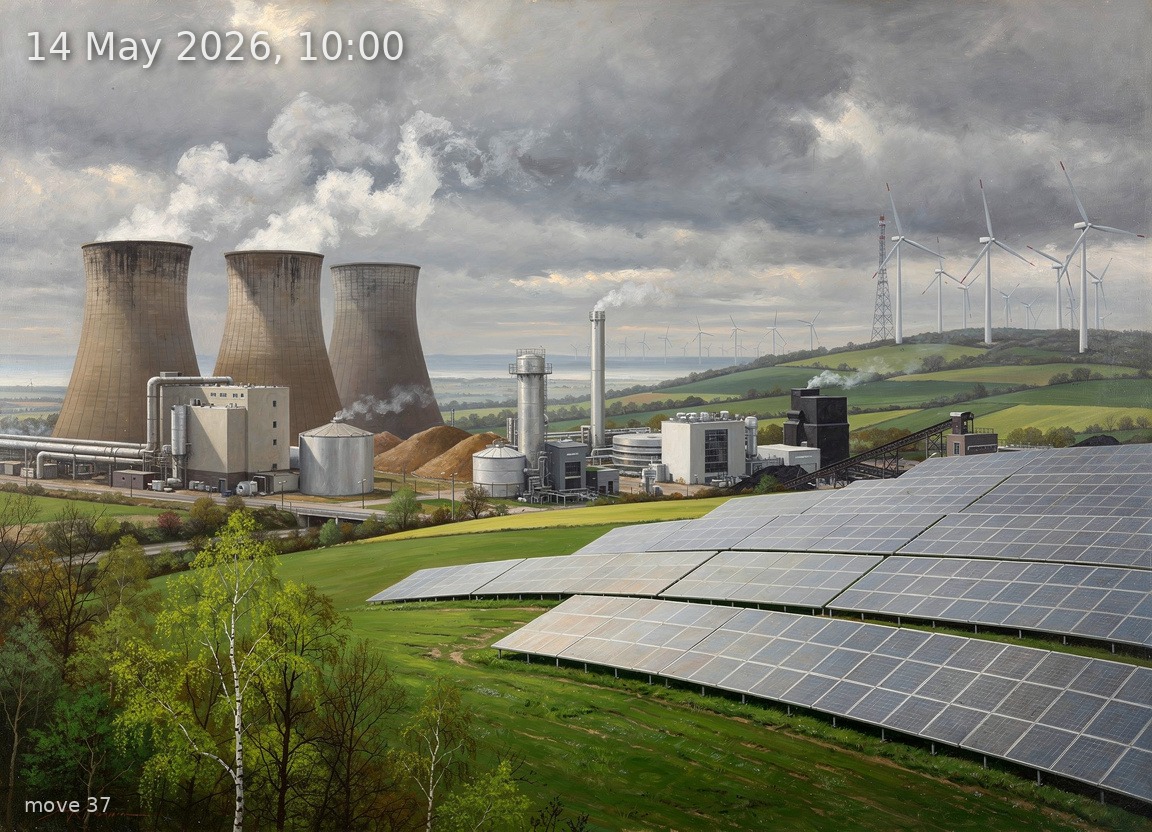
Solar (24.9 GW) and wind (13.4 GW) dominate a mostly renewable spring morning with moderate thermal support.
Back
Generation mix
Wind onshore 22%
Wind offshore 3%
Solar 46%
Biomass 8%
Hydro 3%
Natural gas 6%
Hard coal 3%
Brown coal 10%
81%
Renewable share
13.4 GW
Wind (on + offshore)
24.9 GW
Solar
54.1 GW
Total generation
+3.7 GW
Net export
58.6 €/MWh
Day-ahead price
9.1°C / 18 km/h
Temp / Wind speed
Open-Meteo, Kassel (51.3°N 9.5°E)
88.0% / 117.0 W/m²
Cloud cover / Radiation
132
gCO₂/kWh
Image prompt
Solar 24.9 GW dominates the right half and middle distance as vast fields of aluminium-framed crystalline silicon photovoltaic panels stretching across rolling green spring farmland, angled southward, reflecting diffuse grey-white light; wind onshore 11.9 GW fills the upper-right background as dozens of tall three-blade turbines on lattice and tubular towers, rotors turning steadily in moderate wind across gentle hills; brown coal 5.2 GW anchors the left foreground as a massive lignite power station with three hyperbolic concrete cooling towers emitting thick white-grey steam plumes drifting eastward; biomass 4.3 GW appears as a mid-sized industrial plant with a tall cylindrical stack and adjacent wood-chip storage silos in the left-center middle ground; natural gas 3.1 GW is rendered as a compact modern CCGT facility with a single gleaming exhaust stack and smaller vapor trail, positioned between the coal plant and the solar fields; hard coal 1.8 GW is a smaller coal-fired station with a single square cooling tower and dark conveyor belts, partially obscured behind the lignite plant; wind offshore 1.5 GW is suggested by a faint line of turbines on the far northern horizon; hydro 1.4 GW appears as a small concrete dam and reservoir nestled in a wooded valley at the far left edge. The sky is 88% overcast — a heavy blanket of stratocumulus in layered greys and muted whites, with occasional thin breaks allowing pale diffuse sunlight through, casting soft flat illumination typical of full mid-morning daylight at 10:00 in May. The atmosphere feels moderately oppressive, slightly hazy, fitting a 58.6 EUR/MWh price. Spring vegetation is fresh bright green — new leaves on birch and beech trees, wildflowers in meadow margins, cool 9°C air suggested by a crispness in the light. Highly detailed oil painting in the tradition of 19th-century German Romantic landscape painters — Caspar David Friedrich meets industrial realism — rich layered colour, visible confident brushwork, atmospheric depth with aerial perspective fading distant turbines into mist, meticulous engineering detail on every nacelle, panel frame, cooling tower rib, and exhaust stack. No text, no labels.