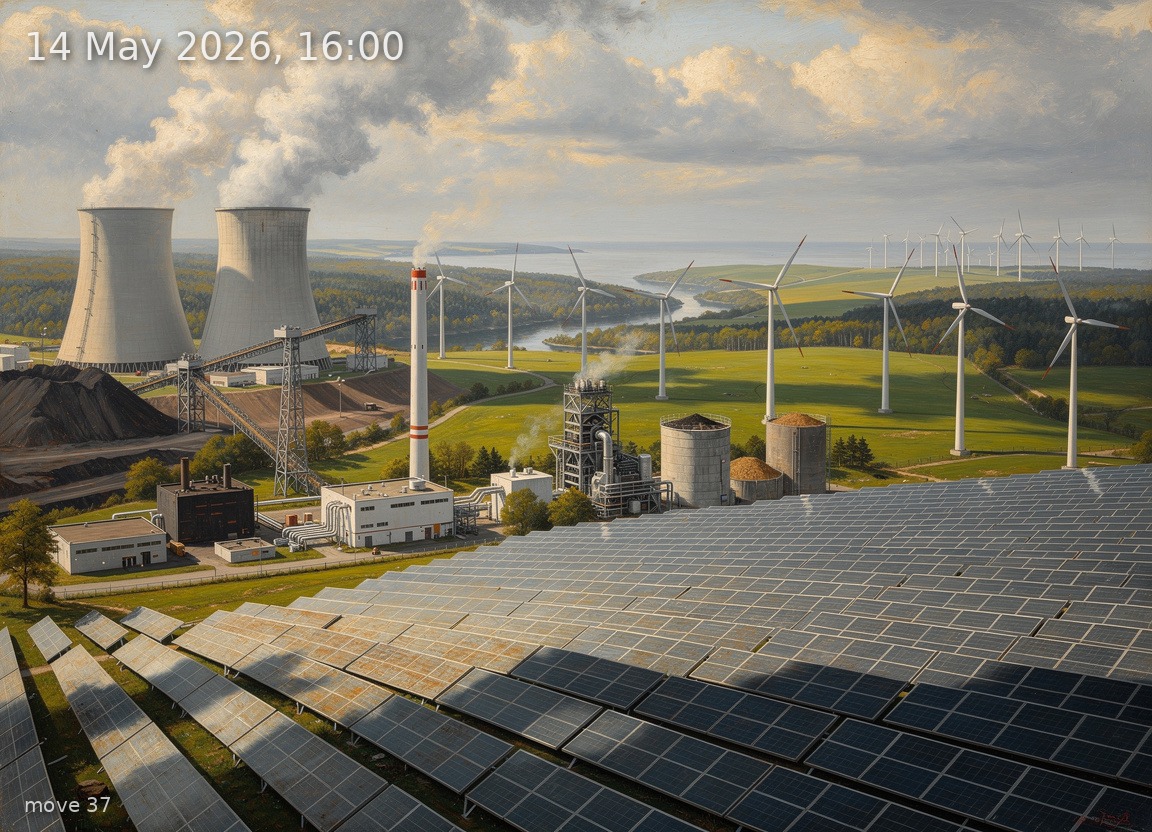
Solar at 24.6 GW leads an 87% renewable mix, with wind and lignite filling the late-afternoon balance.
Back
Generation mix
Wind onshore 17%
Wind offshore 5%
Solar 53%
Biomass 9%
Hydro 3%
Natural gas 4%
Hard coal 2%
Brown coal 7%
87%
Renewable share
10.3 GW
Wind (on + offshore)
24.6 GW
Solar
46.4 GW
Total generation
-0.4 GW
Net import
66.9 €/MWh
Day-ahead price
12.9°C / 11 km/h
Temp / Wind speed
Open-Meteo, Kassel (51.3°N 9.5°E)
88.0% / 432.0 W/m²
Cloud cover / Radiation
90
gCO₂/kWh
Image prompt
Solar 24.6 GW dominates the foreground and centre as vast fields of aluminium-framed crystalline silicon PV panels stretching across gentle rolling hills, their blue-grey surfaces reflecting a bright but hazy overcast sky. Wind onshore 8.1 GW fills the middle distance as dozens of tall three-blade turbines on lattice and tubular towers, blades turning slowly in moderate breeze across green spring meadows. Wind offshore 2.2 GW appears on the far right horizon as a cluster of turbines standing in a faintly visible grey sea. Biomass 4.0 GW is rendered as a group of mid-sized industrial facilities with modest chimneys and woodchip storage silos in the left-centre middle ground. Brown coal 3.1 GW occupies the far left as two large hyperbolic cooling towers emitting thick white-grey steam plumes, flanked by conveyor gantries and lignite stockpiles. Natural gas 2.0 GW sits beside them as a compact CCGT plant with a single tall exhaust stack releasing a thin transparent heat shimmer. Hard coal 0.9 GW appears as a smaller coal plant with a single rectangular chimney, partially obscured behind the gas facility. Hydro 1.5 GW is a modest dam and spillway nestled in a forested valley in the far background. The lighting is full late-afternoon daylight at 16:00 in May—sun high but filtered through 88% cloud cover, creating a bright diffuse luminosity with soft shadows and no harsh contrasts. The sky is predominantly overcast in layered grey-white clouds but with occasional breaks allowing warm golden rays to spill through, casting scattered highlights on the solar panels. Spring vegetation is lush and green, with wildflowers in the meadows. Temperature around 13°C gives a cool crispness to the air. The atmosphere is moderately heavy, slightly oppressive—not stormy but dense and pressing, reflecting a 66.9 EUR/MWh price. Rendered as a highly detailed oil painting in the tradition of 19th-century German Romantic landscape painters—Caspar David Friedrich meets industrial modernity—with rich colour palette, visible confident brushwork, atmospheric aerial perspective and depth, dramatic compositional balance between nature and technology. Meticulous engineering detail on all infrastructure. No text, no labels, no people prominent.