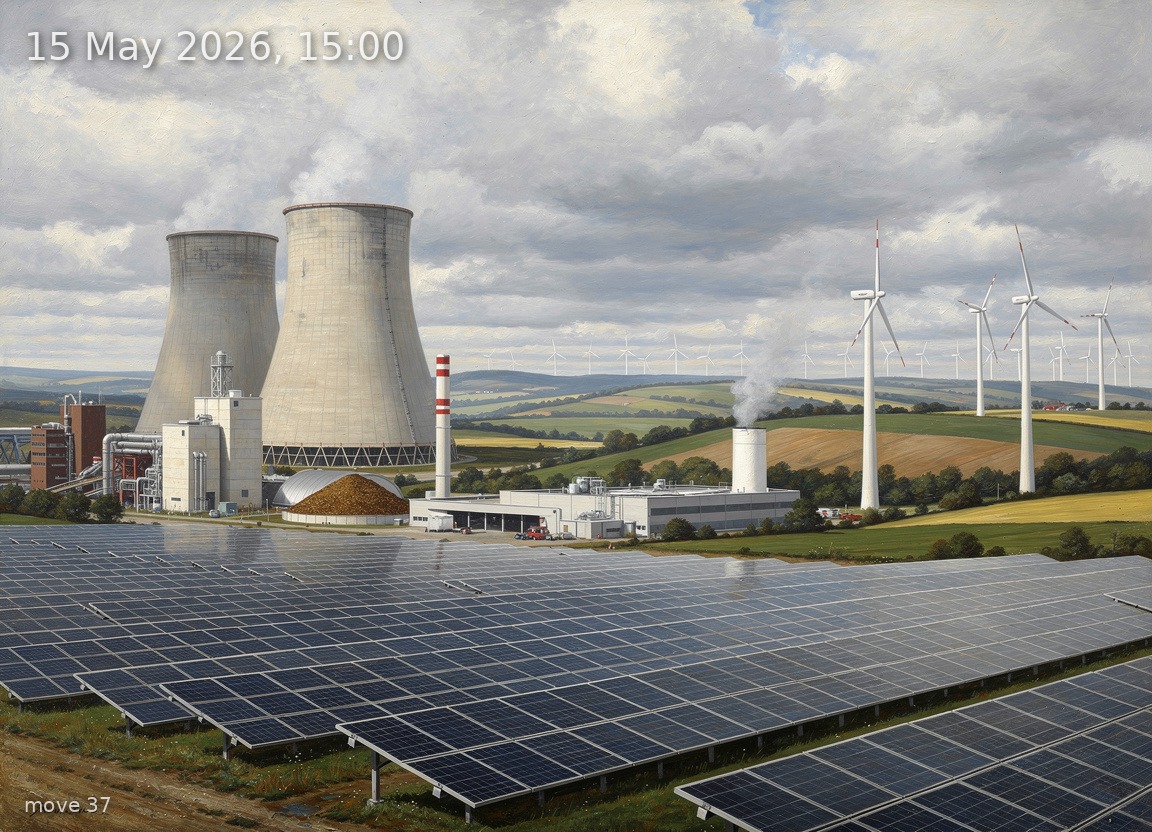
Solar leads at 30.4 GW under overcast skies; wind and coal fill the balance as Germany net-imports 1.2 GW.
Back
Generation mix
Wind onshore 13%
Wind offshore 7%
Solar 57%
Biomass 7%
Hydro 3%
Natural gas 4%
Hard coal 2%
Brown coal 7%
87%
Renewable share
10.5 GW
Wind (on + offshore)
30.4 GW
Solar
52.8 GW
Total generation
-1.2 GW
Net import
51.0 €/MWh
Day-ahead price
10.7°C / 7 km/h
Temp / Wind speed
Open-Meteo, Kassel (51.3°N 9.5°E)
100.0% / 427.0 W/m²
Cloud cover / Radiation
90
gCO₂/kWh
Image prompt
Solar 30.4 GW dominates the scene as vast fields of aluminium-framed crystalline silicon photovoltaic panels stretching across rolling central-German farmland, occupying well over half the canvas. Wind onshore 6.8 GW appears as clusters of three-blade turbines with white tubular towers on gentle hills at mid-distance right. Wind offshore 3.7 GW is suggested by a row of larger turbines visible on the far horizon line. Brown coal 3.4 GW occupies the far left as two massive hyperbolic cooling towers emitting pale steam plumes. Biomass 3.9 GW stands as a compact plant with a tall rectangular boiler house and wood-chip storage dome near the coal stacks. Natural gas 2.1 GW is rendered as a single CCGT unit with a slender exhaust stack and modest heat shimmer, tucked between the biomass facility and the coal towers. Hard coal 1.2 GW appears as a smaller conventional power station with a single stack and conveyor belt, partially behind the lignite towers. Hydro 1.4 GW is depicted as a concrete run-of-river weir visible along a small river in the middle ground. The time is 15:00 on a May afternoon: full daylight but the sky is entirely overcast with a uniform layer of bright, luminous grey-white clouds—no blue sky visible, yet the scene is well-lit with soft diffuse light and no harsh shadows. The temperature is a cool 10.7 °C; spring foliage is fresh and green but restrained, grass slightly wind-bent by gentle 6.6 km/h breeze. The atmosphere is calm and undramatic, reflecting a moderate 51 EUR/MWh price—open, mildly hazy, neither oppressive nor radiant. Style: highly detailed oil painting in the tradition of 19th-century German Romantic landscape painters such as Caspar David Friedrich and Carl Blechen—rich layered colour, visible impasto brushwork, atmospheric depth and aerial perspective—but with meticulous engineering accuracy for every technology: three-blade rotor profiles, nacelle housings, lattice transmission towers, panel racking geometry, cooling tower hyperboloid curves, conveyor structures. The painting should feel monumental yet serene, a masterwork industrial landscape. No text, no labels, no human figures prominent.