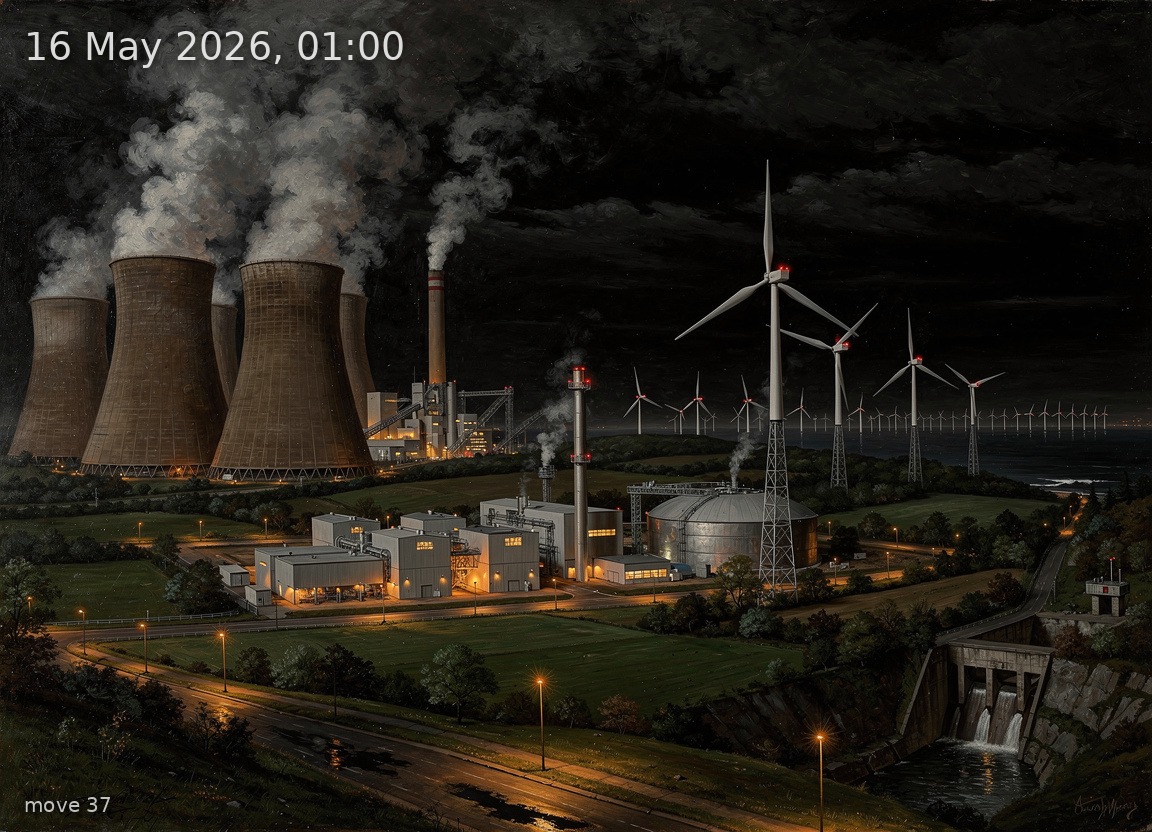
Wind, brown coal, and gas dominate overnight generation as Germany imports 6.1 GW to meet 42.8 GW demand.
Back
Generation mix
Wind onshore 24%
Wind offshore 14%
Biomass 11%
Hydro 3%
Natural gas 16%
Hard coal 11%
Brown coal 20%
53%
Renewable share
14.0 GW
Wind (on + offshore)
0.0 GW
Solar
36.7 GW
Total generation
-6.1 GW
Net import
121.8 €/MWh
Day-ahead price
5.5°C / 8 km/h
Temp / Wind speed
Open-Meteo, Kassel (51.3°N 9.5°E)
86.0% / 0.0 W/m²
Cloud cover / Radiation
327
gCO₂/kWh
Image prompt
Brown coal 7.5 GW dominates the left quarter as a cluster of massive hyperbolic cooling towers with thick white-grey steam plumes rising into blackness; natural gas 6.0 GW occupies the centre-left as a row of compact CCGT power blocks with tall single exhaust stacks emitting thin vapour trails, lit by sodium-orange floodlights; wind onshore 8.9 GW spans the centre-right as dozens of three-blade turbines on lattice and tubular towers receding across rolling farmland, red aviation warning lights blinking on nacelles; wind offshore 5.1 GW appears in the far right background as a line of turbines standing in a dark sea glimpsed beyond a coastal ridge; hard coal 4.0 GW sits behind the brown coal plant as a smaller conventional power station with a single large smokestack and conveyor gantries; biomass 4.0 GW is rendered as a mid-ground industrial plant with a domed digester tank and a small illuminated stack; hydro 1.3 GW appears as a modest dam structure with spillway in a valley on the far right edge. Time is 01:00 at night — the sky is completely black with no twilight, no moon visible, heavy 86% cloud cover erasing all stars, creating a low oppressive ceiling reflecting faint industrial glow. Temperature is 5.5 °C in mid-May: fresh spring vegetation on hillsides, but colours muted to near-black under artificial light. Sodium streetlights cast pools of amber along an access road. The elevated price of 121.8 EUR/MWh is conveyed through a thick, heavy, oppressive atmosphere — humid haze clinging to the cooling towers, steam mixing with low clouds, a sense of thermal weight pressing down on the landscape. Puddles on asphalt reflect orange facility lights. Style: highly detailed oil painting in the tradition of 19th-century German Romantic landscape painters — rich impasto brushwork, deep chiaroscuro contrasts between lit industrial structures and surrounding darkness, atmospheric depth achieved through layered haze and diminishing detail toward the horizon. Each technology rendered with meticulous engineering accuracy: three-blade rotor profiles, nacelle housings, aluminium-clad CCGT modules, reinforced-concrete cooling tower shells with visible ribs. No text, no labels.