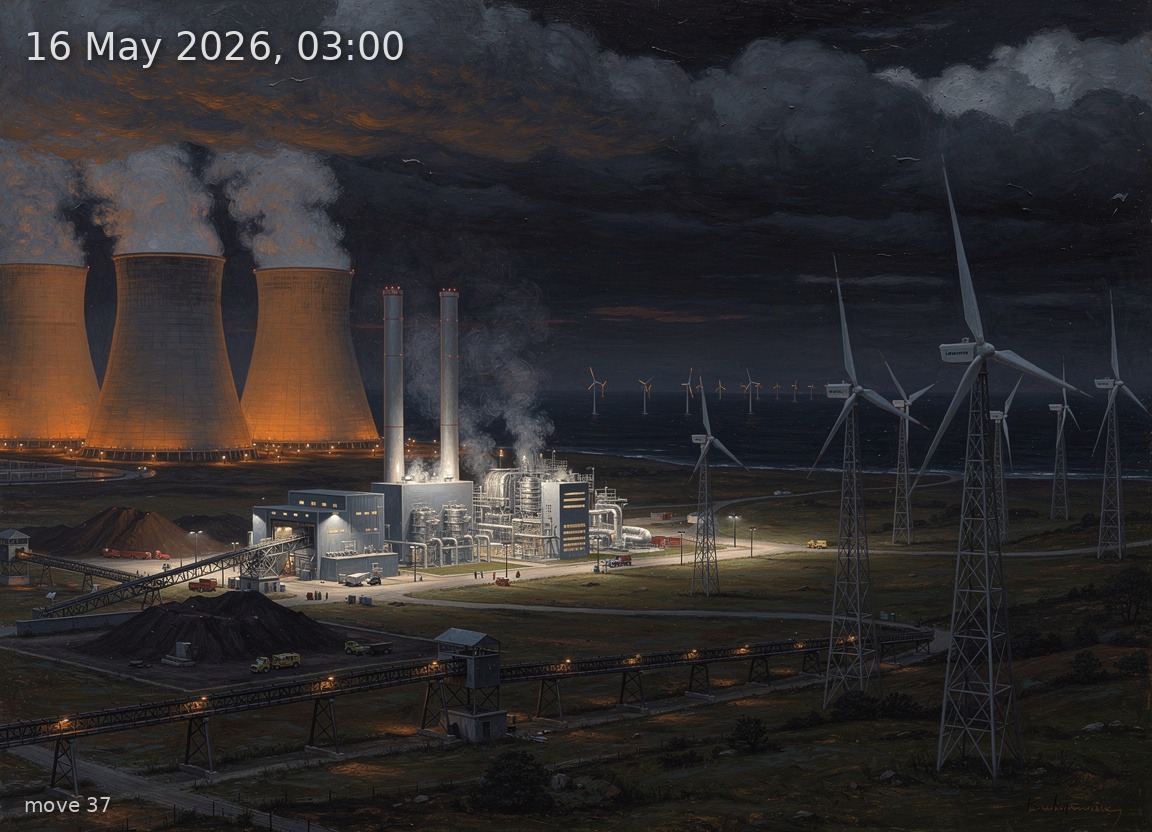
Wind and brown coal anchor overnight supply as Germany imports 2.8 GW under overcast, cool May skies.
Back
Generation mix
Wind onshore 27%
Wind offshore 14%
Biomass 10%
Hydro 3%
Natural gas 15%
Hard coal 10%
Brown coal 20%
55%
Renewable share
15.9 GW
Wind (on + offshore)
0.0 GW
Solar
38.4 GW
Total generation
-2.8 GW
Net import
116.0 €/MWh
Day-ahead price
5.3°C / 9 km/h
Temp / Wind speed
Open-Meteo, Kassel (51.3°N 9.5°E)
93.0% / 0.0 W/m²
Cloud cover / Radiation
312
gCO₂/kWh
Image prompt
Wind onshore 10.6 GW spans the right third of the scene as dozens of tall three-blade turbines on lattice towers, rotors turning steadily on a broad rolling plateau; wind offshore 5.3 GW appears in the far right background as a cluster of turbines rising from a dark sea horizon. Brown coal 7.5 GW dominates the left quarter as massive hyperbolic cooling towers emitting thick white steam plumes, lit from below by sodium-orange industrial lighting, with conveyor belts of lignite visible. Natural gas 5.9 GW fills the centre-left as a compact CCGT plant with tall single exhaust stacks releasing thin heat shimmer, warmly lit by facility floodlights. Hard coal 4.0 GW sits just left of centre as a smaller coal-fired station with a single large stack and coal stockpile. Biomass 4.0 GW appears as a modest wood-chip-fired plant with a low rectangular building and a gently smoking chimney near the centre. Hydro 1.3 GW is a small dam spillway glimpsed in the lower centre-right foreground, water faintly catching artificial light. The time is 3 AM: the sky is completely black to deep navy, no twilight, no sky glow, heavy 93% overcast blotting out all stars — a thick oppressive cloud ceiling reflecting faint orange-sodium light from the industrial facilities below. Temperature is 5.3°C: early spring grass is damp and dark, bare-branched trees just beginning to leaf out. The elevated price creates a heavy, brooding atmosphere — the air feels dense, the cloud deck pressing down. The wind is light at ground level but the turbine blades turn at hub height. The scene is rendered as a highly detailed oil painting in the tradition of 19th-century German Romantic landscape painters — rich, dark palette of Prussian blue, lamp black, raw umber, and cadmium orange from industrial lights, visible impasto brushwork, atmospheric depth with haze and steam dissolving into the dark sky. Each technology is rendered with meticulous engineering accuracy: turbine nacelles, aluminium blade profiles, cooling tower parabolic geometry, gas turbine exhaust diffusers. The composition evokes Caspar David Friedrich's sense of sublime scale, with small human figures near the gas plant for scale. No text, no labels.