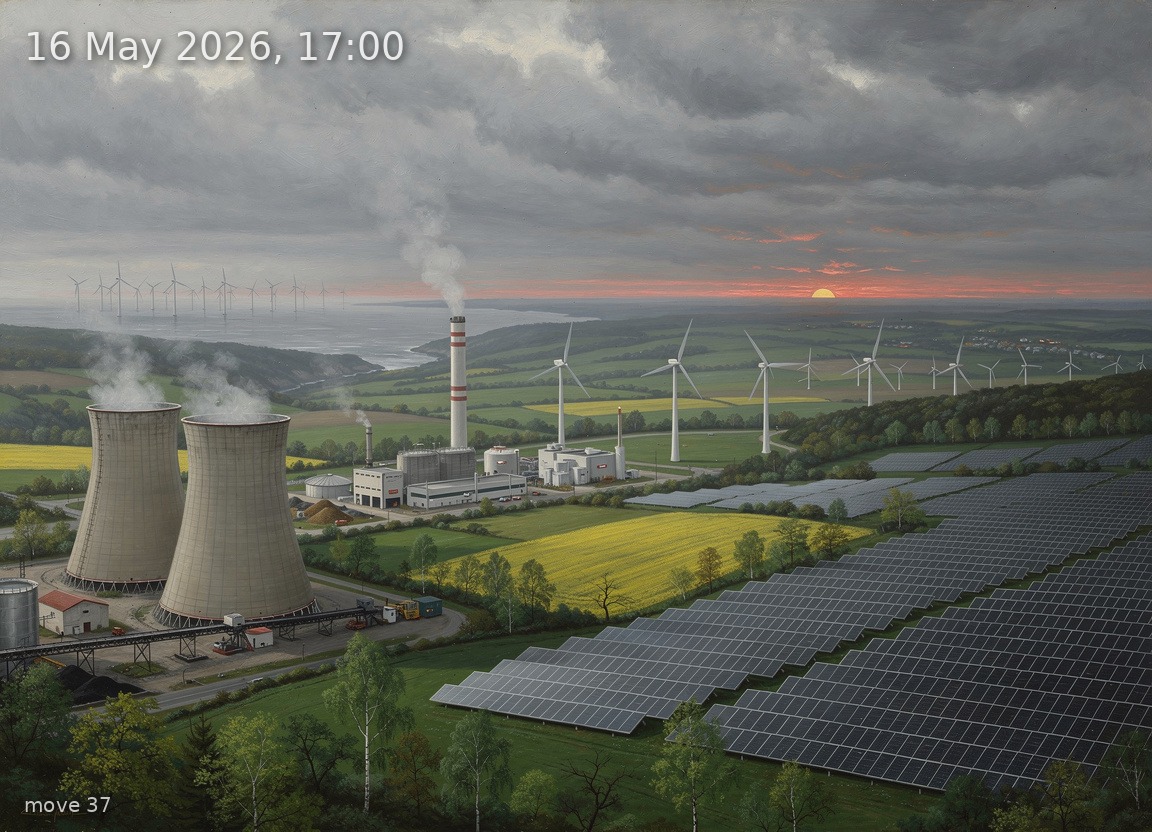
Solar (21.8 GW) and wind (17.1 GW) dominate an 88.8% renewable grid, enabling 2.6 GW net export at dusk.
Back
Generation mix
Wind onshore 27%
Wind offshore 8%
Solar 44%
Biomass 8%
Hydro 3%
Natural gas 4%
Hard coal 1%
Brown coal 6%
89%
Renewable share
17.2 GW
Wind (on + offshore)
21.8 GW
Solar
50.0 GW
Total generation
+2.6 GW
Net export
60.1 €/MWh
Day-ahead price
12.3°C / 10 km/h
Temp / Wind speed
Open-Meteo, Kassel (51.3°N 9.5°E)
100.0% / 67.0 W/m²
Cloud cover / Radiation
79
gCO₂/kWh
Image prompt
Solar 21.8 GW dominates the right half of the composition as vast fields of aluminium-framed crystalline silicon PV panels stretching across gently rolling farmland, their surfaces reflecting dull grey sky; wind onshore 13.3 GW fills the centre-left as dozens of tall three-blade turbines with white nacelles and lattice-free tubular towers turning slowly in moderate breeze across green spring meadows; wind offshore 3.8 GW appears in the far-left distance as a cluster of turbines standing in a grey sea glimpsed through a valley gap; biomass 4.1 GW is rendered as a mid-ground wood-chip-fired power station with a modest stack and visible steam; brown coal 3.2 GW occupies the left foreground as two hyperbolic cooling towers with lazy steam plumes rising against the overcast sky, adjacent conveyor belts visible; natural gas 1.9 GW appears as a compact CCGT plant with a single tall exhaust stack and small heat-shimmer plume between the coal plant and the wind turbines; hard coal 0.6 GW is a single smaller stack with faint smoke behind the gas plant; hydro 1.4 GW is suggested by a small dam and spillway integrated into a river in the lower foreground. Time is 17:00 in mid-May dusk: the sky is entirely overcast at 100% cloud cover, a heavy uniform pearl-grey ceiling, but the lower western horizon shows a thin band of warm orange-red glow where the sun is descending behind the clouds, casting a fading amber light across the landscape. Vegetation is lush mid-spring green—fresh beech and birch leaves, rapeseed fields beginning to yellow. The atmosphere is slightly heavy and oppressive, befitting a moderate electricity price. Style: highly detailed oil painting in the tradition of 19th-century German Romantic landscape painters such as Caspar David Friedrich and Carl Blechen—rich colour palette of muted greens, greys, ochres, and that thin warm horizon glow; visible confident brushwork; deep atmospheric perspective with haze between the layers of infrastructure; meticulous engineering accuracy on every turbine nacelle, PV module frame, cooling tower shell, and exhaust stack. The painting conveys the coexistence of industrial modernity and pastoral landscape, grand in scale, contemplative in mood. No text, no labels, no human figures.