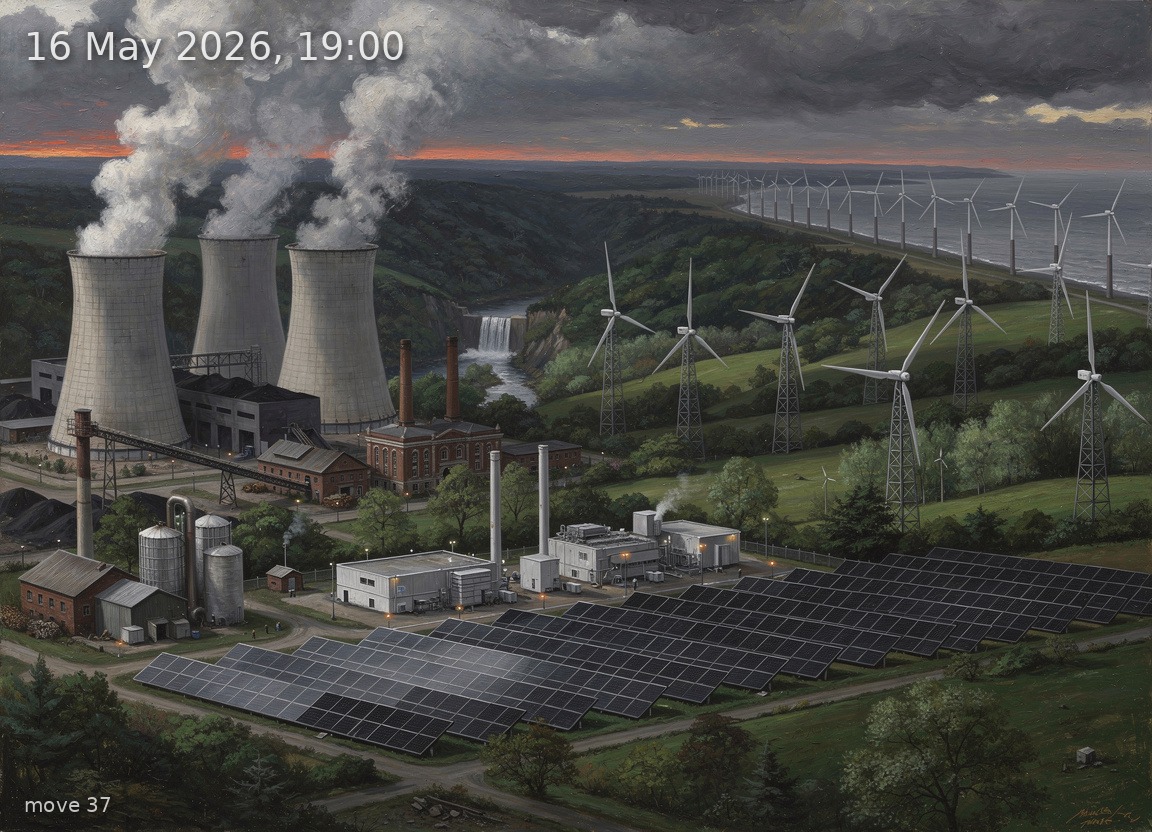
Wind and brown coal anchor generation as overcast skies and 13 GW net imports meet peak evening demand.
Back
Generation mix
Wind onshore 25%
Wind offshore 9%
Solar 16%
Biomass 12%
Hydro 4%
Natural gas 10%
Hard coal 6%
Brown coal 17%
67%
Renewable share
12.5 GW
Wind (on + offshore)
5.7 GW
Solar
36.0 GW
Total generation
-13.0 GW
Net import
126.5 €/MWh
Day-ahead price
12.2°C / 9 km/h
Temp / Wind speed
Open-Meteo, Kassel (51.3°N 9.5°E)
100.0% / 28.0 W/m²
Cloud cover / Radiation
235
gCO₂/kWh
Image prompt
Wind onshore 9.1 GW dominates the right third of the canvas as dozens of three-blade turbines on lattice towers stretching across rolling green hills, rotors turning slowly in moderate breeze; wind offshore 3.4 GW appears as a distant row of tall monopile turbines visible on a grey sea horizon at far right; brown coal 6.2 GW occupies the left quarter as three massive hyperbolic cooling towers with thick white-grey steam plumes merging into overcast clouds, connected to an angular lignite power station with conveyor belts and coal bunkers; solar 5.7 GW is rendered as a mid-ground field of aluminium-framed crystalline silicon panels catching the last dim orange-red glow on the lower western horizon, their surfaces reflecting almost no light under dense cloud; biomass 4.5 GW sits centre-left as a cluster of modest industrial buildings with cylindrical wood-pellet silos and thin exhaust stacks emitting pale vapour; natural gas 3.6 GW appears centre as two compact CCGT units with tall single exhaust stacks and slim rectangular heat recovery steam generators; hard coal 2.2 GW is a smaller classical brick power station with two round chimneys at centre-left behind the biomass plant; hydro 1.3 GW is a small concrete dam and penstock visible in a forested valley in the deep background. Sky: 19:00 late dusk in May, rapidly fading light, a thin band of orange-red glow along the very low western horizon, the rest of the sky entirely covered by heavy, oppressive 100% cloud in tones of slate grey and deep charcoal, pressing down on the landscape to convey high electricity prices. Vegetation is lush mid-May green—fresh deciduous foliage on trees, bright grass—at 12°C cool spring evening. The mood is weighty and industrious, lit by the last dusk glow and warm sodium streetlights beginning to appear along roads between facilities. Style: highly detailed oil painting in the tradition of 19th-century German Romantic landscape painters such as Caspar David Friedrich and Carl Blechen—rich impasto brushwork, atmospheric depth, dramatic chiaroscuro between the dying horizon light and the dark industrial forms, meticulous engineering detail on every turbine nacelle, cooling tower shell, and PV panel frame. No text, no labels.