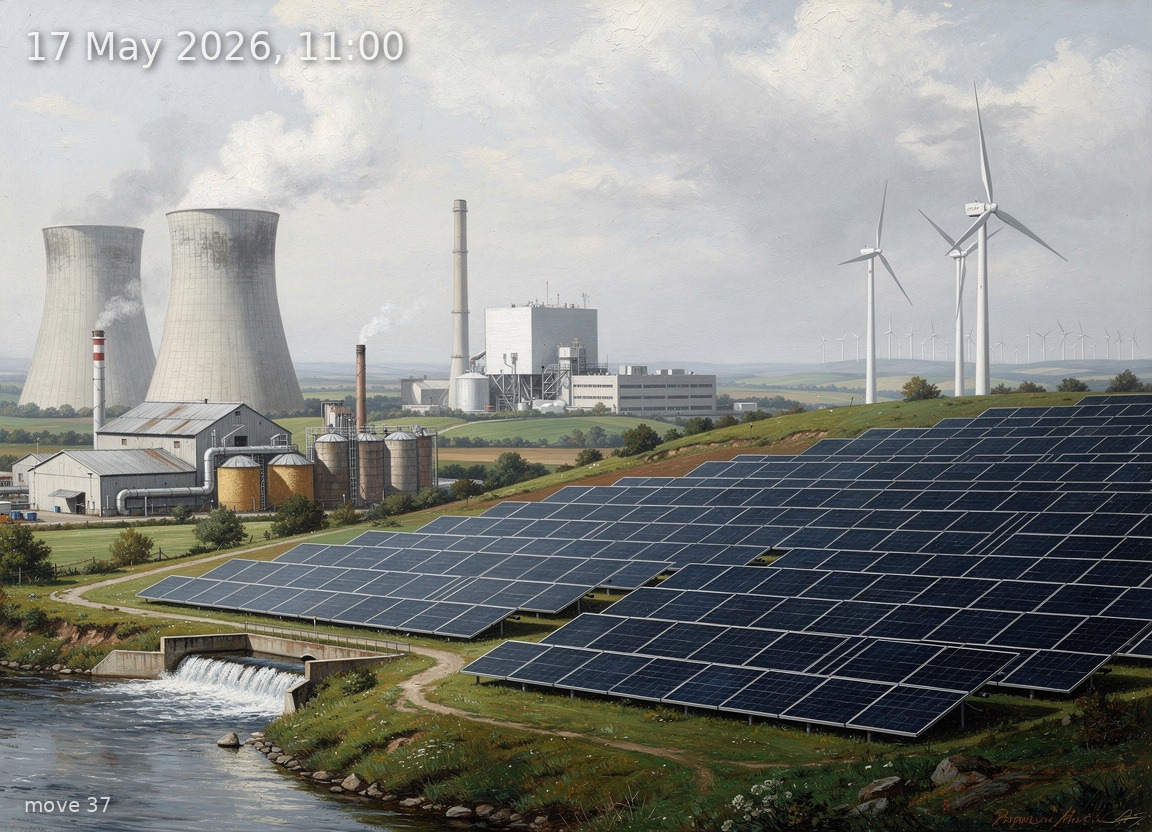
Solar at 37.9 GW drives 8.0 GW net export and near-zero prices on a high-renewables late morning.
Back
Generation mix
Wind onshore 11%
Wind offshore 5%
Solar 65%
Biomass 7%
Hydro 2%
Natural gas 3%
Hard coal 1%
Brown coal 5%
91%
Renewable share
9.3 GW
Wind (on + offshore)
37.9 GW
Solar
58.1 GW
Total generation
+8.0 GW
Net export
0.6 €/MWh
Day-ahead price
12.6°C / 11 km/h
Temp / Wind speed
Open-Meteo, Kassel (51.3°N 9.5°E)
94.0% / 383.0 W/m²
Cloud cover / Radiation
66
gCO₂/kWh
Image prompt
Solar 37.9 GW dominates the scene as an enormous expanse of crystalline silicon PV panels stretching across rolling central German farmland, covering nearly two-thirds of the composition from centre to right, their aluminium frames catching diffuse bright daylight under a high overcast sky. Wind onshore 6.3 GW appears as a line of tall three-blade turbines with white tubular towers on gentle hills in the mid-ground right, rotors turning slowly in light wind. Wind offshore 3.0 GW is suggested by a distant row of turbines on the hazy horizon at far right. Biomass 4.1 GW is rendered as a cluster of mid-sized industrial buildings with wood-chip silos and a single low smokestack emitting thin pale exhaust in the left mid-ground. Brown coal 3.1 GW occupies the far left background as two hyperbolic concrete cooling towers releasing modest white steam plumes into the grey sky. Natural gas 1.9 GW sits as a compact CCGT plant with a single tall exhaust stack and low administrative building just left of centre background. Hydro 1.3 GW appears as a small concrete run-of-river weir with foaming water visible in the lower left foreground along a river cutting through the valley. Hard coal 0.5 GW is a single small stack barely visible behind the gas plant, with a faint wisp of exhaust. The sky is bright but uniformly overcast at 94% cloud cover, a luminous pearl-white canopy with no visible sun disc, yet strong diffuse daylight floods every surface — it is 11:00 on a May morning, full daytime brightness. Spring vegetation: fresh green grass, young rapeseed in bloom with patches of yellow, deciduous trees in full new leaf. The atmosphere is calm and expansive, reflecting the near-zero electricity price — open, serene, unhurried. Temperature around 13°C gives a cool-spring softness to the air, light mist in the river valley. Style: highly detailed oil painting in the tradition of 19th-century German Romantic landscape painters such as Caspar David Friedrich and Carl Blechen — rich layered colour, visible confident brushwork, atmospheric aerial perspective with depth receding to a hazy horizon, meticulous engineering detail on every turbine nacelle, PV panel frame, cooling tower flute, and smokestack. The painting balances the sublime scale of industrial infrastructure against pastoral farmland. No text, no labels.