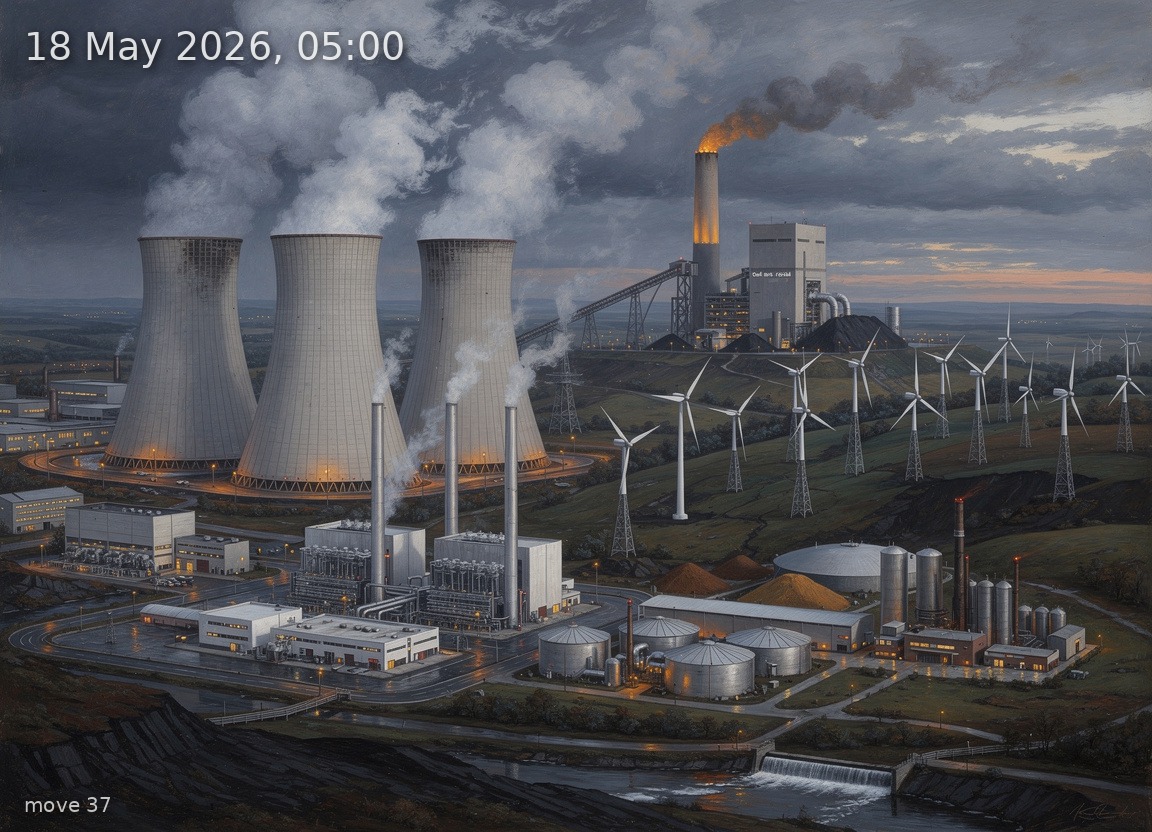
Brown coal and onshore wind lead domestic generation as ~14.7 GW net imports cover a high-price, pre-dawn demand gap.
Back
Generation mix
Wind onshore 24%
Wind offshore 1%
Solar 1%
Biomass 13%
Hydro 4%
Natural gas 18%
Hard coal 12%
Brown coal 26%
43%
Renewable share
8.0 GW
Wind (on + offshore)
0.3 GW
Solar
32.1 GW
Total generation
-14.8 GW
Net import
137.0 €/MWh
Day-ahead price
7.4°C / 11 km/h
Temp / Wind speed
Open-Meteo, Kassel (51.3°N 9.5°E)
100.0% / 0.0 W/m²
Cloud cover / Radiation
397
gCO₂/kWh
Image prompt
Brown coal 8.4 GW dominates the left quarter as a sprawling Lusatian lignite complex with four massive hyperbolic cooling towers emitting thick white steam plumes into the dark sky; onshore wind 7.6 GW spans the centre-right as dozens of three-blade turbines on lattice and tubular towers across rolling hills, rotors turning at moderate speed; natural gas 5.8 GW appears centre-left as a pair of modern CCGT plants with tall slender exhaust stacks venting thin hot exhaust; hard coal 4.0 GW sits behind the lignite complex as a coal-fired station with rectangular boiler house, conveyor belts, and a single large chimney with amber-lit plume; biomass 4.1 GW is rendered as a cluster of medium-sized industrial facilities with rounded digesters and wood-chip silos, warmly lit from within; hydro 1.4 GW appears in the far background as a small dam with white water spilling over a weir; offshore wind 0.5 GW is barely visible as two distant turbines on a hazy horizon line suggesting the sea. Pre-dawn lighting at 05:00 in May: the sky is deep blue-grey with the faintest pale band of cold light along the eastern horizon, no direct sunlight, no warm tones — the scene is lit primarily by sodium-orange industrial lamps illuminating the power stations, with cooling tower steam glowing faintly from below. Full overcast: 100% cloud cover forms a heavy, low, oppressive blanket of grey stratus pressing down on the landscape, reinforcing the 137 EUR/MWh high-price atmosphere. Temperature 7.4°C: spring vegetation is present but subdued, dew on grass, bare-branched and budding deciduous trees, muted greens. The landscape is the flat-to-gently-rolling terrain of central Germany, with patches of farmland between installations. Style: highly detailed oil painting in the tradition of Caspar David Friedrich and Carl Blechen — rich, sombre palette of slate blue, ochre, burnt sienna, and lampblack — visible, confident brushwork with atmospheric depth and sfumato in the distant clouds — meticulous engineering detail on every turbine nacelle, cooling tower fluting, gas-stack geometry, and coal conveyor — a Romantic industrial sublime. No text, no labels.