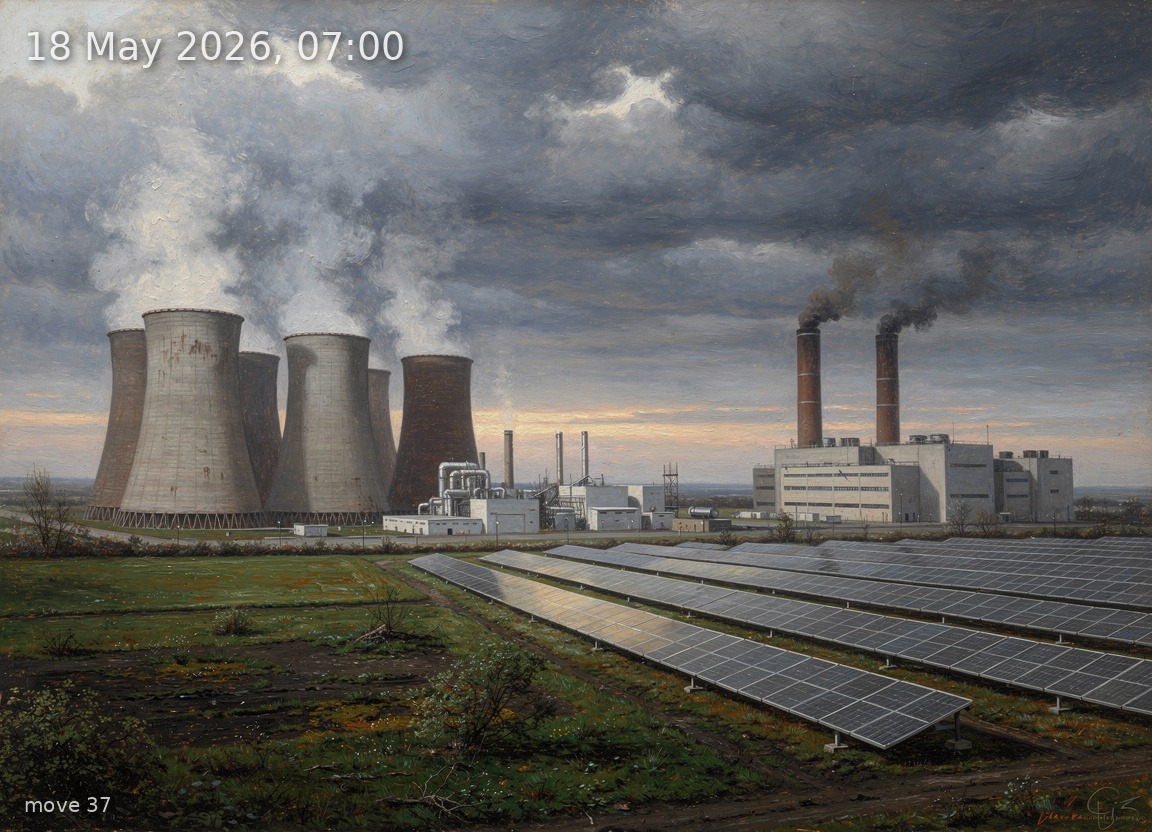
Overcast morning with heavy coal and gas backup; 19.3 GW net imports needed as renewables cover just over half of generation.
Back
Generation mix
Wind onshore 16%
Wind offshore 1%
Solar 24%
Biomass 10%
Hydro 4%
Natural gas 15%
Hard coal 10%
Brown coal 20%
56%
Renewable share
7.0 GW
Wind (on + offshore)
9.8 GW
Solar
40.4 GW
Total generation
-19.3 GW
Net import
160.1 €/MWh
Day-ahead price
8.4°C / 12 km/h
Temp / Wind speed
Open-Meteo, Kassel (51.3°N 9.5°E)
100.0% / 3.0 W/m²
Cloud cover / Radiation
309
gCO₂/kWh
Image prompt
Brown coal 8.0 GW dominates the left quarter as a cluster of massive hyperbolic cooling towers with thick white-grey steam plumes merging into the overcast sky; hard coal 4.0 GW sits just right of them as a pair of smaller conventional power station stacks trailing dark exhaust; natural gas 5.9 GW occupies the centre-left as compact CCGT units with tall single exhaust stacks and visible heat shimmer; solar 9.8 GW stretches across the centre as vast fields of aluminium-framed crystalline silicon photovoltaic panels on flat ground, their surfaces reflecting only dull grey light under total cloud cover—no sunshine, no glare; onshore wind 6.6 GW fills the right third as rows of tall three-blade turbines on lattice and tubular towers, blades turning slowly in moderate breeze; offshore wind 0.5 GW appears as a few distant turbines on the far-right horizon above a faint grey sea line; biomass 4.2 GW is rendered as a mid-ground industrial biogas facility with rounded digesters and a short steam stack; hydro 1.4 GW is a small concrete run-of-river dam with white water spilling, tucked in the lower-right corner near a wooded riverbank. Time is early dawn at 07:00 in May: the sky is a deep blue-grey with the faintest pale luminescence along the eastern horizon, no direct sun visible, pre-dawn diffuse light only. The atmosphere is heavy and oppressive—thick uniform 100% stratocumulus ceiling pressing low, reflecting the high electricity price. Temperature is a cool 8.4 °C: spring vegetation is fresh green but subdued, dew on grass, bare patches of dark soil. The landscape is broad and flat, evoking the North German Plain. Highly detailed oil painting in the tradition of 19th-century German Romantic landscape painters—Caspar David Friedrich meets industrial sublime—rich muted colour palette of slate greys, moss greens, and warm coal-fire oranges, visible impasto brushwork, atmospheric depth with haze between layers. Each technology rendered with meticulous engineering accuracy: turbine nacelles, rotor hubs, PV module grid patterns, cooling tower parabolic profiles, CCGT exhaust geometry. No text, no labels.