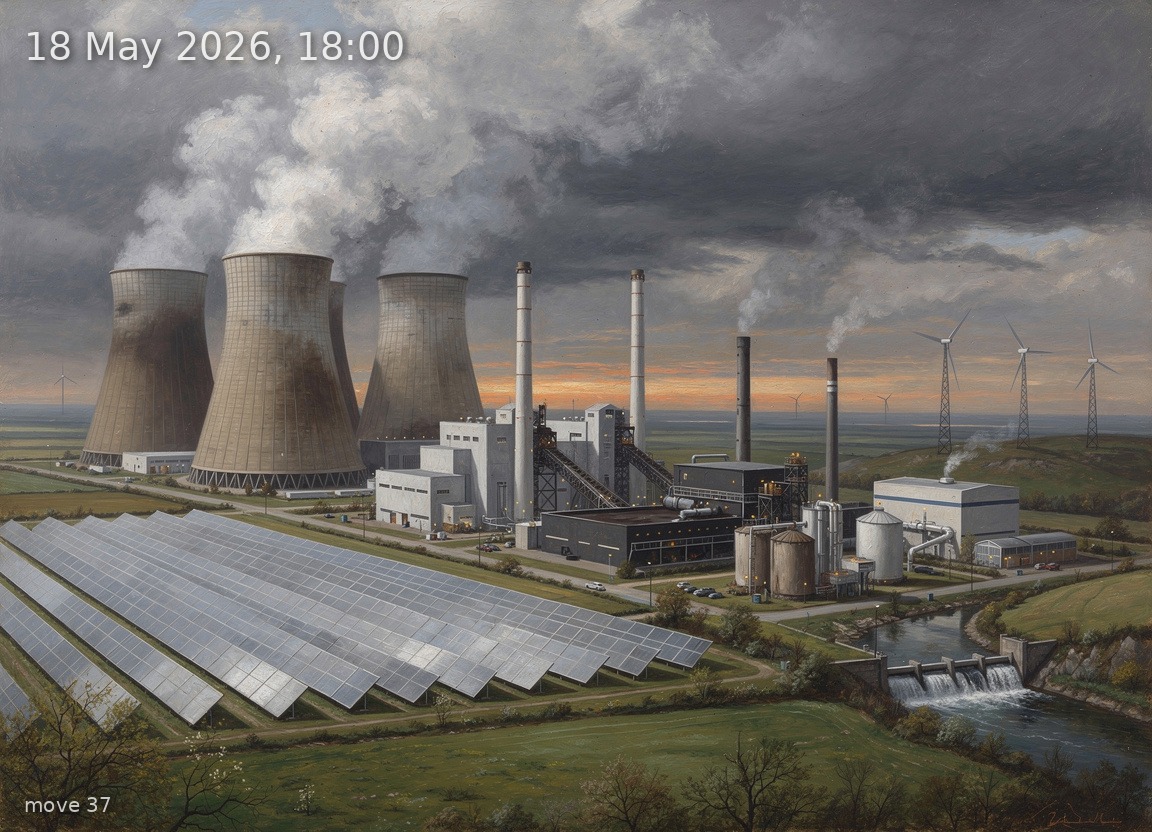
Overcast skies and light winds force heavy coal and gas dispatch alongside fading solar, with 20.6 GW net imports.
Back
Generation mix
Wind onshore 9%
Wind offshore 1%
Solar 28%
Biomass 11%
Hydro 3%
Natural gas 15%
Hard coal 10%
Brown coal 22%
53%
Renewable share
4.2 GW
Wind (on + offshore)
11.2 GW
Solar
39.5 GW
Total generation
-20.7 GW
Net import
152.1 €/MWh
Day-ahead price
12.5°C / 5 km/h
Temp / Wind speed
Open-Meteo, Kassel (51.3°N 9.5°E)
100.0% / 24.0 W/m²
Cloud cover / Radiation
330
gCO₂/kWh
Image prompt
Brown coal 8.9 GW dominates the left quarter of the scene as a massive lignite power station with four hyperbolic cooling towers emitting thick white steam plumes into the grey sky; solar 11.2 GW occupies the centre-left as a vast field of aluminium-framed crystalline silicon PV panels stretching across flat farmland, their surfaces reflecting only diffuse grey light under total overcast; natural gas 5.9 GW appears centre-right as a cluster of modern CCGT plants with tall single exhaust stacks and compact turbine halls, heat shimmer visible at their vents; biomass 4.2 GW is rendered as two mid-sized biomass plants with cylindrical wood-chip silos and modest chimneys emitting thin pale smoke; hard coal 3.8 GW sits in the right-centre as a traditional coal-fired station with rectangular cooling towers and coal conveyor belts; wind onshore 3.7 GW appears in the right background as a sparse line of three-blade turbines on lattice towers, blades barely turning in calm air; hydro 1.3 GW is visible at the far right as a small dam with a modest river spillway; wind offshore 0.5 GW is a faint silhouette of two turbines on the distant horizon. The sky is entirely overcast with heavy, low, oppressive stratiform clouds in tones of slate grey and charcoal, creating a brooding, heavy atmosphere reflecting the high electricity price. The time is 18:00 in late May — dusk beginning, with a faint orange-amber glow barely visible along the lower horizon beneath the cloud deck, the upper sky darkening to deep grey. Spring vegetation is lush green but muted under the flat light; fields of rapeseed show dull yellow. Temperature is mild at 12.5°C, no frost, fresh spring foliage on scattered birch and oak trees. High-voltage transmission pylons recede into the hazy distance, symbolising the massive import flows. Style: highly detailed oil painting in the tradition of 19th-century German Romantic landscape painters such as Caspar David Friedrich and Carl Blechen — rich, layered colour in muted earth tones and greys, visible impasto brushwork, dramatic atmospheric depth and chiaroscuro, meticulous engineering detail on every turbine nacelle, cooling tower rib, and PV panel frame. The composition conveys industrial sublime — the vast human energy infrastructure set against an indifferent, cloud-smothered sky. No text, no labels, no human figures.