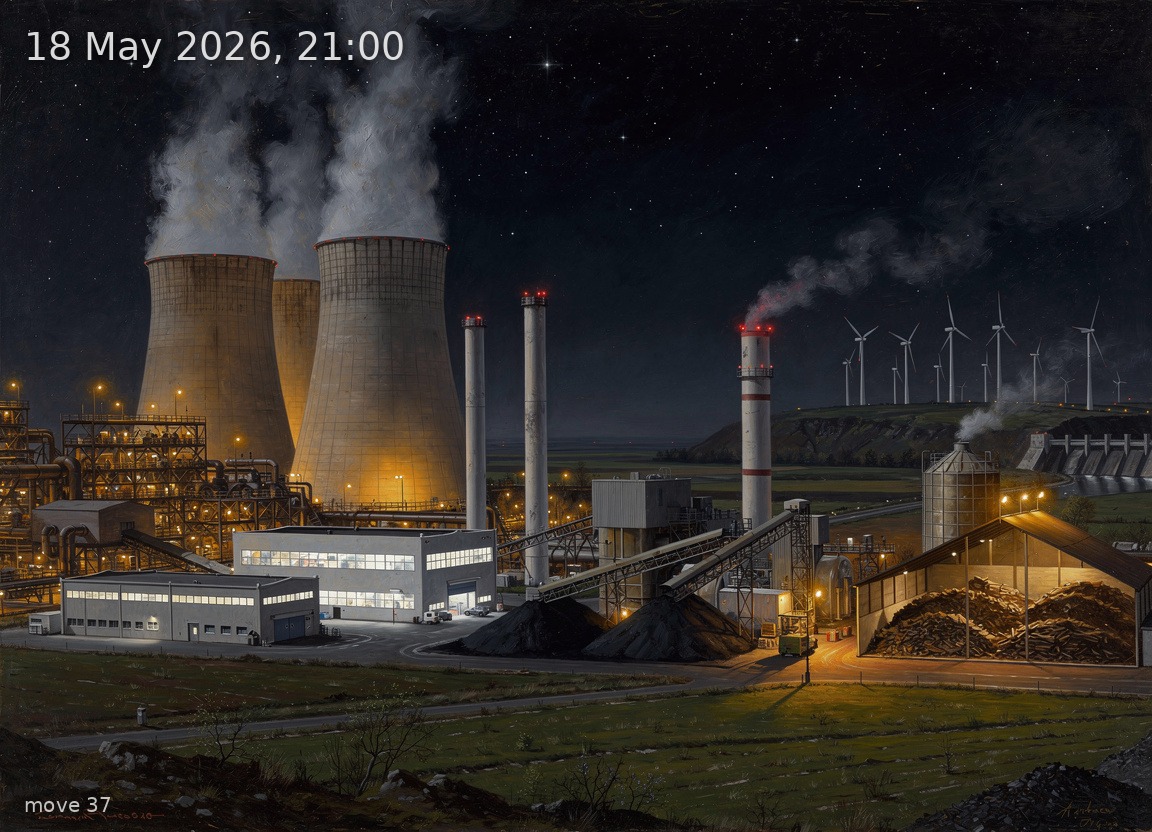
Brown coal, gas, and hard coal anchor a 30 GW domestic supply against 56 GW demand, requiring massive imports at elevated prices.
Back
Generation mix
Wind onshore 14%
Wind offshore 1%
Solar 0%
Biomass 15%
Hydro 4%
Natural gas 22%
Hard coal 13%
Brown coal 30%
35%
Renewable share
4.6 GW
Wind (on + offshore)
0.0 GW
Solar
30.2 GW
Total generation
-25.4 GW
Net import
214.3 €/MWh
Day-ahead price
11.7°C / 6 km/h
Temp / Wind speed
Open-Meteo, Kassel (51.3°N 9.5°E)
0.0% / 13.0 W/m²
Cloud cover / Radiation
451
gCO₂/kWh
Image prompt
Brown coal 9.0 GW dominates the left third of the scene as a cluster of four massive hyperbolic cooling towers with thick white-grey steam plumes rising into the night sky, lit from below by amber sodium lamps illuminating the sprawling lignite plant infrastructure. Natural gas 6.7 GW occupies the centre-left as two compact CCGT units with tall single exhaust stacks emitting thin heat shimmer, their turbine halls glowing with interior fluorescent light spilling through high windows. Hard coal 3.9 GW appears centre-right as a smaller coal-fired station with a single large stack and conveyor belts feeding from a dark coal pile, red aviation warning lights blinking on the chimney. Biomass 4.6 GW sits to the right as a mid-sized industrial facility with a cylindrical silo, wood-chip storage yard, and a modest stack with faint exhaust, warmly lit by yellowish industrial floodlights. Wind onshore 4.2 GW appears in the far right background as a sparse row of three-blade turbines on a low ridge, their nacelles carrying slowly turning rotors, red beacon lights flashing on each tower. Hydro 1.3 GW is suggested by a concrete dam structure barely visible in the far distance at the right edge, with a faint cascade of water catching reflected light. Wind offshore 0.4 GW is represented by a single distant turbine silhouette on the far horizon. The sky is completely dark — deep navy to black, no twilight, no sky glow — a clear moonless spring night with sharp pinpoint stars visible overhead since cloud cover is zero. The atmosphere feels heavy and oppressive despite the clear sky, conveying the tension of extremely high electricity prices: a faint industrial haze hangs low over the thermal plants, and the sodium-orange glow from the facilities creates an uneasy warm pall across the lower sky. The landscape is a flat central German plain with fresh spring grass barely visible in the artificial light, young leaves on scattered birch trees at the margins. Rendered as a highly detailed oil painting in the tradition of 19th-century German Romantic landscape painters — rich, deep colour palette of blacks, navy blues, warm ambers, and sulphurous oranges — with visible impasto brushwork, atmospheric depth, and chiaroscuro contrasts between the dark countryside and the blazing industrial light. Each technology rendered with meticulous engineering accuracy: three-blade rotors with proper nacelle housings on lattice-free tubular towers, hyperbolic concrete cooling towers with realistic ribbing, CCGT stacks with correct proportions. No text, no labels.