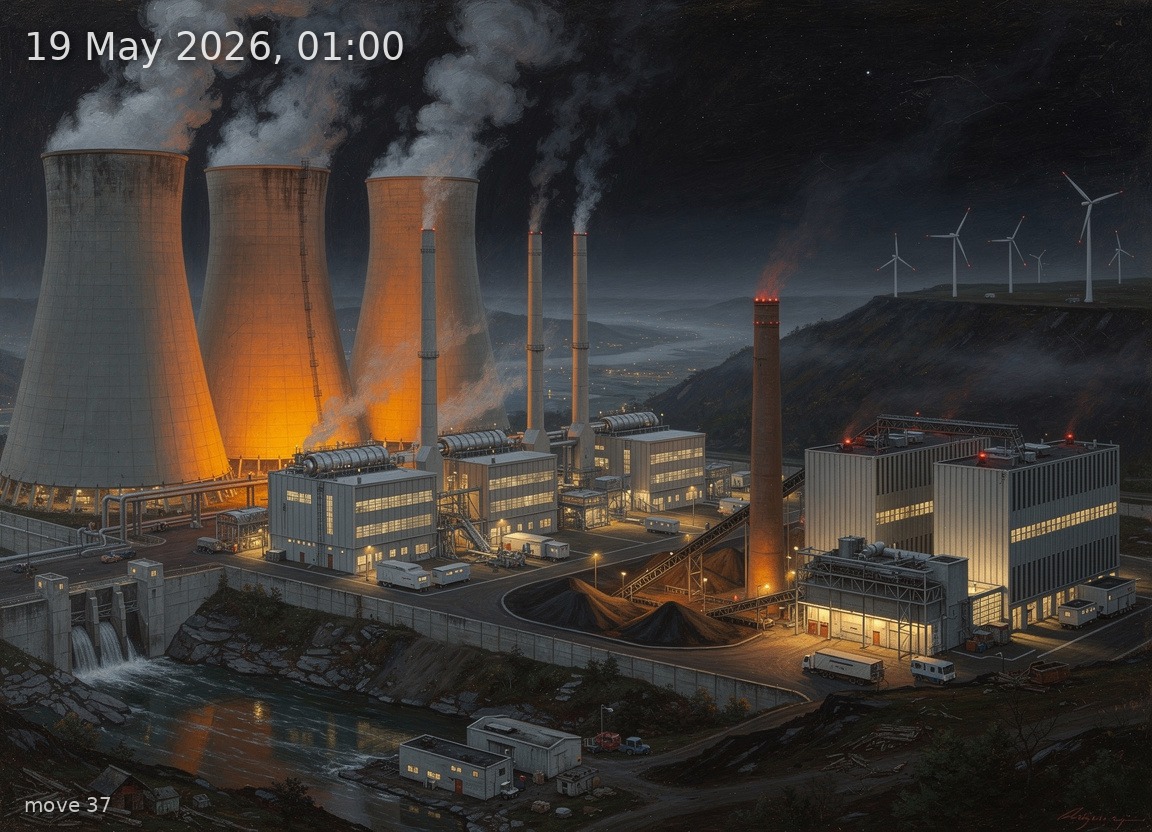
Brown coal, gas, and hard coal dominate overnight generation as calm winds and net imports of 17 GW meet demand.
Back
Generation mix
Wind onshore 12%
Wind offshore 1%
Biomass 15%
Hydro 5%
Natural gas 24%
Hard coal 13%
Brown coal 31%
32%
Renewable share
3.5 GW
Wind (on + offshore)
0.0 GW
Solar
27.8 GW
Total generation
-17.0 GW
Net import
141.9 €/MWh
Day-ahead price
8.4°C / 3 km/h
Temp / Wind speed
Open-Meteo, Kassel (51.3°N 9.5°E)
13.0% / 0.0 W/m²
Cloud cover / Radiation
471
gCO₂/kWh
Image prompt
Brown coal 8.6 GW dominates the left third of the scene as a cluster of massive hyperbolic cooling towers with thick white-grey steam plumes rising into the night, lit from below by sodium-orange industrial lighting; natural gas 6.6 GW fills the centre-left as a row of compact CCGT power blocks with tall single exhaust stacks emitting thin translucent plumes, their steel casings catching amber floodlight; biomass 4.1 GW appears centre-right as a medium-scale industrial plant with wood-chip conveyors and a single squat smokestack, warmly lit from within; hard coal 3.7 GW sits to the right as a traditional coal-fired station with a pair of large rectangular boiler houses, conveyor gantries, and a tall chimney with a faint reddish glow at its tip; wind onshore 3.2 GW is represented by a handful of widely spaced three-blade turbines on a distant ridge, their rotors barely turning, red aviation warning lights blinking; hydro 1.3 GW appears as a small concrete dam structure in the far background with faint blue-white security lighting reflecting on dark water. The sky is deep black to navy, nearly clear with only thin wisps of cloud (13% cover), revealing scattered stars and a faint Milky Way band. No moon glow, no twilight — it is 1 AM in late May. The landscape is central German rolling hills with fresh spring-green deciduous foliage on the trees, barely visible in the artificial light. The atmosphere feels heavy, oppressive, and hazy near the industrial facilities, reflecting the very high electricity price — a warm smog hangs low across the middle ground, diffusing the sodium lighting into an amber fog. Temperature is cool at 8°C: a thin ground mist clings to a small river in the foreground, its surface glassy and dark. Style: highly detailed oil painting in the tradition of 19th-century German Romantic landscape masters such as Caspar David Friedrich and Carl Blechen — rich impasto brushwork, dramatic chiaroscuro between pitch-dark sky and glowing industrial complexes, atmospheric depth with layered mist and haze, meticulous engineering accuracy on each turbine nacelle, cooling tower shell, conveyor gantry, and exhaust stack. The mood is sublime and contemplative — the grandeur and weight of industrial civilisation burning through the silent spring night. No text, no labels.