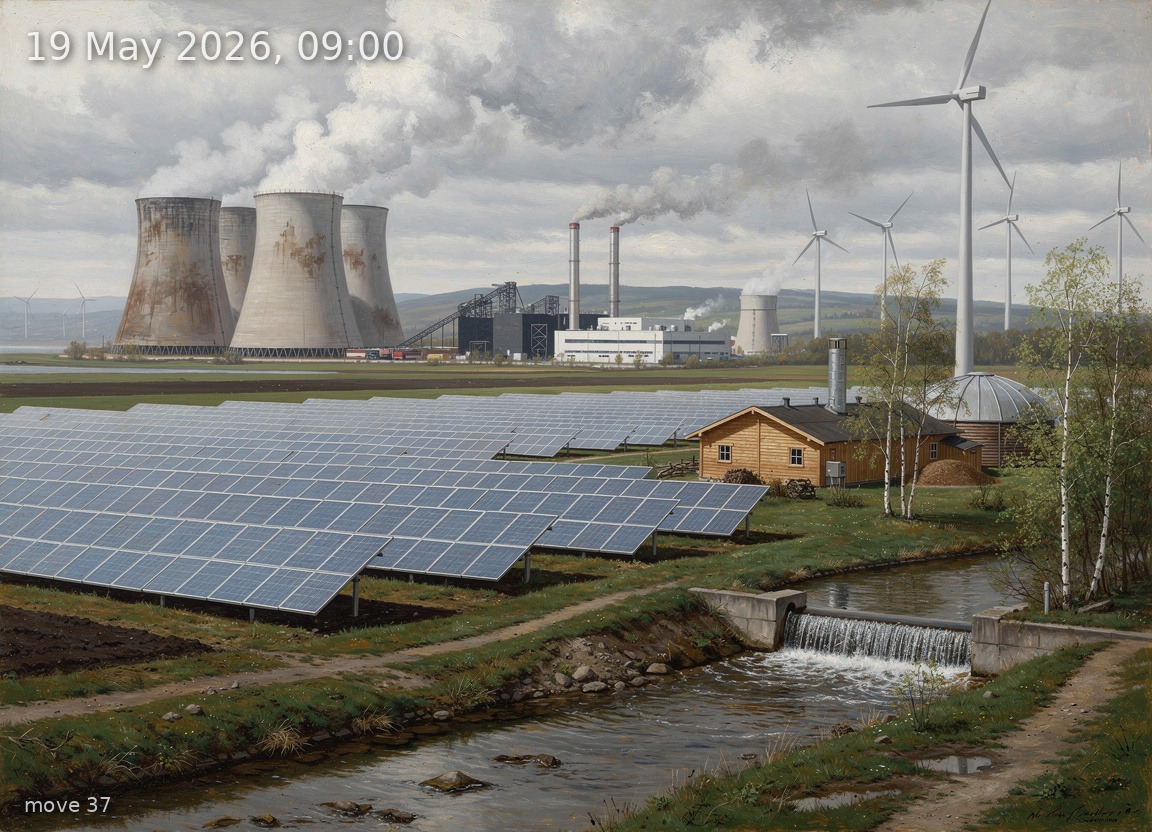
Solar leads at 30.2 GW under heavy overcast; low wind and high thermal output support 62.3 GW demand with 5.7 GW net imports.
Back
Generation mix
Wind onshore 2%
Wind offshore 1%
Solar 53%
Biomass 8%
Hydro 2%
Natural gas 12%
Hard coal 7%
Brown coal 15%
66%
Renewable share
1.6 GW
Wind (on + offshore)
30.2 GW
Solar
56.6 GW
Total generation
-5.8 GW
Net import
108.7 €/MWh
Day-ahead price
9.3°C / 8 km/h
Temp / Wind speed
Open-Meteo, Kassel (51.3°N 9.5°E)
94.0% / 68.0 W/m²
Cloud cover / Radiation
233
gCO₂/kWh
Image prompt
Solar 30.2 GW dominates the centre and right of the scene as vast fields of aluminium-framed crystalline silicon PV panels stretching across gently rolling farmland, their blue-grey surfaces reflecting a flat, overcast sky; brown coal 8.6 GW occupies the far left as a cluster of massive hyperbolic cooling towers emitting thick white-grey steam plumes that merge with the low clouds; natural gas 6.7 GW appears as a mid-ground group of compact CCGT power plants with tall single exhaust stacks venting thin heat shimmer; hard coal 3.9 GW is rendered as a smaller coal-fired station with rectangular boiler houses and a single shorter cooling tower behind the gas plant; biomass 4.4 GW appears as a timber-clad biomass plant with a modest stack and wood-chip storage dome nestled among birch trees at mid-right; hydro 1.3 GW is a small concrete weir and penstock visible along a stream in the right foreground; wind onshore 1.1 GW shows a handful of three-blade turbines on the distant horizon with rotors barely turning; wind offshore 0.5 GW is suggested by two or three tiny turbines visible through haze on the far-left horizon. The time is 09:00 on a May morning: full daylight but deeply diffused through 94% cloud cover — the sky is a uniform heavy pewter-grey blanket with no blue patches, light is flat and shadowless, creating a muted tonal palette. Temperature is a cool 9.3°C: spring vegetation is fresh green but subdued, grass is damp, puddles on dirt paths. The atmosphere feels heavy, oppressive, and close, reflecting the high electricity price — the clouds press low over the industrial landscape, giving a sense of constrained, burdened energy. Rendered as a highly detailed oil painting in the tradition of 19th-century German Romantic landscape painters such as Caspar David Friedrich and Carl Blechen — rich layered colour, visible impasto brushwork, atmospheric aerial perspective with deepening haze toward the horizon, meticulous engineering detail on every turbine nacelle, panel frame, and cooling tower shell. No text, no labels, no people in foreground.