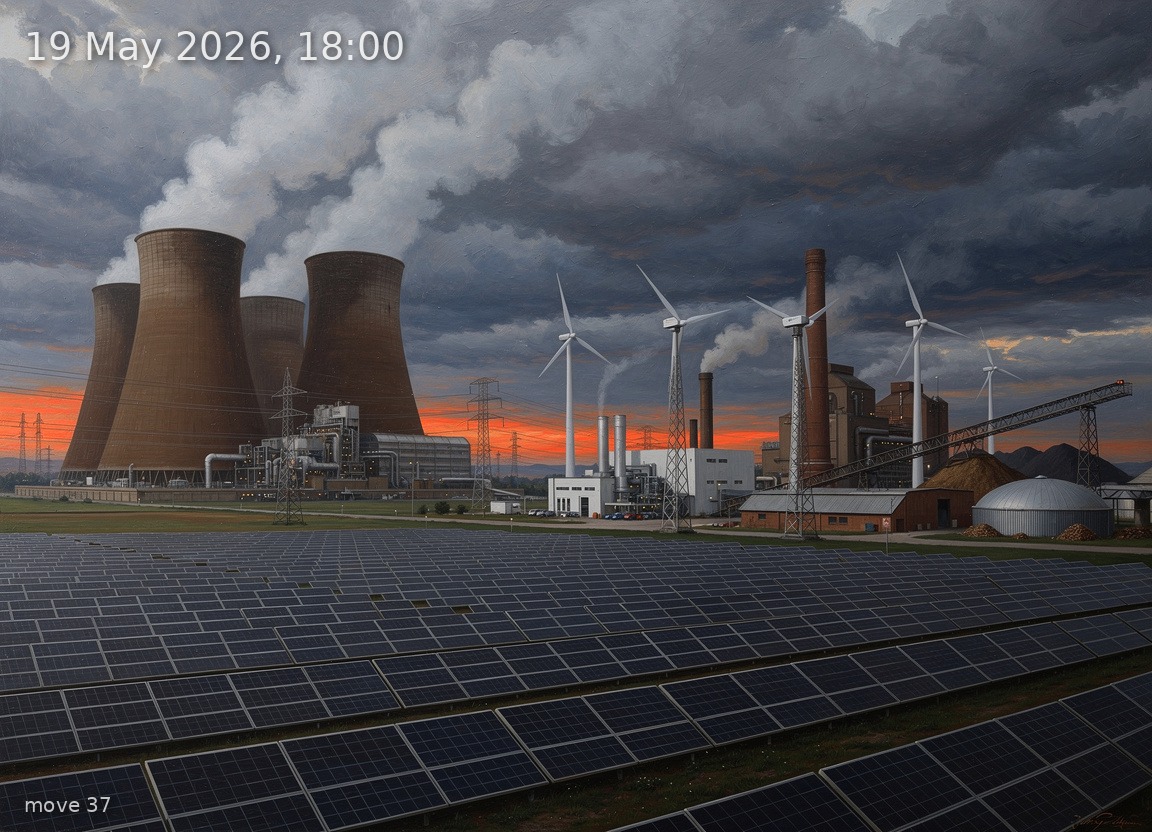
Brown coal, solar, and gas lead generation as heavy cloud cover and high demand drive 18.4 GW net imports at elevated prices.
Back
Generation mix
Wind onshore 12%
Wind offshore 5%
Solar 26%
Biomass 10%
Hydro 4%
Natural gas 12%
Hard coal 10%
Brown coal 22%
57%
Renewable share
6.7 GW
Wind (on + offshore)
10.6 GW
Solar
40.4 GW
Total generation
-18.4 GW
Net import
144.9 €/MWh
Day-ahead price
15.7°C / 14 km/h
Temp / Wind speed
Open-Meteo, Kassel (51.3°N 9.5°E)
90.0% / 25.0 W/m²
Cloud cover / Radiation
310
gCO₂/kWh
Image prompt
Brown coal 8.9 GW dominates the left quarter of the scene as a massive lignite power station with three hyperbolic cooling towers trailing thick white steam plumes into a heavy overcast sky; solar 10.6 GW occupies the centre-left as a vast field of aluminium-framed crystalline silicon photovoltaic panels stretching across flat farmland, their surfaces reflecting dull grey light under dense clouds; wind onshore 4.8 GW appears centre-right as a row of tall three-blade turbines on lattice towers, blades rotating moderately in 14 km/h winds; natural gas 4.8 GW is rendered as a compact CCGT plant with twin exhaust stacks and a single smaller cooling tower emitting thin exhaust, positioned right of the wind turbines; hard coal 3.9 GW sits in the right background as a traditional coal plant with a tall brick chimney and conveyor belt feeding a bunker; wind offshore 1.9 GW is glimpsed as distant turbines on the far horizon line; biomass 4.2 GW appears as a mid-sized industrial facility with a wood-chip storage dome and a single square stack releasing pale smoke, nestled between the gas plant and coal plant; hydro 1.4 GW is suggested by a small dam and powerhouse visible in a river valley in the far right background. The time is 18:00 in late May — dusk lighting with a rapidly fading orange-red glow confined to the lowest strip of the western horizon, the sky above transitioning from slate grey to deep blue-grey, 90% cloud cover forming a thick oppressive blanket that presses down on the landscape. The atmosphere feels heavy and brooding, reflecting the high electricity price. Spring vegetation — fresh green grass and leafy deciduous trees at approximately 16°C — softens the industrial foreground. Rendered as a highly detailed oil painting in the tradition of 19th-century German Romantic landscape painters such as Caspar David Friedrich and Carl Blechen: rich saturated colour, visible impasto brushwork, atmospheric depth with sfumato haze around distant structures, dramatic chiaroscuro from the fading horizon light against dark cloud masses. Every energy technology is painted with meticulous engineering accuracy — turbine nacelles, three-blade rotors, PV cell grid patterns, cooling tower parabolic profiles, conveyor gantries. No text, no labels.