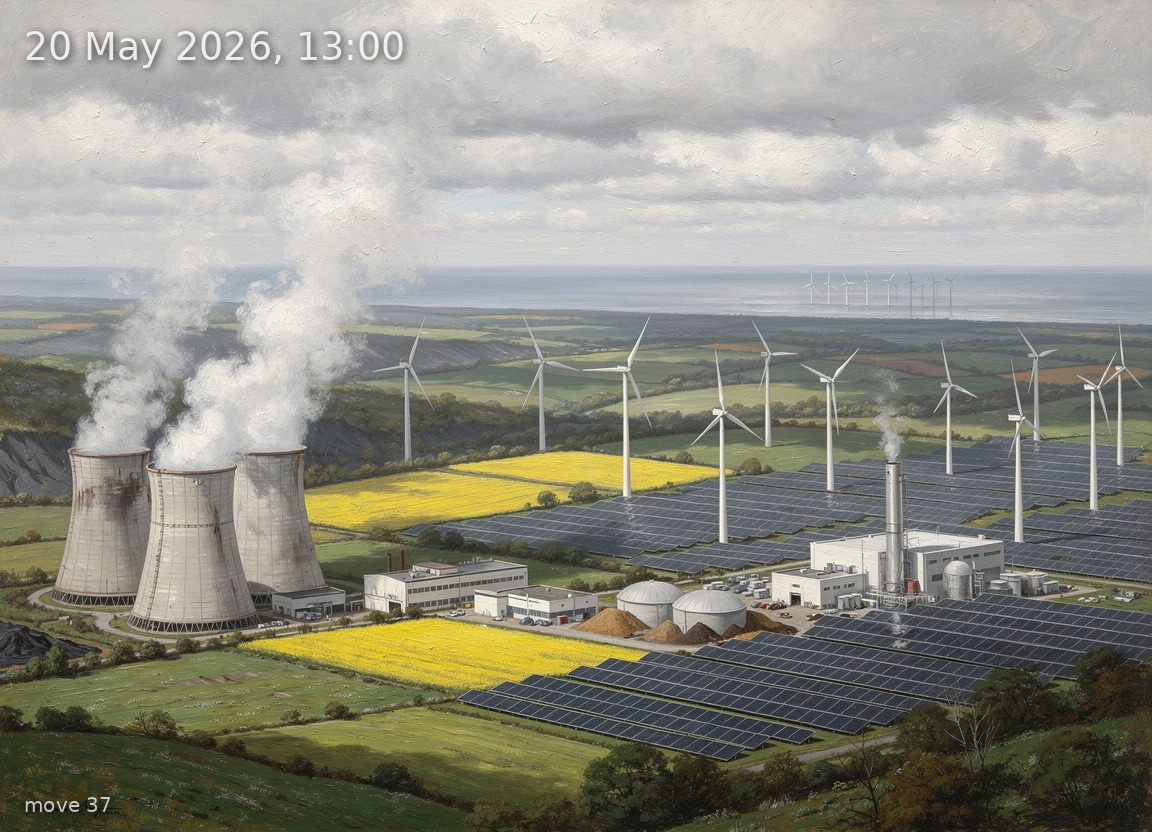
Solar at 29.7 GW and wind at 14.8 GW dominate under full overcast, with lignite providing baseload support.
Back
Generation mix
Wind onshore 21%
Wind offshore 4%
Solar 51%
Biomass 7%
Hydro 2%
Natural gas 4%
Hard coal 3%
Brown coal 9%
85%
Renewable share
14.8 GW
Wind (on + offshore)
29.7 GW
Solar
58.4 GW
Total generation
-1.3 GW
Net import
45.0 €/MWh
Day-ahead price
16.7°C / 15 km/h
Temp / Wind speed
Open-Meteo, Kassel (51.3°N 9.5°E)
100.0% / 71.0 W/m²
Cloud cover / Radiation
109
gCO₂/kWh
Image prompt
Solar 29.7 GW dominates the centre and right of the composition as vast fields of aluminium-framed crystalline silicon photovoltaic panels stretching across gentle rolling hills, their surfaces gleaming dully under a uniformly overcast sky with no direct sun — diffused, flat white-grey daylight at 1 PM. Wind onshore 12.3 GW appears as dozens of tall three-blade turbines with white tubular towers and nacelles scattered across the middle distance, their rotors turning at moderate speed in the 15 km/h breeze. Wind offshore 2.5 GW is glimpsed far in the background as a small cluster of taller turbines on a hazy flat horizon suggesting the North Sea. Brown coal 5.0 GW occupies the left foreground as a lignite power station with three hyperbolic concrete cooling towers issuing thick white steam plumes that merge with the overcast ceiling. Biomass 4.0 GW appears as a cluster of mid-sized industrial buildings with wood-chip storage domes and a single squat chimney emitting thin pale smoke, placed between the coal plant and the solar fields. Natural gas 2.3 GW is rendered as a compact combined-cycle gas turbine facility with a tall slender exhaust stack and a single smaller cooling tower, set just behind the coal plant. Hard coal 1.5 GW shows as a smaller conventional power station with a single large smokestack and conveyor belts, partially obscured behind the gas plant. Hydro 1.2 GW is suggested by a small dam and reservoir visible in a valley to the far left. The sky is entirely overcast, 100% cloud cover, flat bright grey light with no shadows, spring green vegetation — fresh beech leaves, flowering rapeseed fields in patches of yellow among the solar arrays. Temperature is mild, 16–17°C, giving lush green grass. The atmosphere is calm and mildly hazy, not oppressive. Style: highly detailed oil painting in the tradition of 19th-century German Romantic landscape painting — rich layered colour, visible impasto brushwork, atmospheric aerial perspective with receding blue-grey tones, meticulous engineering detail on every turbine nacelle, every PV panel frame, every cooling tower's reinforced concrete ribs. The composition has the grandeur of a Caspar David Friedrich panorama but populated with modern energy infrastructure rendered with technical precision. No text, no labels, no people.