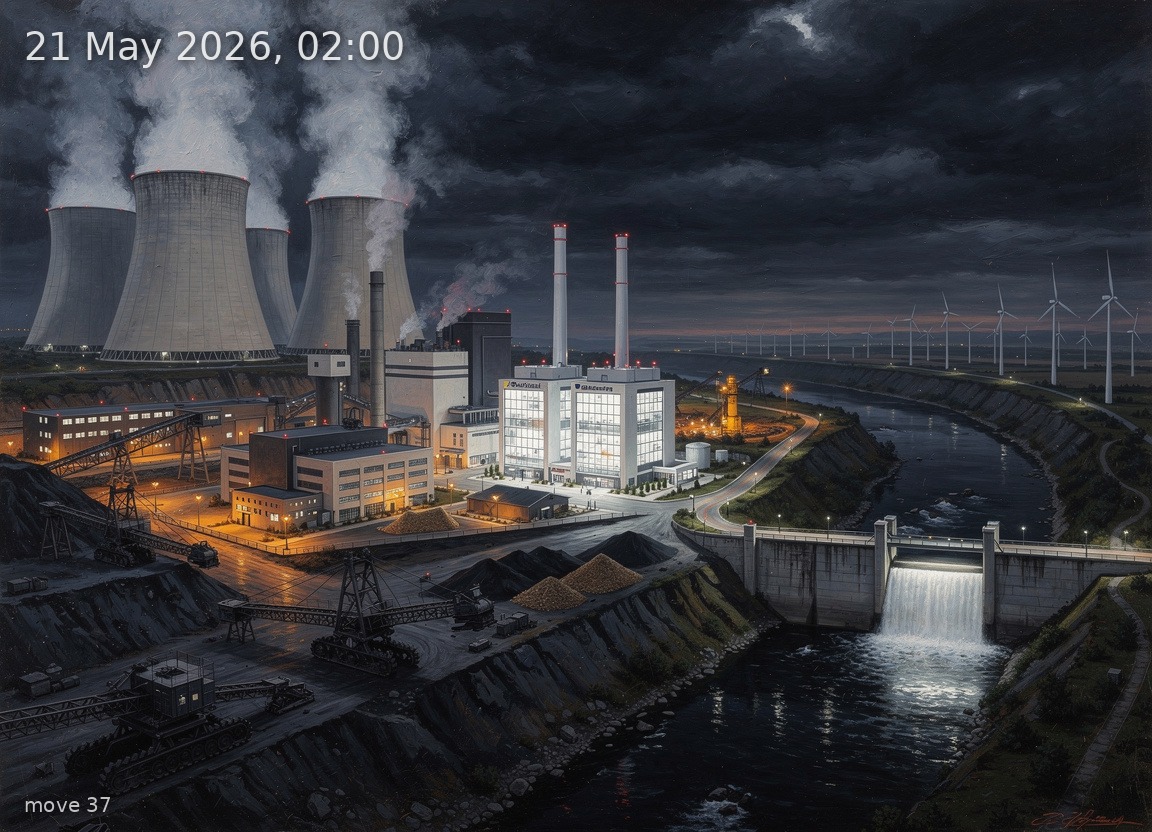
Nighttime wind and persistent coal generation drive a 20 GW net export position despite elevated overnight prices.
Back
Generation mix
Wind onshore 22%
Wind offshore 4%
Solar 34%
Biomass 7%
Hydro 2%
Natural gas 7%
Hard coal 7%
Brown coal 16%
70%
Renewable share
16.2 GW
Wind (on + offshore)
21.1 GW
Solar
61.8 GW
Total generation
+20.4 GW
Net export
116.0 €/MWh
Day-ahead price
11.9°C / 9 km/h
Temp / Wind speed
Open-Meteo, Kassel (51.3°N 9.5°E)
100.0% / 0.0 W/m²
Cloud cover / Radiation
220
gCO₂/kWh
Image prompt
Brown coal 10.1 GW dominates the left quarter of the scene as a cluster of massive hyperbolic cooling towers rising from an open-pit lignite mine, thick white steam plumes billowing upward into a pitch-black overcast sky; hard coal 4.1 GW appears just left of centre as a smaller conventional power station with rectangular chimneys and conveyor belts, dimly lit by sodium-orange industrial floodlights; natural gas 4.6 GW occupies the centre as two compact CCGT plants with slender exhaust stacks emitting thin heat shimmer, their turbine halls glowing with interior light behind glass facades; wind onshore 13.7 GW spans the right third as dozens of three-blade turbines on lattice and tubular towers stretching across rolling farmland, their red aviation warning lights blinking in unison; wind offshore 2.5 GW is suggested in the far right background as a row of turbines on the horizon above a faintly reflective North Sea glimpsed through a gap in terrain; biomass 4.1 GW appears as a mid-sized wood-chip-fed plant with a modest smokestack near the coal station; hydro 1.5 GW is a small concrete dam structure in the middle distance with illuminated spillway. Time is 2 AM: the sky is completely black with heavy unbroken cloud cover, no stars, no moon, no twilight—only artificial light sources illuminate the scene. A spring landscape with fresh green vegetation on hills, temperature around 12°C suggesting light mist clinging to low ground. The atmosphere feels heavy and oppressive despite the night, reflecting the unusually high electricity price—the air is thick, humid, almost suffocating. Rendered as a highly detailed oil painting in the tradition of 19th-century German Romantic landscape art—think Caspar David Friedrich meets industrial sublime—with rich, deep color palette of indigo, charcoal, burnt sienna, and sodium orange, visible textured brushwork, atmospheric depth and chiaroscuro, meticulous engineering accuracy on every turbine nacelle, cooling tower curvature, and CCGT exhaust detail. No text, no labels.