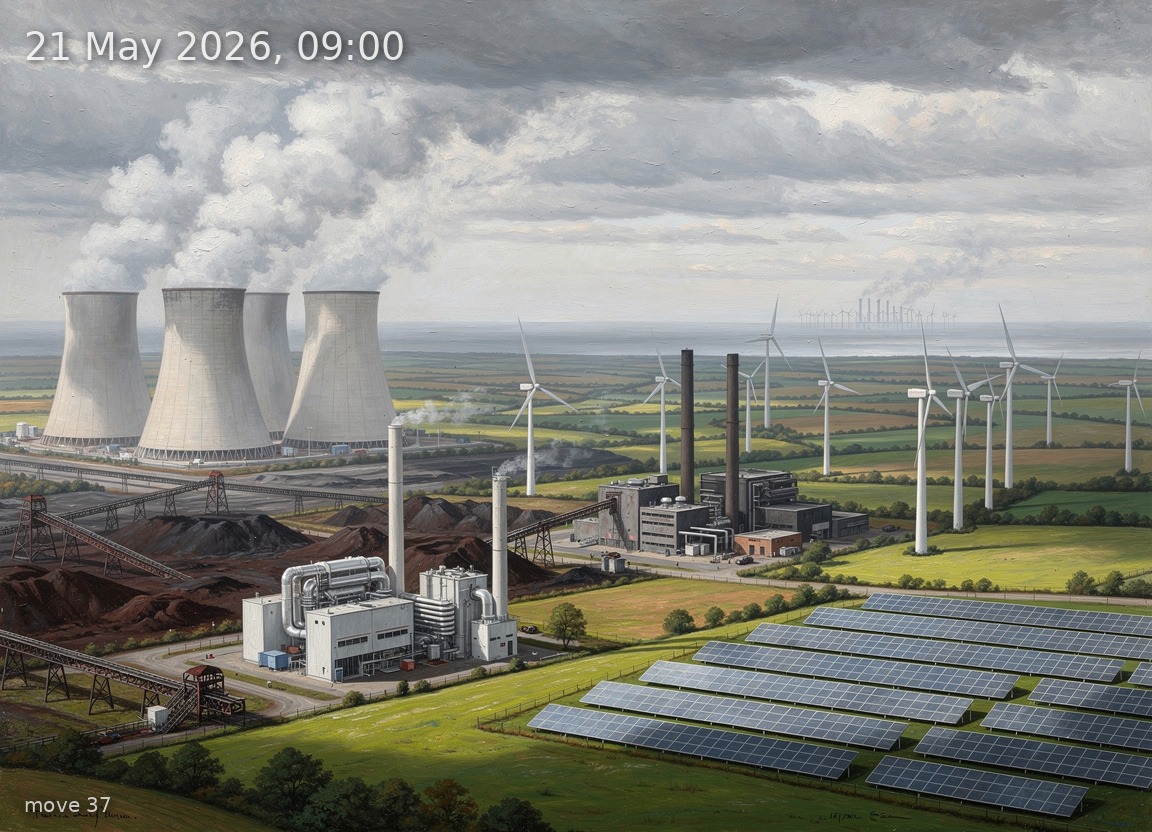
Diffuse solar leads at 21.1 GW under heavy overcast, with 15 GW wind and 17.7 GW thermal filling a tight 60.3 GW demand.
Back
Generation mix
Wind onshore 23%
Wind offshore 2%
Solar 36%
Biomass 7%
Hydro 3%
Natural gas 7%
Hard coal 7%
Brown coal 16%
70%
Renewable share
15.0 GW
Wind (on + offshore)
21.1 GW
Solar
59.4 GW
Total generation
-0.8 GW
Net import
104.1 €/MWh
Day-ahead price
14.2°C / 9 km/h
Temp / Wind speed
Open-Meteo, Kassel (51.3°N 9.5°E)
98.0% / 46.0 W/m²
Cloud cover / Radiation
215
gCO₂/kWh
Image prompt
Solar 21.1 GW dominates the right third of the scene as vast fields of aluminium-framed crystalline silicon PV panels stretching across gentle green rolling hills, their surfaces reflecting only flat grey-white diffuse light under a completely overcast sky — no direct sun visible. Wind onshore 13.7 GW occupies the centre-right as dozens of tall three-blade turbines with white tubular towers and detailed nacelles, blades turning slowly in light breeze, scattered across farmland. Wind offshore 1.3 GW appears as a small cluster of turbines on a distant hazy horizon line. Brown coal 9.4 GW fills the left portion as a massive lignite power station with four hyperbolic cooling towers emitting thick white steam plumes that merge into the low grey cloud ceiling, conveyor belts of dark brown lignite visible at ground level. Natural gas 4.3 GW sits centre-left as two compact CCGT units with tall single exhaust stacks and clean metallic housings. Hard coal 4.0 GW appears adjacent as a darker, older plant with rectangular stacks and coal bunkers. Biomass 4.1 GW is rendered as a mid-sized wood-chip facility with a squat chimney and timber storage yard. Hydro 1.5 GW is a small run-of-river weir with a concrete spillway in the lower foreground beside a swollen spring river. Time is 09:00 full daylight but deeply overcast — the entire sky is a uniform heavy grey at 98% cloud cover, oppressive and low-hanging, pressing down on the landscape. Spring foliage is lush bright green at 14.2°C, with rapeseed fields adding yellow patches. The atmosphere feels dense, humid, and heavy, conveying the economic pressure of a 104 EUR/MWh price — no blue sky, no dramatic breaks in cloud. Style: highly detailed oil painting in the tradition of 19th-century German Romantic landscape painters such as Caspar David Friedrich and Carl Blechen — rich saturated colour despite the overcast, visible impasto brushwork in the clouds and steam plumes, atmospheric depth with layers of haze between foreground turbines and distant cooling towers. Meticulous engineering accuracy on all technology. No text, no labels, no people.