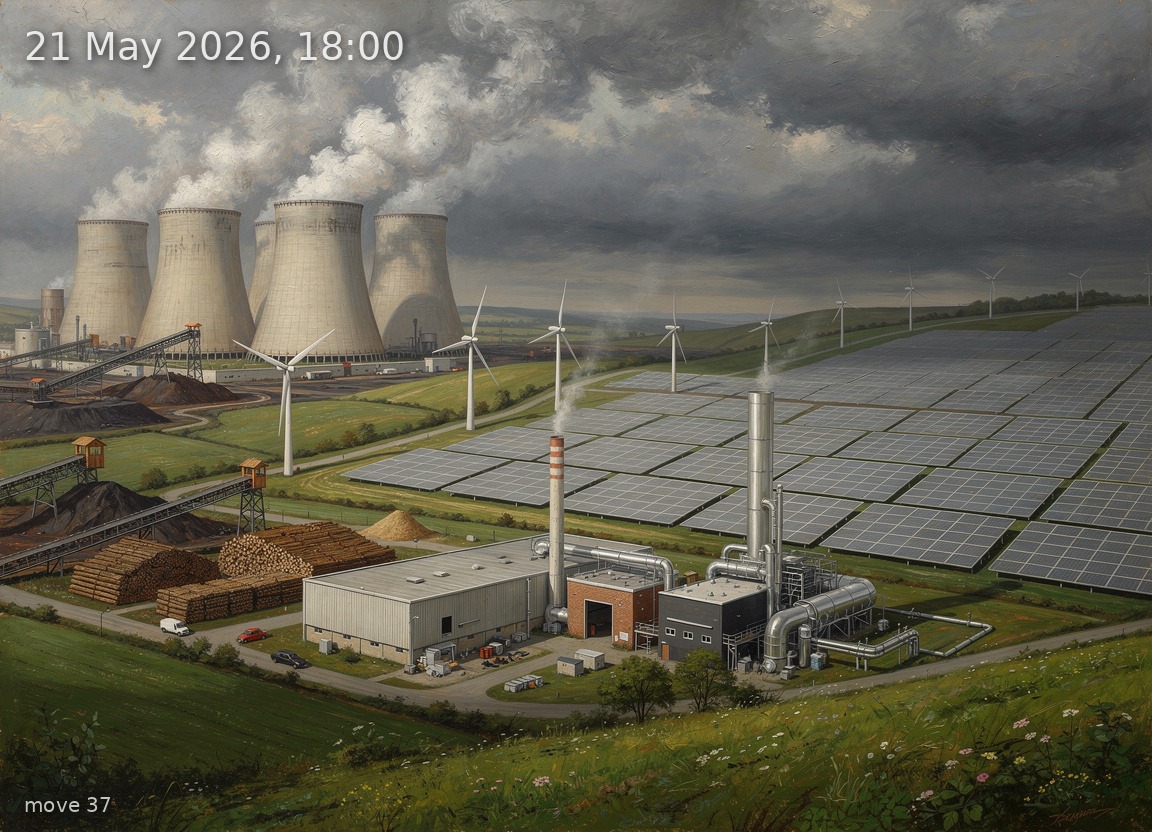
Overcast skies limit solar effectiveness; brown coal and large net imports cover a 17 GW domestic generation shortfall.
Back
Generation mix
Wind onshore 11%
Wind offshore 5%
Solar 36%
Biomass 11%
Hydro 4%
Natural gas 7%
Hard coal 6%
Brown coal 21%
66%
Renewable share
6.4 GW
Wind (on + offshore)
14.2 GW
Solar
39.6 GW
Total generation
-17.2 GW
Net import
135.9 €/MWh
Day-ahead price
19.5°C / 8 km/h
Temp / Wind speed
Open-Meteo, Kassel (51.3°N 9.5°E)
99.0% / 28.0 W/m²
Cloud cover / Radiation
250
gCO₂/kWh
Image prompt
Solar 14.2 GW dominates the right half of the scene as vast fields of aluminium-framed crystalline silicon PV panels stretching across gentle green farmland, their surfaces reflecting only flat grey light under total overcast; brown coal 8.2 GW occupies the left quarter as a cluster of massive hyperbolic cooling towers with thick white-grey steam plumes merging into the low clouds, alongside conveyor belts of dark lignite; wind onshore 4.5 GW appears as a line of tall three-blade turbines on rolling hills in the centre-left, rotors barely turning in light air; biomass 4.2 GW is rendered as a mid-sized industrial facility with a tall chimney and stacked woodchip storage in the centre; natural gas 2.9 GW shows as a compact CCGT plant with a single gleaming exhaust stack and thin heat shimmer, positioned between the biomass plant and coal complex; hard coal 2.3 GW is a smaller traditional power station with a single square cooling tower and coal bunkers beside rail tracks; wind offshore 1.9 GW is suggested by distant turbines on the far horizon above a faint line of sea; hydro 1.5 GW appears as a small concrete dam with spillway in the lower right foreground, water catching dim light. TIME AND ATMOSPHERE: 18:00 late May dusk — the sky is a heavy, oppressive blanket of unbroken cloud in tones of slate-grey and bruised violet, with only a thin strip of muted amber-orange glow along the very lowest western horizon where the sun sets unseen. The light is dim and diffuse, casting no shadows. Temperature is mild at 19.5°C; vegetation is lush spring green — mature deciduous trees in full leaf, wildflowers in meadow grass. The overall mood is heavy and pressured, reflecting the high electricity price. Overhead high-voltage transmission lines with lattice pylons cross the entire scene diagonally, symbolising the massive import flows. STYLE: highly detailed oil painting in the tradition of 19th-century German Romantic landscape masters such as Caspar David Friedrich and Carl Blechen — rich, layered colour with visible impasto brushwork, dramatic atmospheric depth, chiaroscuro contrasts between the glowing industrial facilities and the darkening overcast sky, meticulous engineering accuracy on every turbine nacelle, PV panel frame, and cooling tower curve. No text, no labels.