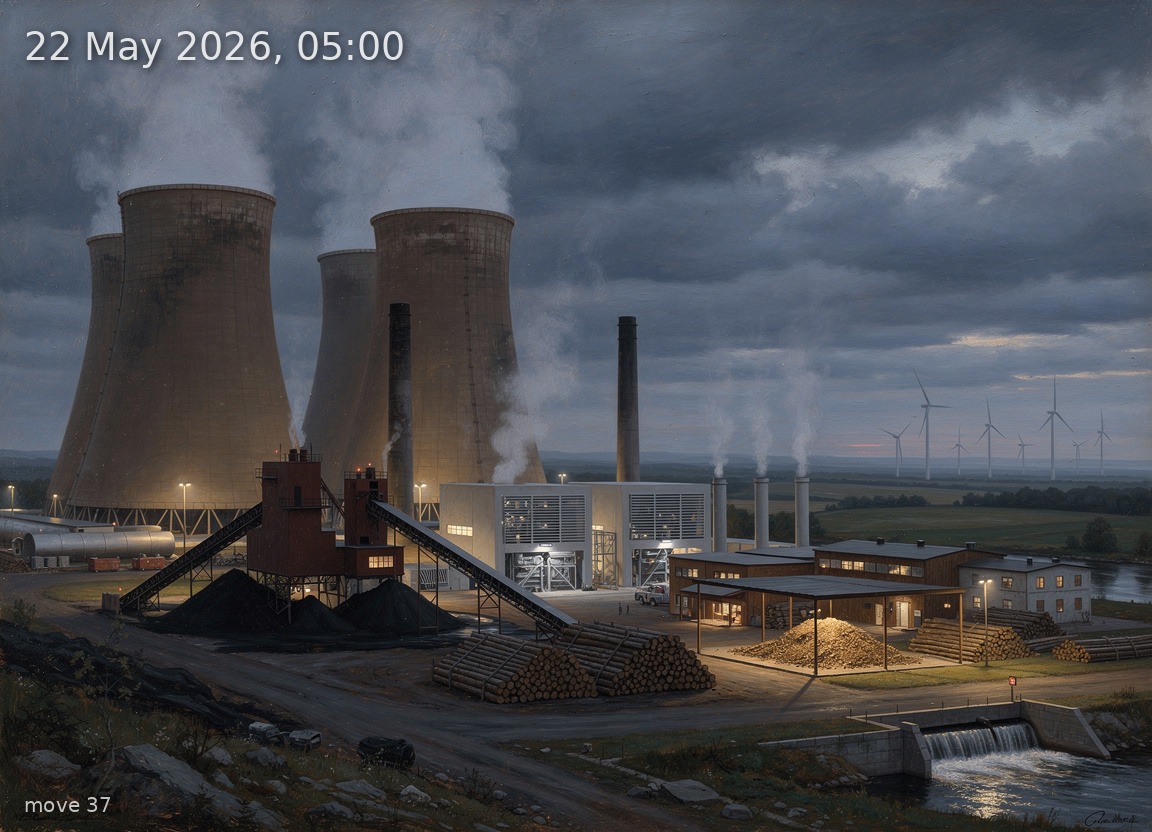
Brown coal, gas, and hard coal dominate at 05:00 as near-calm winds and overcast skies suppress renewable output.
Back
Generation mix
Wind onshore 7%
Wind offshore 4%
Solar 1%
Biomass 15%
Hydro 5%
Natural gas 20%
Hard coal 14%
Brown coal 33%
32%
Renewable share
3.1 GW
Wind (on + offshore)
0.4 GW
Solar
27.3 GW
Total generation
+27.3 GW
Net export
135.7 €/MWh
Day-ahead price
10.5°C / 2 km/h
Temp / Wind speed
Open-Meteo, Kassel (51.3°N 9.5°E)
100.0% / 0.0 W/m²
Cloud cover / Radiation
476
gCO₂/kWh
Image prompt
Brown coal 9.1 GW dominates the left third of the scene as a massive lignite power station with four hyperbolic cooling towers emitting thick pale steam plumes into the darkness; hard coal 3.7 GW appears as a smaller coal plant with two rectangular stacks and conveyors carrying dark fuel, positioned left of centre; natural gas 5.6 GW fills the centre as two compact CCGT units with tall single exhaust stacks releasing thin translucent plumes; biomass 4.0 GW sits right of centre as a cluster of industrial wood-burning facilities with squat chimneys and stacked timber visible in floodlit yards; wind onshore 2.0 GW and wind offshore 1.0 GW appear as a modest row of three-blade turbines along the right horizon, their rotors nearly motionless in still air; hydro 1.4 GW is suggested by a small dam and spillway at the far right edge; solar 0.4 GW is absent from the visual scene — no panels visible. Time is 05:00 in late May: the sky is deep blue-grey pre-dawn, no direct sunlight, the faintest pale lavender glow barely touching the eastern horizon. Full 100% cloud cover creates a heavy, oppressive overcast ceiling pressing low. Temperature is cool at 10.5°C; spring vegetation — fresh green leaves on birch and linden trees — is damp with morning dew. The air is perfectly still, no motion in grass or branches. The high electricity price is conveyed through a brooding, heavy atmospheric weight. Sodium streetlights cast amber pools on wet roads in the foreground. Industrial floodlights illuminate the power stations in harsh white. Painted as a highly detailed oil painting in the tradition of 19th-century German Romantic landscape painters — Caspar David Friedrich's atmospheric gravity meets industrial realism — with rich chiaroscuro, visible impasto brushwork, deep tonal contrasts between the warm industrial glow and the cold blue-grey sky, meticulous engineering detail on each facility, and a sweeping panoramic composition conveying the monumental scale of thermal generation against a subdued, overcast spring dawn. No text, no labels.