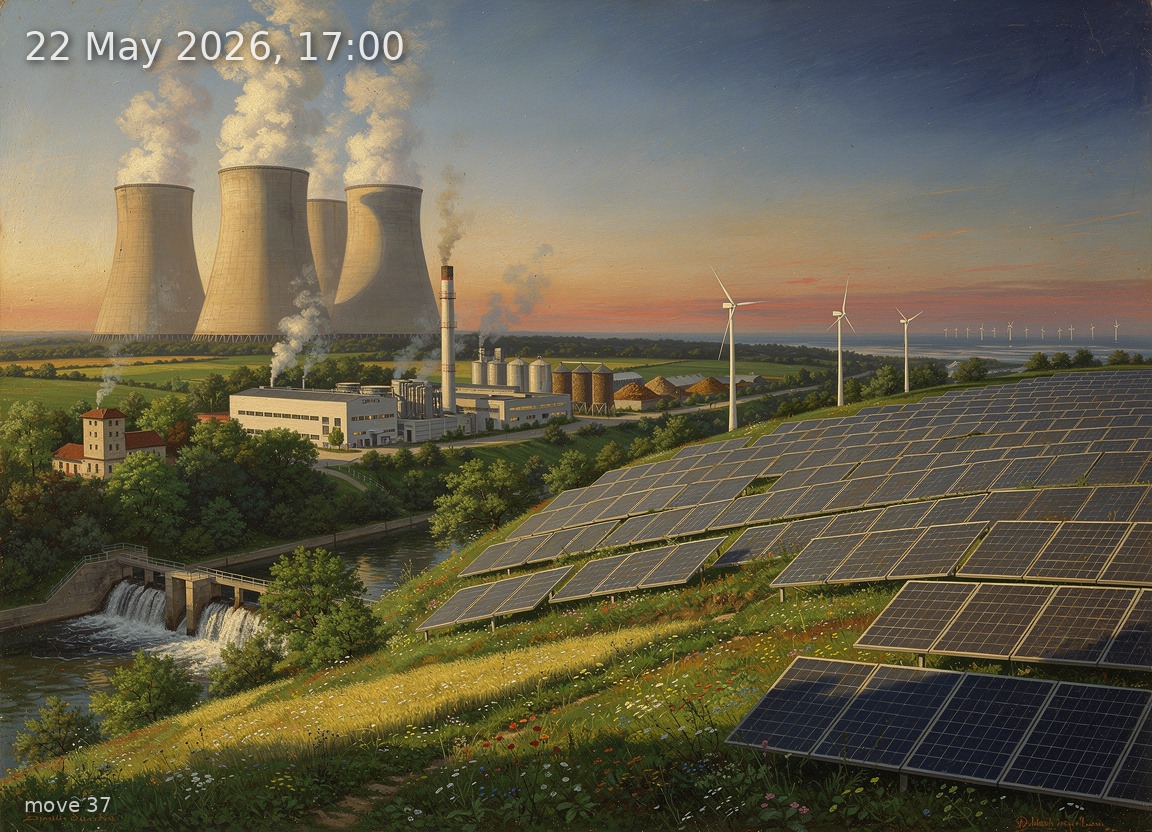
Strong solar leads at 26.6 GW but 13.7 GW net imports needed as wind stalls and evening demand peaks.
Back
Generation mix
Wind onshore 2%
Wind offshore 1%
Solar 65%
Biomass 10%
Hydro 3%
Natural gas 5%
Hard coal 2%
Brown coal 12%
82%
Renewable share
1.4 GW
Wind (on + offshore)
26.6 GW
Solar
41.0 GW
Total generation
-13.7 GW
Net import
104.2 €/MWh
Day-ahead price
25.4°C / 1 km/h
Temp / Wind speed
Open-Meteo, Kassel (51.3°N 9.5°E)
0.0% / 520.0 W/m²
Cloud cover / Radiation
135
gCO₂/kWh
Image prompt
Solar 26.6 GW dominates the scene as vast fields of aluminium-framed crystalline silicon PV panels stretching across the right two-thirds of the composition, their glass surfaces catching low golden-orange light; brown coal 4.9 GW occupies the left background as a cluster of massive hyperbolic cooling towers emitting thick white steam plumes against the sky; biomass 4.0 GW appears as a row of mid-sized industrial plant buildings with wood-chip silos and short stacks releasing thin grey smoke, positioned left of centre; natural gas 1.9 GW rendered as a compact CCGT facility with a single tall exhaust stack and heat-recovery unit, placed centre-left; hydro 1.4 GW shown as a modest concrete dam with water cascading over a spillway in the far left middle ground; wind onshore 0.9 GW depicted as a few three-blade turbines on a distant ridge, rotors nearly still; wind offshore 0.5 GW suggested by tiny turbines on the far horizon line; hard coal 0.8 GW as a small conventional power station with a single square cooling tower at the far left edge. TIME AND LIGHT: 17:00 late-May dusk beginning — the sun is low in the west, casting long amber-orange shadows, the upper sky transitioning from warm blue to deepening indigo overhead, a faint orange-red glow suffusing the lower horizon. WEATHER: perfectly clear sky with zero clouds, the air shimmering slightly with 25.4 °C warmth; lush green late-spring vegetation — full canopy deciduous trees, wildflower meadows, fresh wheat fields between solar arrays. ATMOSPHERE: despite the beauty of the golden hour, the air feels heavy and oppressive, a faint industrial haze hangs near the cooling towers suggesting high electricity prices and system strain; the stillness of the air is palpable — no leaf stirs, no turbine blade turns with conviction. STYLE: highly detailed oil painting in the tradition of 19th-century German Romantic landscape painters such as Caspar David Friedrich and Carl Blechen — rich impasto brushwork visible on close inspection, luminous atmospheric depth, dramatic chiaroscuro between the glowing solar fields and the shadowed industrial structures, golden varnish-like tonality throughout, painted on a large canvas with meticulous engineering accuracy for every turbine nacelle, PV cell grid pattern, cooling tower curvature, and CCGT exhaust geometry. No text, no labels, no people.