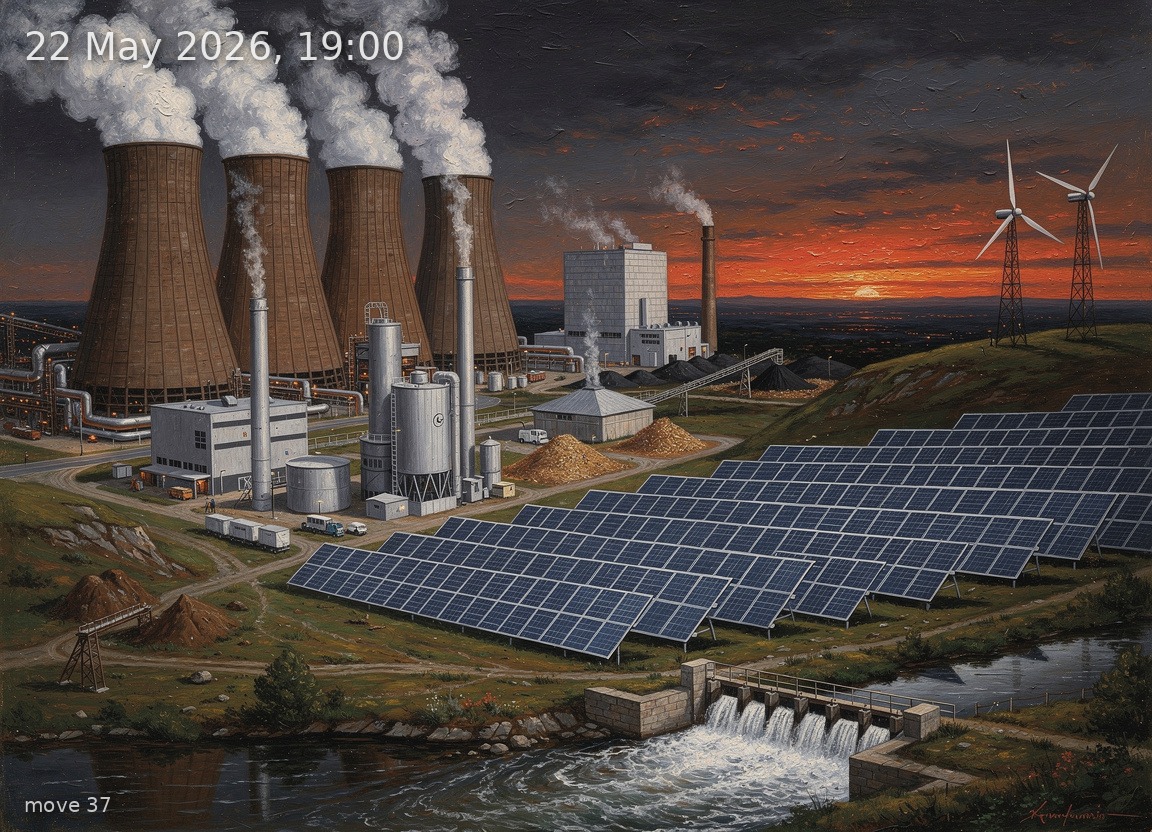
Brown coal and imports dominate as wind collapses to 1.4 GW on a warm, calm May evening.
Back
Generation mix
Wind onshore 3%
Wind offshore 1%
Solar 23%
Biomass 14%
Hydro 5%
Natural gas 13%
Hard coal 10%
Brown coal 30%
46%
Renewable share
1.4 GW
Wind (on + offshore)
7.0 GW
Solar
30.5 GW
Total generation
-24.4 GW
Net import
161.2 €/MWh
Day-ahead price
24.8°C / 6 km/h
Temp / Wind speed
Open-Meteo, Kassel (51.3°N 9.5°E)
0.0% / 241.0 W/m²
Cloud cover / Radiation
390
gCO₂/kWh
Image prompt
Brown coal 9.2 GW dominates the left third of the scene as a massive lignite power station with four hyperbolic cooling towers emitting thick white steam plumes; solar 7.0 GW occupies the centre-right foreground as extensive rows of aluminium-framed crystalline silicon photovoltaic panels catching the last orange-red light; natural gas 4.0 GW appears as two compact CCGT units with tall single exhaust stacks and thin heat shimmer, positioned centre-left; biomass 4.3 GW is rendered as a mid-ground wood-chip-fed plant with a squat cylindrical boiler building and modest smokestack; hard coal 3.2 GW sits behind the lignite station as a smaller coal plant with a single rectangular cooling tower and conveyor belt; hydro 1.4 GW appears as a small concrete run-of-river weir with churning white water in the lower right; wind onshore 1.0 GW is a sparse cluster of three nearly motionless three-blade turbines on lattice towers on a distant ridge at far right; wind offshore 0.4 GW is barely visible as two tiny turbines on the extreme horizon line. Time of day is 19:00 in late May — dusk lighting with a deep orange-red glow confined to the lower horizon, the sky above transitioning from warm amber near the horizon to a darkening steel blue overhead, long horizontal shadows across the landscape. The atmosphere feels heavy and oppressive, a faint industrial haze hanging in still air, reflecting the high electricity price. Vegetation is lush late-spring green — full-canopy deciduous trees, tall grass, wildflowers — under warm 25°C conditions. The air is dead calm, no motion in tree leaves or grass, conveying the windless conditions. Highly detailed oil painting in the tradition of 19th-century German Romantic landscape painters — rich saturated colour, visible impasto brushwork, atmospheric depth and aerial perspective — rendered with meticulous engineering accuracy for each technology: correct nacelle housings and three-blade rotors on turbines, ribbed hyperbolic concrete shells on cooling towers, glass-faced PV modules in aluminium frames. The scene evokes a masterwork industrial landscape painting. No text, no labels.