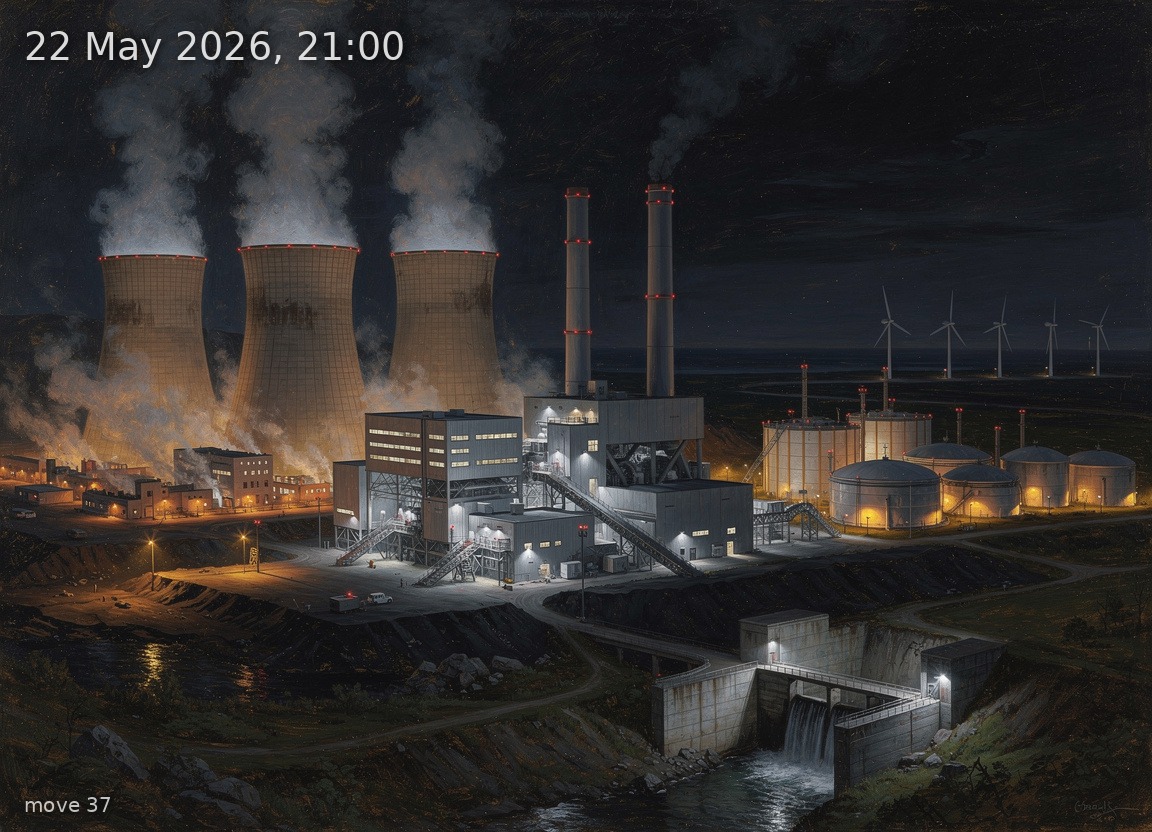
Brown coal, gas, and hard coal dominate a 27.9 GW domestic supply while ~23.4 GW of net imports fill evening demand.
Back
Generation mix
Wind onshore 7%
Wind offshore 2%
Solar 0%
Biomass 16%
Hydro 5%
Natural gas 22%
Hard coal 14%
Brown coal 34%
31%
Renewable share
2.7 GW
Wind (on + offshore)
0.0 GW
Solar
27.9 GW
Total generation
-23.4 GW
Net import
193.7 €/MWh
Day-ahead price
21.4°C / 13 km/h
Temp / Wind speed
Open-Meteo, Kassel (51.3°N 9.5°E)
0.0% / 18.0 W/m²
Cloud cover / Radiation
486
gCO₂/kWh
Image prompt
Brown coal 9.4 GW dominates the left third of the scene as a massive lignite power station with four hyperbolic cooling towers emitting thick white-grey steam plumes lit from below by orange sodium lamps; natural gas 6.1 GW occupies the centre-left as two compact CCGT units with tall single exhaust stacks venting thin heat shimmer into the darkness; hard coal 3.9 GW appears centre-right as a bulky conventional coal plant with a single large chimney and conveyor belts visible under floodlights; biomass 4.5 GW is rendered as a cluster of industrial biogas facilities with cylindrical digesters and small stacks glowing warmly behind the coal plant; wind onshore 2.1 GW and offshore 0.7 GW appear as a modest line of eight three-blade turbines on the far right horizon, blades turning slowly, their red aviation warning lights blinking; hydro 1.4 GW is suggested by a small dam and penstock visible in the lower-right foreground, water glinting under artificial light. The sky is completely dark — a deep navy-black May night with no twilight or sky glow, clear with zero cloud cover and faint stars visible overhead, but the atmosphere feels heavy and oppressive, hinting at the extreme electricity price. The warm 21°C spring night shows lush green deciduous trees and grass in the foreground, visible only where industrial floodlights and sodium streetlamps cast amber pools of light. No solar panels anywhere. The overall visual weight of each technology's footprint in the painting matches its GW share of the 27.9 GW total generation. In the deep background, faint lights of a distant city suggest the enormous 51.3 GW consumption being served. Style: highly detailed oil painting in the tradition of 19th-century German Romantic landscape painters — rich, saturated colour with visible impasto brushwork, dramatic chiaroscuro between the dark sky and the glowing industrial facilities, atmospheric depth achieved through layers of steam and haze, meticulous engineering detail on every turbine nacelle, cooling tower rib, and exhaust stack. The painting conveys the sublime tension between nature's quiet spring night and the roaring industrial effort beneath it. No text, no labels.