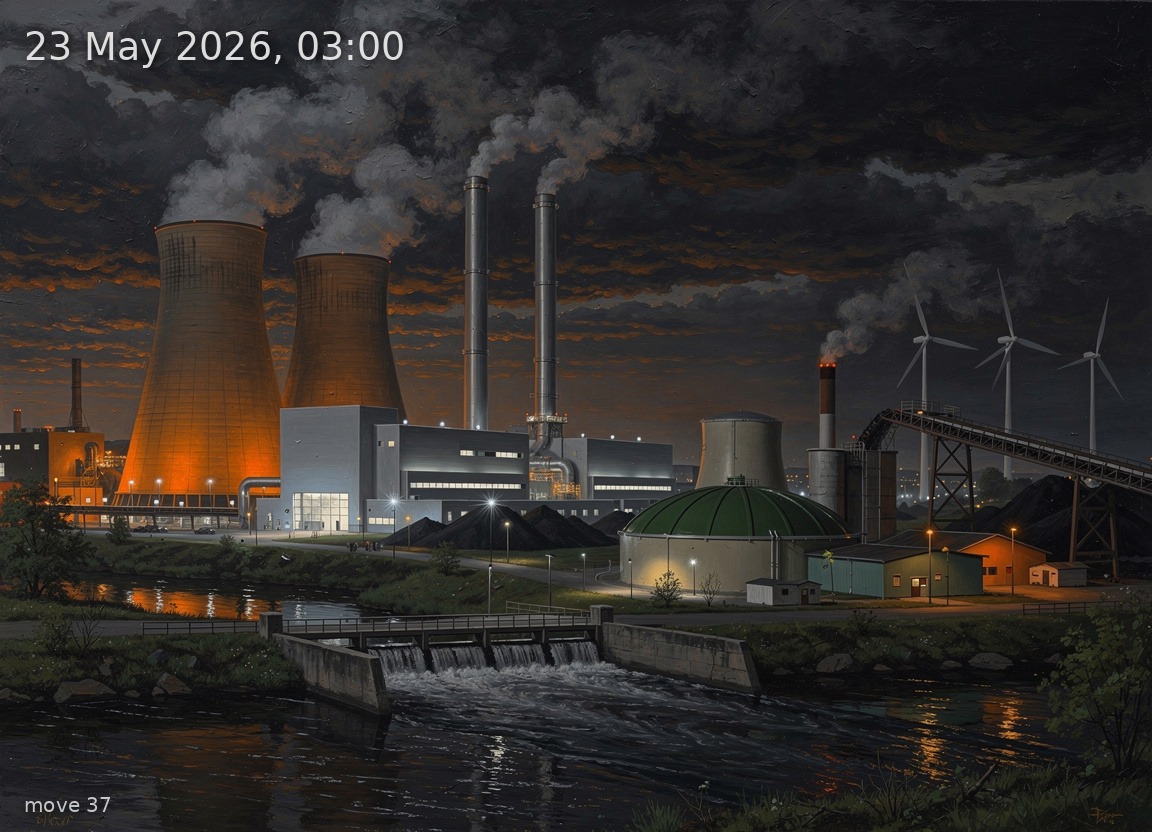
Brown coal and gas anchor nighttime baseload while moderate wind covers 26% of generation; 10 GW net imports required.
Back
Generation mix
Wind onshore 15%
Wind offshore 11%
Biomass 14%
Hydro 4%
Natural gas 17%
Hard coal 12%
Brown coal 26%
44%
Renewable share
7.6 GW
Wind (on + offshore)
0.0 GW
Solar
29.1 GW
Total generation
-10.1 GW
Net import
125.4 €/MWh
Day-ahead price
12.2°C / 8 km/h
Temp / Wind speed
Open-Meteo, Kassel (51.3°N 9.5°E)
85.0% / 0.0 W/m²
Cloud cover / Radiation
393
gCO₂/kWh
Image prompt
Brown coal 7.7 GW dominates the left third of the scene as a massive lignite power station with four hyperbolic cooling towers emitting thick white-grey steam plumes into the black night sky, lit from below by harsh sodium-orange industrial floodlights; natural gas 4.9 GW occupies the left-centre as two compact CCGT units with tall single exhaust stacks venting thin heat shimmer, illuminated by blue-white facility lighting; hard coal 3.6 GW appears centre-right as a smaller coal plant with a single squat cooling tower and a conveyor belt structure, dimly lit; wind onshore 4.5 GW fills the right-centre as a cluster of tall three-blade turbines on lattice towers on a dark ridgeline, their red aviation warning lights blinking; wind offshore 3.1 GW is suggested in the far right distance as a row of turbines standing in a barely visible dark sea, marked only by tiny red lights on the horizon; biomass 4.0 GW appears as a modest biogas facility with a rounded digester dome and a small chimney with a warm amber glow, nestled between the coal plant and the wind turbines; hydro 1.3 GW is represented by a small run-of-river station visible as a lit concrete weir structure in the lower foreground beside a dark river reflecting the industrial lights. The sky is completely black with no twilight whatsoever — it is 3 AM — heavy 85% cloud cover obscures all stars, creating an oppressive low ceiling that traps and reflects the orange and white industrial light from below, giving the clouds a sickly amber underglow suggesting the high electricity price. No solar panels anywhere, no sunshine, no moon. The landscape is a spring German lowland with fresh green vegetation barely visible in the peripheral glow of the facilities, temperature mild at 12°C with faint mist hugging the river. The wind is light at 8 km/h, turbine blades rotating slowly. The entire composition is rendered as a highly detailed oil painting in the tradition of 19th-century German Romantic landscape painters — rich impasto brushwork, deep chiaroscuro contrasts between the industrial light and surrounding darkness, atmospheric depth with receding layers of infrastructure dissolving into the murky night. Each technology is painted with meticulous engineering accuracy: three-blade rotor profiles, nacelle housings, hyperbolic concrete cooling tower geometry with visible ribbing, aluminium-clad CCGT exhaust stacks, biogas dome curvature. The mood is solemn, industrial, heavy — a masterwork nocturne of the working grid. No text, no labels.