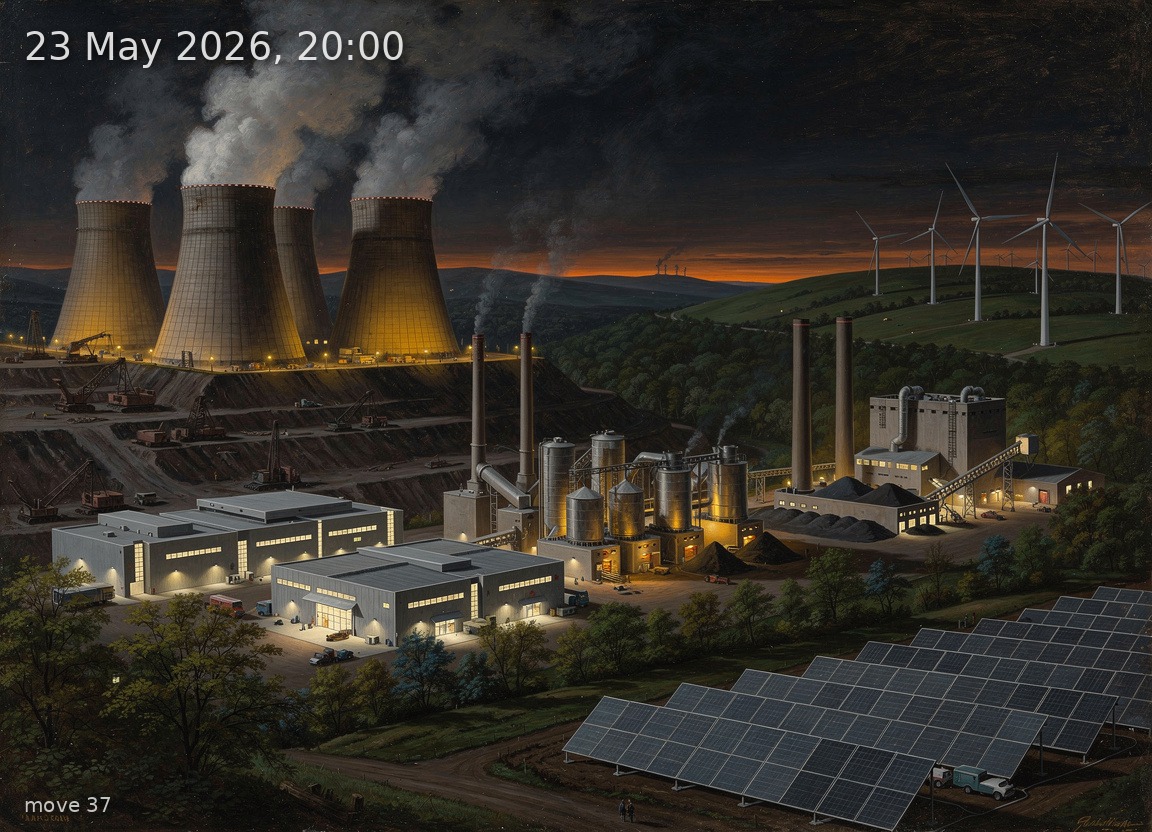
Heavy net imports of 24.6 GW and strong thermal dispatch drive prices to 174.5 EUR/MWh on a calm, warm May evening.
Back
Generation mix
Wind onshore 11%
Wind offshore 3%
Solar 7%
Biomass 20%
Hydro 6%
Natural gas 20%
Hard coal 13%
Brown coal 20%
47%
Renewable share
3.2 GW
Wind (on + offshore)
1.7 GW
Solar
22.7 GW
Total generation
-24.6 GW
Net import
174.5 €/MWh
Day-ahead price
26.3°C / 9 km/h
Temp / Wind speed
Open-Meteo, Kassel (51.3°N 9.5°E)
0.0% / 107.0 W/m²
Cloud cover / Radiation
358
gCO₂/kWh
Image prompt
Brown coal 4.6 GW dominates the left quarter as three massive hyperbolic cooling towers rising from an open-pit lignite mine, thick white steam plumes drifting upward into the dark sky; natural gas 4.4 GW appears just left of centre as two sleek CCGT power blocks with tall single exhaust stacks emitting thin heat shimmer; biomass 4.4 GW occupies the centre as a cluster of industrial biomass plants with cylindrical wood-pellet silos and modest chimneys glowing with amber furnace light; hard coal 3.0 GW sits right of centre as a traditional coal-fired station with twin rectangular stacks and conveyor belts visible under sodium floodlights; wind onshore 2.5 GW appears in the right background as a scattered line of three-blade turbines on gentle green hills, rotors barely turning in the light breeze; solar 1.7 GW is rendered as a modest field of aluminium-framed crystalline silicon panels in the right foreground, catching the last faint warm glow near the horizon; wind offshore 0.6 GW is a distant pair of turbines on a far-off sea horizon at the extreme right; hydro 1.4 GW appears as a small concrete dam with spillway in the middle distance. Time is 20:00 in late May in central Germany — the sky is deep navy-black overhead with only a narrow burnt-orange afterglow along the very lowest horizon line; all facilities are illuminated by harsh sodium-yellow industrial floodlights and glowing windows. The atmosphere is heavy, oppressive, and warm at 26°C — lush green deciduous trees in full late-spring foliage line the middle ground, leaves hanging motionless in still air. High-voltage transmission pylons stretch across the scene carrying thick bundled conductors, symbolising massive power flows. Painted in the style of a highly detailed 19th-century German Romantic oil painting — rich, dark palette with visible impasto brushwork, dramatic chiaroscuro between artificial light and deep shadow, atmospheric depth receding into hazy warm darkness, technically precise engineering details on every structure including turbine nacelles, lattice towers, cooling tower ribbing, and panel racking. No text, no labels.