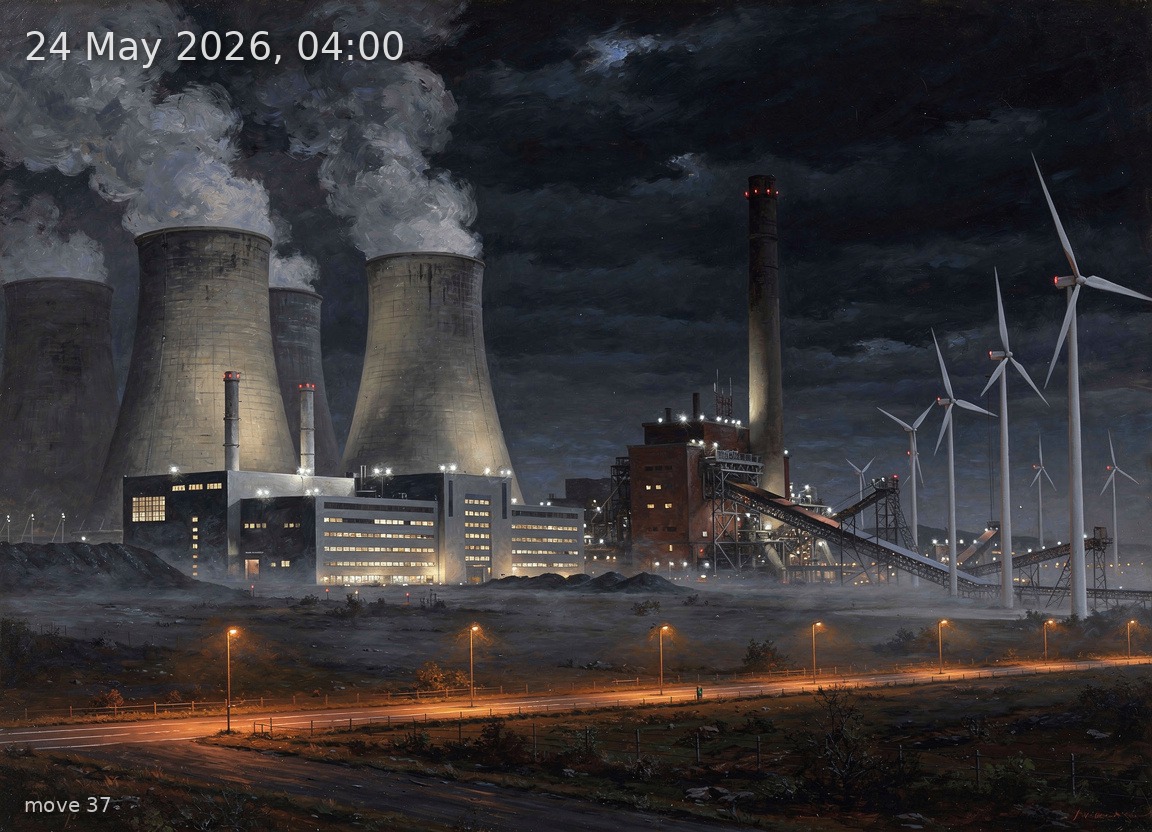
Coal, gas, and wind share overnight generation while 13 GW of net imports fill a significant supply gap.
Back
Generation mix
Wind onshore 20%
Wind offshore 3%
Solar 0%
Biomass 18%
Hydro 6%
Natural gas 20%
Hard coal 14%
Brown coal 19%
47%
Renewable share
5.0 GW
Wind (on + offshore)
0.0 GW
Solar
22.4 GW
Total generation
-13.0 GW
Net import
122.9 €/MWh
Day-ahead price
12.6°C / 6 km/h
Temp / Wind speed
Open-Meteo, Kassel (51.3°N 9.5°E)
79.0% / 0.0 W/m²
Cloud cover / Radiation
360
gCO₂/kWh
Image prompt
Brown coal 4.3 GW dominates the left quarter of the scene as a massive lignite power station with three hyperbolic cooling towers emitting thick white-grey steam plumes into the night sky; natural gas 4.5 GW occupies the centre-left as two compact CCGT units with tall single exhaust stacks venting pale heat shimmer, their aluminium cladding reflecting sodium-orange light; hard coal 3.0 GW appears centre-right as a dark brick-and-steel conventional plant with a single large smokestack and conveyor infrastructure; onshore wind 4.5 GW spans the right third as a line of eight modern three-blade turbines on lattice-free tubular towers, their rotors turning slowly in light breeze, red aviation warning lights blinking on nacelles; biomass 4.0 GW sits in the mid-ground as a wood-chip-fed CHP facility with a modest chimney and steaming vents beside stacked timber; hydro 1.4 GW appears as a small concrete run-of-river dam with spillway foam barely visible in the far distance; offshore wind 0.6 GW is suggested by faint blinking red dots on the far horizon line. The sky is completely dark, deep navy-black, 79% cloud cover rendering it a thick overcast ceiling with no stars and no moon visible, no twilight glow whatsoever—it is 4 AM. All illumination comes from artificial sources: sodium streetlights casting orange pools along access roads, harsh white floodlights on plant structures, and the soft amber glow of control-room windows. The atmosphere feels heavy and oppressive, reflecting the high electricity price—low haze clings to the ground, diffusing the industrial light into a murky amber fog. Spring vegetation is present but invisible in the darkness except where lit: fresh green grass near the dam, young leaves on roadside trees. The landscape is flat northern German lowland. Rendered as a highly detailed oil painting in the tradition of 19th-century German Romantic landscape art—rich, dark palette of deep blues, warm ambers, and smoky greys, visible impasto brushwork in the steam plumes, meticulous engineering detail on every turbine nacelle, cooling tower, and exhaust stack, atmospheric depth created by layered hazes receding into blackness. No text, no labels.