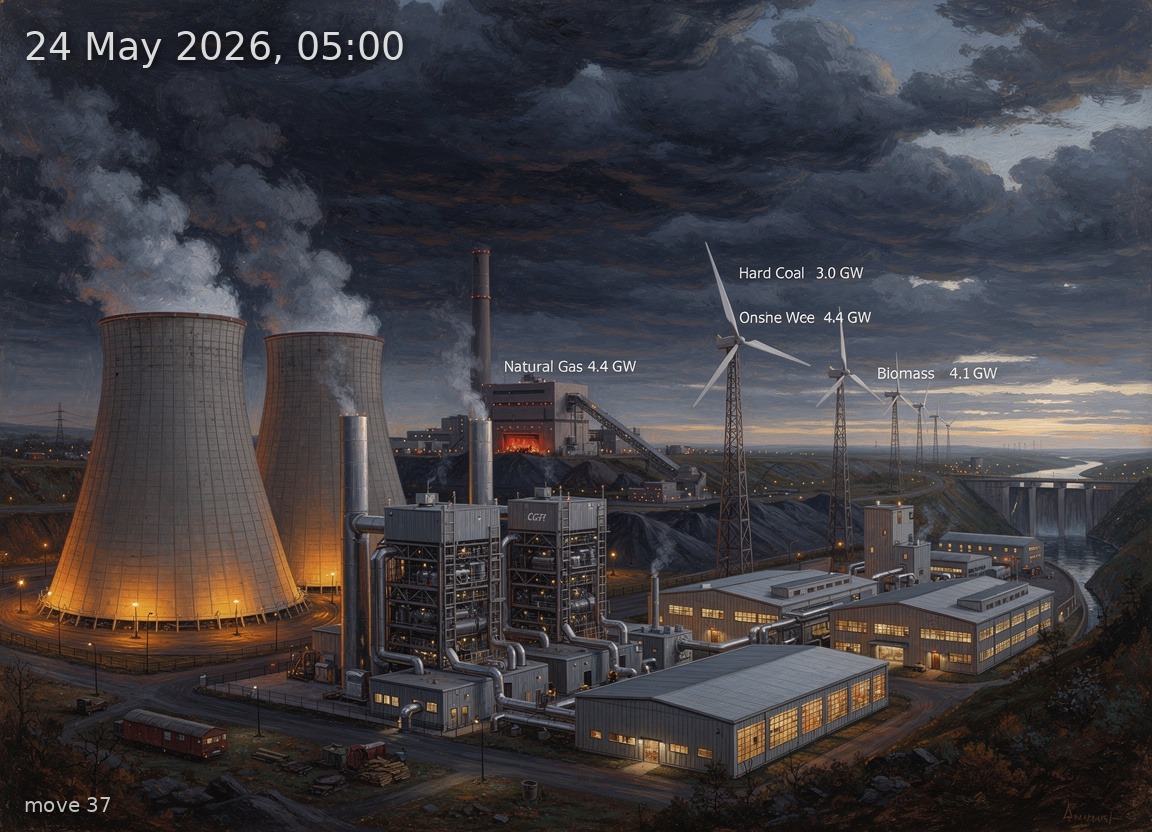
Pre-dawn coal, gas, and moderate wind supply half of demand; 13 GW net imports fill the gap under full overcast.
Back
Generation mix
Wind onshore 20%
Wind offshore 2%
Solar 2%
Biomass 18%
Hydro 6%
Natural gas 19%
Hard coal 13%
Brown coal 19%
48%
Renewable share
4.9 GW
Wind (on + offshore)
0.4 GW
Solar
22.6 GW
Total generation
-13.0 GW
Net import
117.7 €/MWh
Day-ahead price
12.2°C / 6 km/h
Temp / Wind speed
Open-Meteo, Kassel (51.3°N 9.5°E)
100.0% / 0.0 W/m²
Cloud cover / Radiation
355
gCO₂/kWh
Image prompt
Brown coal 4.4 GW occupies the left quarter as three massive hyperbolic cooling towers with thick white-grey steam plumes rising into darkness; natural gas 4.4 GW sits centre-left as a pair of compact CCGT power blocks with tall single exhaust stacks emitting thin heat shimmer; hard coal 3.0 GW appears behind them as a blocky coal-fired station with a single large chimney and conveyor belts; onshore wind 4.4 GW spans the centre-right as a row of tall three-blade turbines on lattice towers turning slowly in light breeze; biomass 4.1 GW is rendered as a cluster of industrial wood-chip gasification plants with low rectangular buildings, small stacks, and warm amber light in their windows; hydro 1.4 GW appears as a concrete dam structure in the far right middle distance with water gleaming faintly; offshore wind 0.5 GW is barely visible on the far horizon as two small turbine silhouettes. The sky is deep blue-grey pre-dawn at 05:00 — no direct sunlight, no sunrise glow yet, just the faintest pale luminance along the eastern horizon hinting at the coming day. Full 100% cloud cover forms a heavy, oppressive low ceiling reflecting the amber sodium lights of the industrial facilities below. The atmosphere feels dense and pressured, conveying the high electricity price. Spring vegetation — fresh green grass and leafy trees — is barely visible in the dim light, consistent with 12°C in late May. Ground-level mist threads between the power plants. All illumination comes from artificial sources: orange sodium lamps along access roads, white LED floodlights on turbine nacelles, glowing control-room windows, and the dull red glow of furnace interiors glimpsed through openings. Transmission pylons with high-voltage lines recede into the murky distance toward unseen borders, suggesting the massive import flows. Highly detailed oil painting in the tradition of 19th-century German Romantic landscape painters — Caspar David Friedrich's atmospheric depth merged with industrial sublimity — rich dark colour palette of navy, slate grey, amber, and burnt sienna, visible impasto brushwork, meticulous engineering detail on every turbine nacelle, cooling tower ribbing, and smokestack profile. No text, no labels.