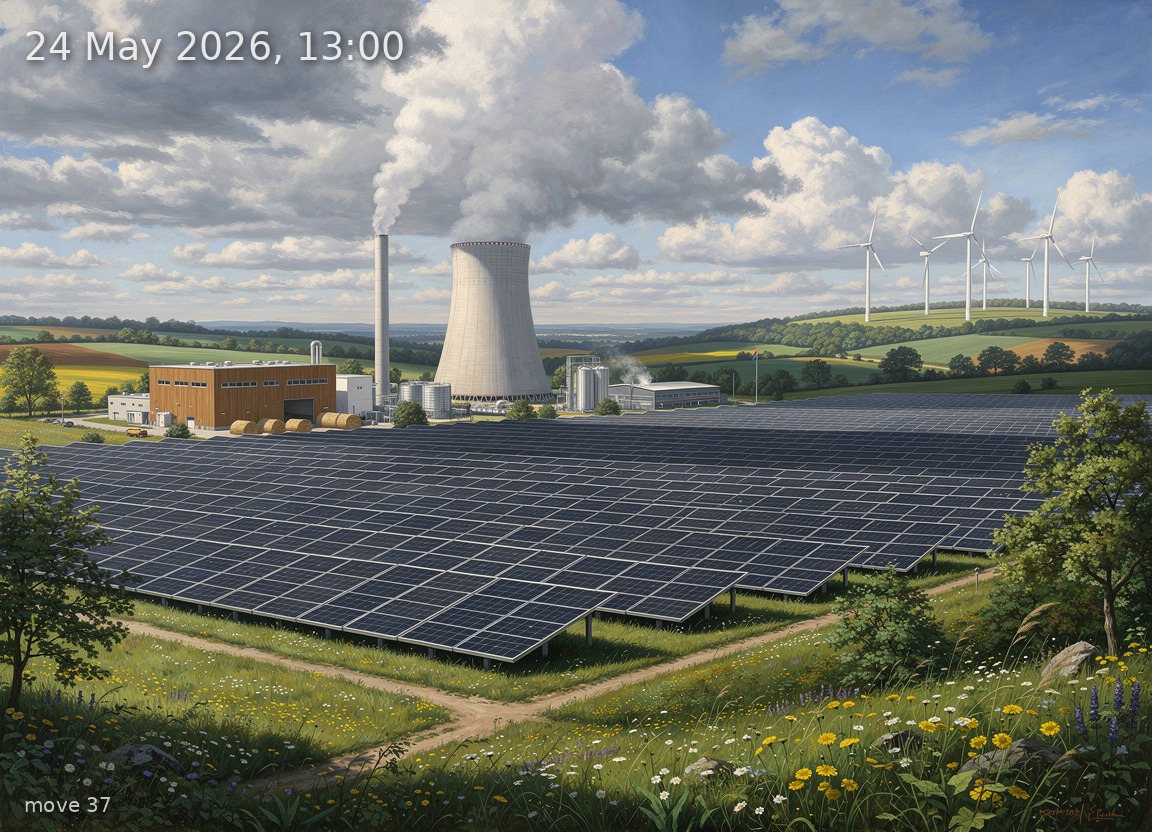
Solar at 47.5 GW overwhelms 44.4 GW demand, driving 15.2 GW net exports and deeply negative prices.
Back
Generation mix
Wind onshore 5%
Wind offshore 1%
Solar 80%
Biomass 7%
Hydro 2%
Natural gas 2%
Hard coal 0%
Brown coal 3%
94%
Renewable share
3.7 GW
Wind (on + offshore)
47.5 GW
Solar
59.6 GW
Total generation
+15.2 GW
Net export
-75.9 €/MWh
Day-ahead price
25.7°C / 12 km/h
Temp / Wind speed
Open-Meteo, Kassel (51.3°N 9.5°E)
76.0% / 542.0 W/m²
Cloud cover / Radiation
38
gCO₂/kWh
Records
#3
Clean Hour
Image prompt
Solar 47.5 GW dominates the scene as a vast expanse of crystalline silicon photovoltaic panels stretching across rolling farmland covering nearly the entire foreground and middle ground, their aluminium frames glinting under broken afternoon sunlight filtering through scattered cumulus clouds. Wind onshore 3.2 GW appears as a modest cluster of three-blade turbines with white lattice towers on a distant ridge at the right, rotors turning lazily in light breeze. Biomass 3.9 GW is rendered as a compact wood-clad power station with a low smokestack and woodchip storage silos at the far left edge. Brown coal 1.6 GW appears as a single hyperbolic cooling tower with a thin steam plume rising behind the biomass plant. Natural gas 1.5 GW sits as a small CCGT unit with a slender exhaust stack beside it. Hydro 1.1 GW is suggested by a distant reservoir dam nestled in a green valley at the far horizon. Wind offshore 0.4 GW is omitted from the foreground but hinted at by tiny turbine silhouettes on a hazy sea glimpsed through a gap in distant hills. The time is 1:00 PM in late May: full bright daylight, the sun high but partially veiled by broken grey-white clouds at 76% cover, patches of vivid blue sky breaking through, strong direct sunlight casting defined shadows across the solar field. The landscape is lush late-spring green — tall grass, blooming wildflowers, leafy deciduous trees. Temperature is warm, 26°C, a slight heat shimmer rising from dark panel surfaces. The sky is open and calm, reflecting the deeply negative electricity price — no oppressive atmosphere, instead an almost excessive serenity, too much abundance. Highly detailed oil painting in the tradition of 19th-century German Romantic landscape painters such as Caspar David Friedrich and Carl Blechen — rich saturated colour, visible confident brushwork, atmospheric depth with layered aerial perspective, dramatic cloud study. Each energy technology rendered with meticulous engineering accuracy: three-blade rotor profiles, aluminium PV module frames, hyperbolic cooling tower geometry, CCGT exhaust stacks. The scene feels like a masterwork painting of the modern German industrial-pastoral landscape. No text, no labels.