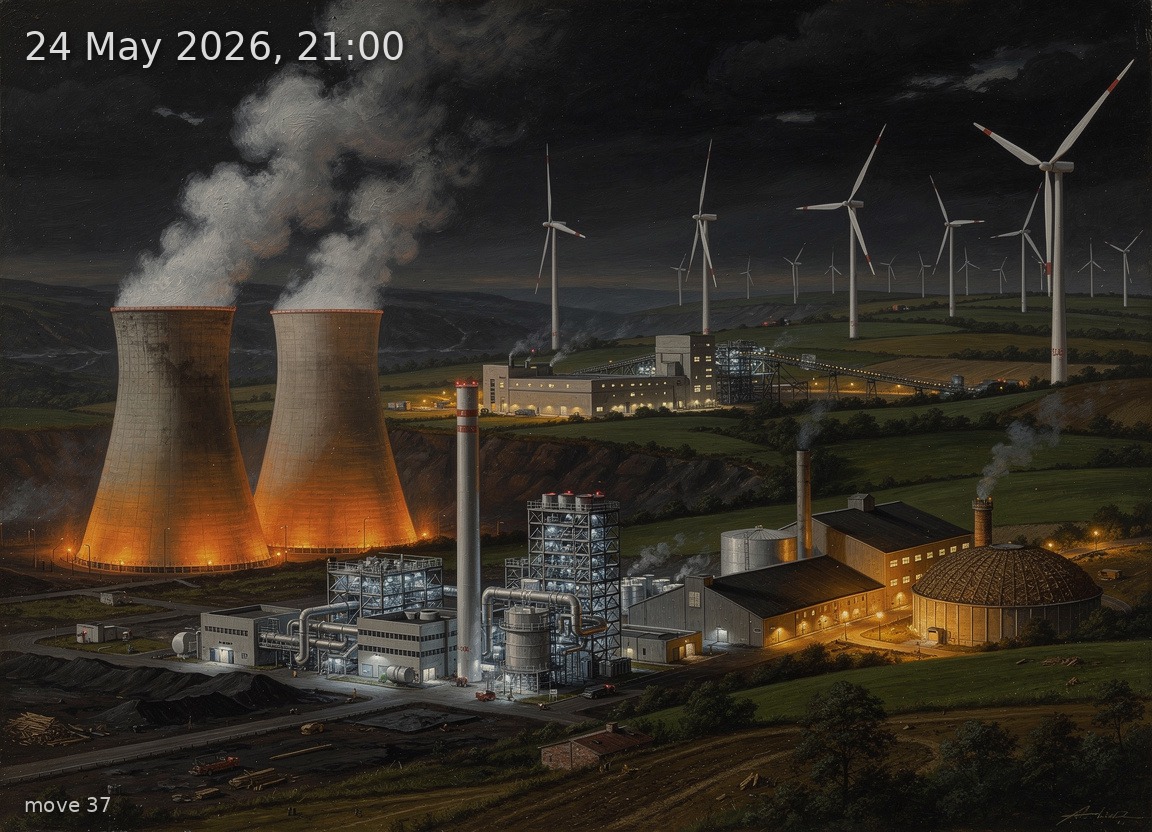
Wind, brown coal, gas, and biomass lead domestic generation as heavy imports fill a 19.4 GW evening gap.
Back
Generation mix
Wind onshore 29%
Wind offshore 2%
Solar 0%
Biomass 18%
Hydro 6%
Natural gas 18%
Hard coal 10%
Brown coal 17%
55%
Renewable share
7.6 GW
Wind (on + offshore)
0.1 GW
Solar
25.1 GW
Total generation
-19.4 GW
Net import
153.2 €/MWh
Day-ahead price
21.4°C / 13 km/h
Temp / Wind speed
Open-Meteo, Kassel (51.3°N 9.5°E)
82.0% / 3.0 W/m²
Cloud cover / Radiation
307
gCO₂/kWh
Image prompt
Wind onshore 7.2 GW dominates the right third of the scene as a procession of tall three-blade wind turbines with white tubular towers and nacelles, rotors turning slowly in moderate wind across rolling green farmland; brown coal 4.4 GW occupies the left foreground as a massive lignite power station with two hyperbolic concrete cooling towers emitting thick white steam plumes, illuminated from below by sodium-orange floodlights; natural gas 4.4 GW sits center-left as a compact CCGT facility with a tall slender exhaust stack and a smaller heat-recovery steam generator, blue-white industrial lighting on its steel structures; biomass 4.5 GW appears center-right as a cluster of mid-sized industrial buildings with a wood-chip storage dome and a single smokestack releasing pale vapor, warmly lit; hard coal 2.6 GW is visible behind the lignite plant as a smaller station with a rectangular boiler house and conveyor belt infrastructure, lit by amber spotlights; hydro 1.5 GW is suggested in the far middle distance as a concrete dam across a river gorge with spillway lights reflecting on dark water; offshore wind 0.4 GW is a faint silhouette of two turbines on the far horizon. The sky is completely dark—deep navy-black, no twilight, no sky glow—it is fully nighttime at 21:00 in late May under 82% cloud cover, so stars are almost entirely hidden behind invisible clouds. The atmosphere feels heavy and oppressive, reflecting the high electricity price. Late spring vegetation: lush green grass, leafy deciduous trees in full canopy, barely visible in the darkness except where industrial light spills. Warm 21°C air suggested by slight haze around the cooling towers. No solar panels visible anywhere. Painted in the style of a highly detailed 19th-century German Romantic oil painting—rich impasto brushwork, deep chiaroscuro contrasts between industrial light and surrounding darkness, atmospheric depth with layered fog and steam, meticulous engineering accuracy on every turbine nacelle, cooling tower curve, and exhaust stack. No text, no labels.