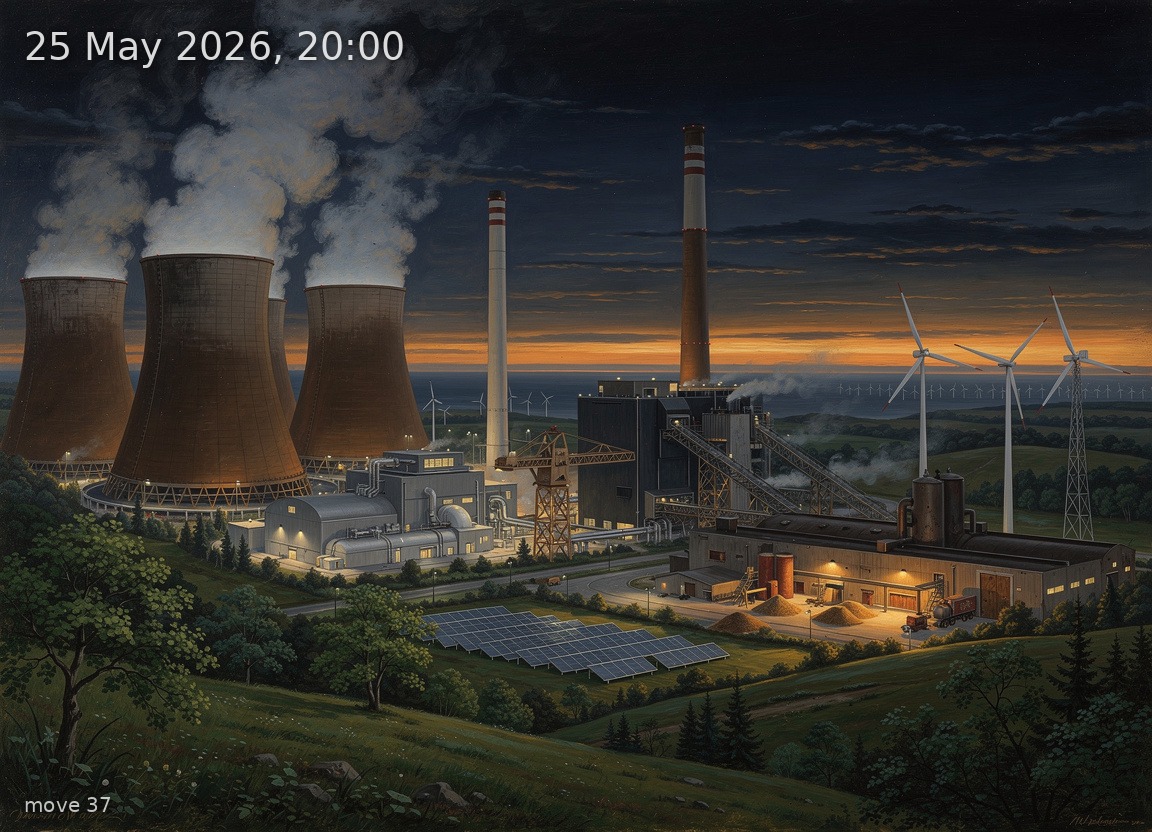
Brown coal, gas, and hard coal dominate evening generation as solar fades and large net imports fill a 20.6 GW gap.
Back
Generation mix
Wind onshore 15%
Wind offshore 5%
Solar 8%
Biomass 17%
Hydro 6%
Natural gas 16%
Hard coal 11%
Brown coal 22%
51%
Renewable share
5.0 GW
Wind (on + offshore)
2.0 GW
Solar
25.0 GW
Total generation
-20.6 GW
Net import
172.2 €/MWh
Day-ahead price
25.6°C / 10 km/h
Temp / Wind speed
Open-Meteo, Kassel (51.3°N 9.5°E)
17.0% / 112.0 W/m²
Cloud cover / Radiation
344
gCO₂/kWh
Image prompt
Brown coal 5.5 GW dominates the left quarter of the scene as a cluster of massive hyperbolic cooling towers emitting thick white steam plumes into a darkening sky; natural gas 4.1 GW occupies the centre-left as compact CCGT units with tall single exhaust stacks releasing thin heat shimmer; hard coal 2.8 GW appears centre-right as a blocky industrial power station with conveyor belts and a single large chimney; biomass 4.2 GW is rendered as a sprawling wood-chip-fed plant with squat stacks and warm amber glow from furnace openings; wind onshore 3.7 GW spans the right portion as a line of three-blade turbines on lattice towers turning slowly in light breeze; wind offshore 1.2 GW is suggested on the far-right horizon as tiny turbines on a dark sea; solar 2.0 GW appears as a modest field of aluminium-framed crystalline silicon panels in the mid-ground reflecting the last traces of fading light; hydro 1.5 GW is depicted as a small dam and powerhouse nestled in a valley in the far background. Time is 20:00 in late May — the sky is deep navy-blue fading to near-black overhead, with only a thin residual amber-orange band along the lowest horizon line rapidly disappearing; no direct sunlight remains. Warm 25.6°C evening: lush green deciduous trees in full leaf, meadow grasses, late-spring foliage. Cloud cover is minimal at 17%, so a few scattered clouds catch the faintest dying glow. The atmosphere feels heavy and oppressive, conveying the high electricity price — a thick industrial haze hangs over the thermal plants, sodium streetlights cast pools of orange along access roads, lit windows glow in distant buildings. Highly detailed oil painting in the tradition of 19th-century German Romantic landscape painters — rich, saturated colour palette of deep blues, warm oranges, and industrial greys, visible confident brushwork, dramatic atmospheric depth and chiaroscuro. Each technology rendered with meticulous engineering accuracy: turbine nacelles and three-blade rotors, cooling tower parabolic profiles, conveyor infrastructure, PV panel grid lines. The scene feels like a masterwork industrial landscape painting. No text, no labels.