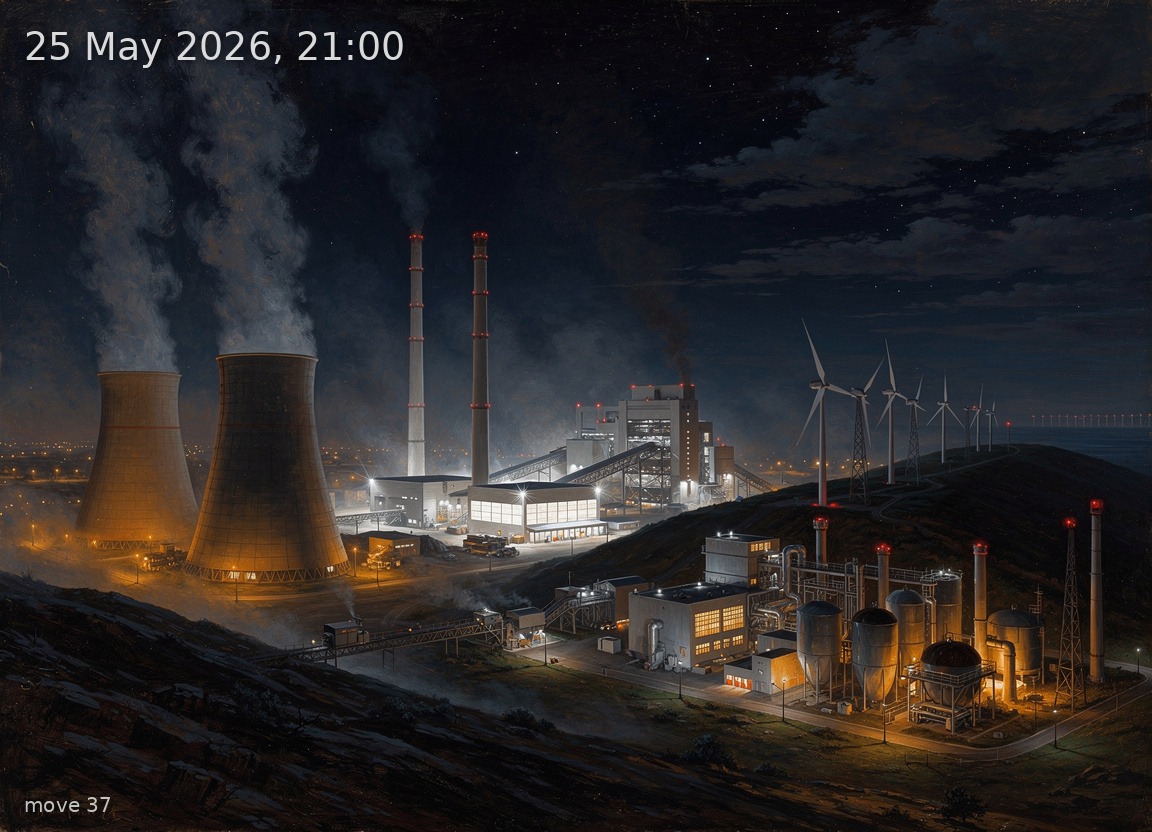
Brown coal, gas, and hard coal anchor a generation shortfall of 20.2 GW covered by net imports at nightfall.
Back
Generation mix
Wind onshore 18%
Wind offshore 5%
Solar 0%
Biomass 17%
Hydro 6%
Natural gas 18%
Hard coal 13%
Brown coal 22%
47%
Renewable share
5.9 GW
Wind (on + offshore)
0.1 GW
Solar
25.2 GW
Total generation
-20.2 GW
Net import
170.2 €/MWh
Day-ahead price
22.7°C / 11 km/h
Temp / Wind speed
Open-Meteo, Kassel (51.3°N 9.5°E)
14.0% / 19.0 W/m²
Cloud cover / Radiation
368
gCO₂/kWh
Image prompt
Brown coal 5.6 GW dominates the left quarter as three massive hyperbolic cooling towers with thick white steam plumes rising into the dark sky, their bases lit by amber sodium lights; natural gas 4.7 GW occupies the centre-left as two compact CCGT power blocks with tall single exhaust stacks emitting thin heat shimmer, illuminated by industrial floodlights; hard coal 3.2 GW sits centre-right as a blocky coal-fired station with a single large smokestack and visible coal conveyors under security lighting; biomass 4.2 GW appears as a cluster of medium-sized industrial facilities with cylindrical digesters and short stacks, warmly lit from within, placed in the right-centre; wind onshore 4.6 GW spans the right third as a line of seven three-blade turbines on lattice and tubular towers along a gentle ridge, their red aviation warning lights blinking; wind offshore 1.3 GW is suggested in the far-right background as a faint row of smaller turbine silhouettes on the distant horizon; hydro 1.5 GW appears as a concrete dam structure nestled in the far left background with illuminated spillway. The scene is set at full nighttime — the sky is deep black-navy with scattered stars visible through 14% cloud cover, absolutely no twilight or sky glow on the horizon. The atmosphere is heavy and oppressive despite the clear sky, conveying the tension of a 170 EUR/MWh price — a faint industrial haze hangs low, diffusing the sodium and mercury-vapor lights into halos. Late-May vegetation is lush and green but visible only where artificial light spills onto foreground meadows and trees; the warm 22.7°C night gives a sense of humid stillness. A gentle breeze of 11 km/h barely stirs the grass. Overhead transmission lines on steel lattice pylons cross the scene diagonally, symbolizing the massive import flows. Highly detailed oil painting in the tradition of 19th-century German Romantic landscape painters — rich deep colour palette of indigo, amber, and charcoal, visible impasto brushwork, atmospheric depth with sfumato smoke and steam effects — but with meticulous engineering accuracy on every turbine nacelle, cooling tower curvature, and CCGT exhaust detail. No text, no labels.