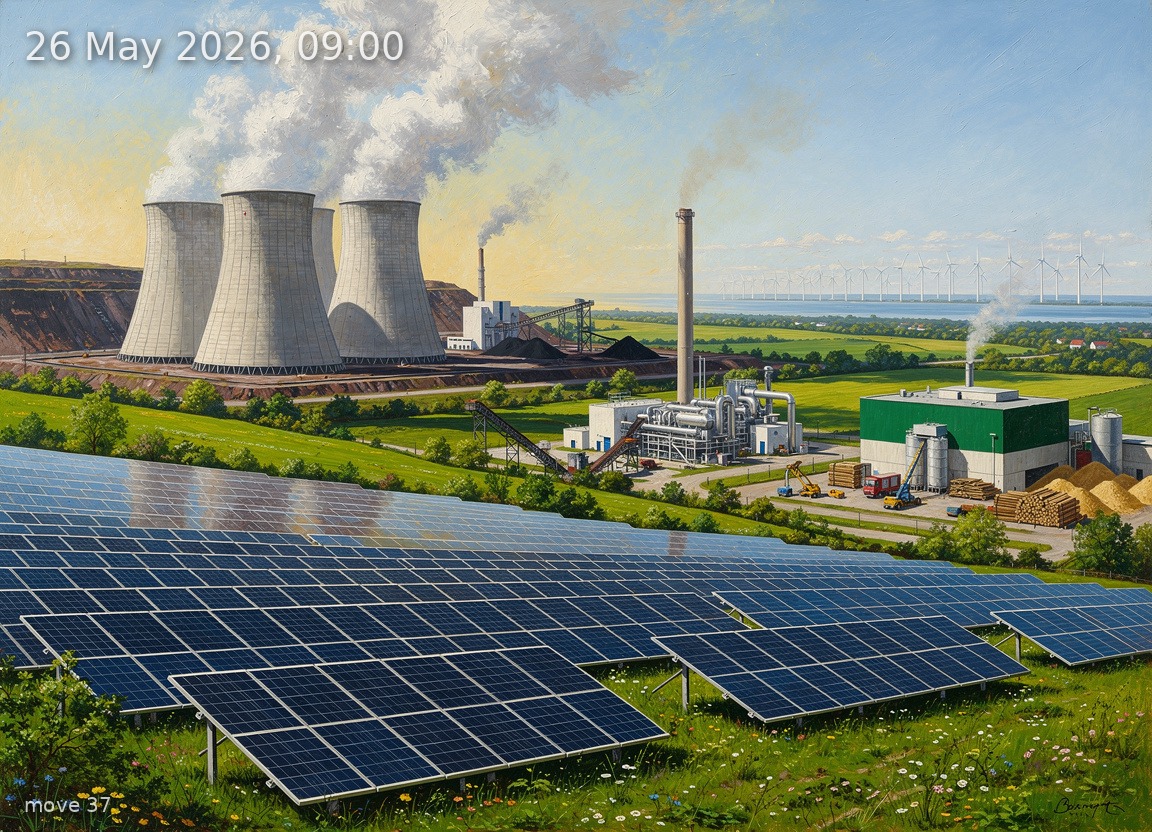
Solar at 37.1 GW leads an 82% renewable mix, with coal and gas covering residual load under calm winds.
Back
Generation mix
Wind onshore 3%
Wind offshore 5%
Solar 65%
Biomass 7%
Hydro 3%
Natural gas 5%
Hard coal 4%
Brown coal 9%
82%
Renewable share
4.5 GW
Wind (on + offshore)
37.1 GW
Solar
57.3 GW
Total generation
-3.1 GW
Net import
78.8 €/MWh
Day-ahead price
17.2°C / 2 km/h
Temp / Wind speed
Open-Meteo, Kassel (51.3°N 9.5°E)
16.0% / 249.0 W/m²
Cloud cover / Radiation
125
gCO₂/kWh
Image prompt
Solar 37.1 GW dominates the scene as a vast expanse of crystalline silicon photovoltaic panels stretching across gently rolling fields covering roughly two-thirds of the composition, their aluminium frames glinting under bright late-morning sunshine. Brown coal 4.9 GW appears at the left as a cluster of massive hyperbolic cooling towers with heavy white-grey steam plumes rising into the sky. Wind offshore 2.8 GW is suggested by a thin row of tall three-blade turbines visible on the far horizon behind a faint coastal haze. Hard coal 2.4 GW sits as a smaller coal plant with a single stack and conveyor belts beside the lignite complex. Natural gas 2.8 GW occupies a compact area as a modern CCGT facility with a clean exhaust stack and modest heat shimmer. Wind onshore 1.7 GW appears as a small group of three-blade turbines on a distant ridge, their rotors nearly still. Biomass 4.1 GW is rendered as a medium-sized wood-chip-fed power station with a modest steam plume and stacked timber nearby. Hydro 1.6 GW appears as a small run-of-river weir with a turbine house at the edge of a gentle stream. The sky is mostly clear with only thin wisps of high cirrus clouds covering about 16% of the blue expanse; the sun is positioned at a mid-morning angle from the east-southeast, casting warm but not harsh light. The air feels slightly heavy and oppressive despite the sunshine, hinting at the moderately high electricity price — a faint yellowish industrial haze lingers near the coal plants. Late-May vegetation is lush and fully leafed out, bright green meadows and hedgerows bordering the solar fields, wildflowers dotting the margins, temperature around 17°C suggesting a fresh spring morning. Style: highly detailed oil painting in the tradition of 19th-century German Romantic landscape painters such as Caspar David Friedrich and Carl Blechen — rich saturated colour, visible impasto brushwork, atmospheric aerial perspective giving depth from the foreground solar arrays to the distant industrial horizon. Every technology rendered with meticulous engineering accuracy: turbine nacelles, lattice towers, PV module grid patterns, cooling tower parabolic curvature, conveyor structures. The composition feels monumental and contemplative, a masterwork painting of the modern German industrial-pastoral landscape. No text, no labels.