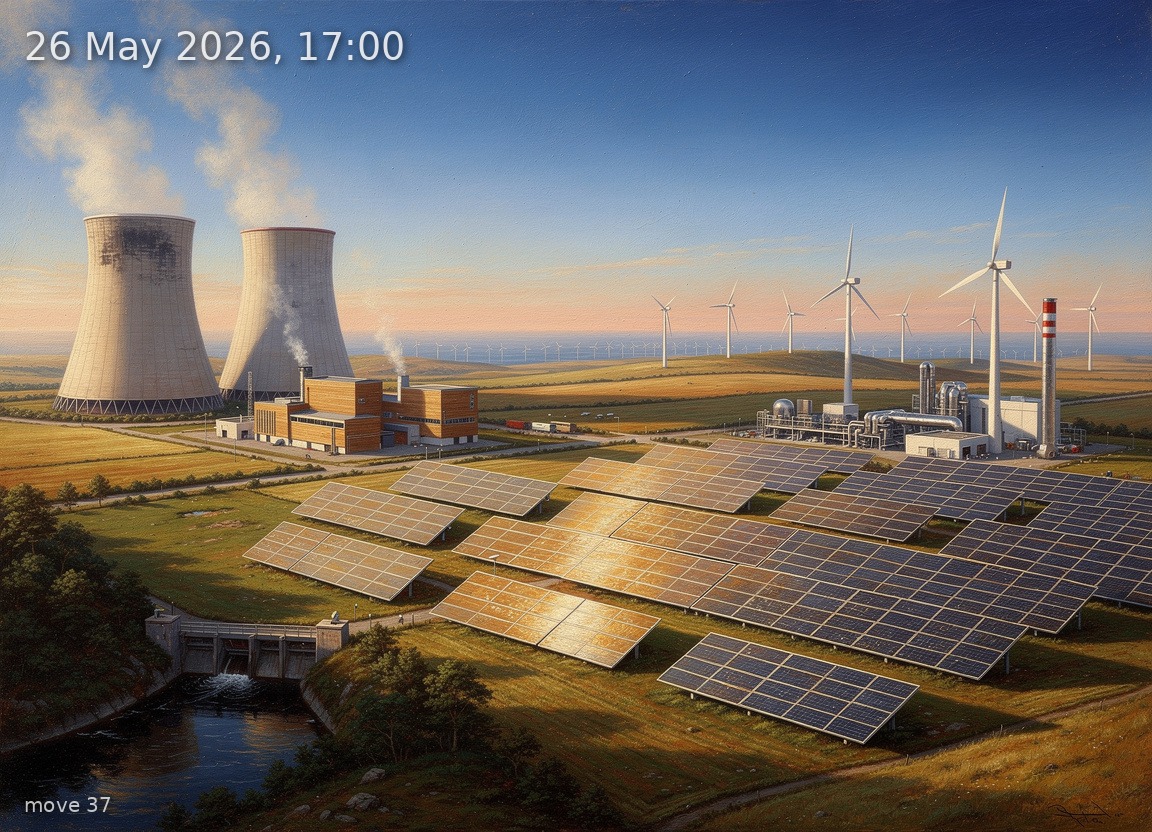
Solar leads at 29.7 GW under clear 30°C skies, but 8 GW net imports fill the evening demand gap.
Back
Generation mix
Wind onshore 15%
Wind offshore 4%
Solar 60%
Biomass 7%
Hydro 3%
Natural gas 5%
Hard coal 1%
Brown coal 5%
89%
Renewable share
9.4 GW
Wind (on + offshore)
29.7 GW
Solar
49.8 GW
Total generation
-8.0 GW
Net import
89.7 €/MWh
Day-ahead price
30.5°C / 3 km/h
Temp / Wind speed
Open-Meteo, Kassel (51.3°N 9.5°E)
0.0% / 522.0 W/m²
Cloud cover / Radiation
73
gCO₂/kWh
Records
#2
Furnace Hour
Image prompt
Solar 29.7 GW dominates the centre and right as vast fields of aluminium-framed crystalline silicon photovoltaic panels stretching across sun-baked farmland, reflecting intense golden light; wind onshore 7.6 GW appears as scattered clusters of three-blade turbines on gentle ridgelines in the mid-distance, their rotors barely turning in near-still air; wind offshore 1.8 GW is a faint row of turbines on a hazy horizon line suggesting the North Sea; biomass 3.7 GW sits as a cluster of compact wood-clad power plants with modest stacks and wispy white exhaust at left-centre; brown coal 2.6 GW occupies the far left as two hyperbolic concrete cooling towers with lazy steam plumes rising into the sky; natural gas 2.4 GW appears nearby as a sleek CCGT facility with a single polished exhaust stack and thin heat shimmer; hydro 1.6 GW is suggested by a small concrete dam and spillway nestled in a wooded valley at the far left edge; hard coal 0.5 GW is a single smaller stack partially obscured behind the brown coal towers. Time is 17:00 Berlin late May—the sun hangs roughly 25 degrees above the western horizon, casting long amber-orange shadows across the landscape; the sky is perfectly cloudless, deep blue overhead fading to a warm apricot-gold band near the horizon. The atmosphere feels heavy and oppressive, a heat haze shimmering above the solar panels and parched green-to-golden vegetation suggesting 30°C temperatures. Lush but slightly wilted late-spring foliage—lindens, oaks, rapeseed fields past bloom. Style: highly detailed oil painting in the tradition of Caspar David Friedrich and Carl Blechen—rich impasto brushwork, luminous atmospheric depth, Romantic grandeur—but with meticulous engineering accuracy on every turbine nacelle, every PV cell grid line, every cooling tower's parabolic curve. No text, no labels.