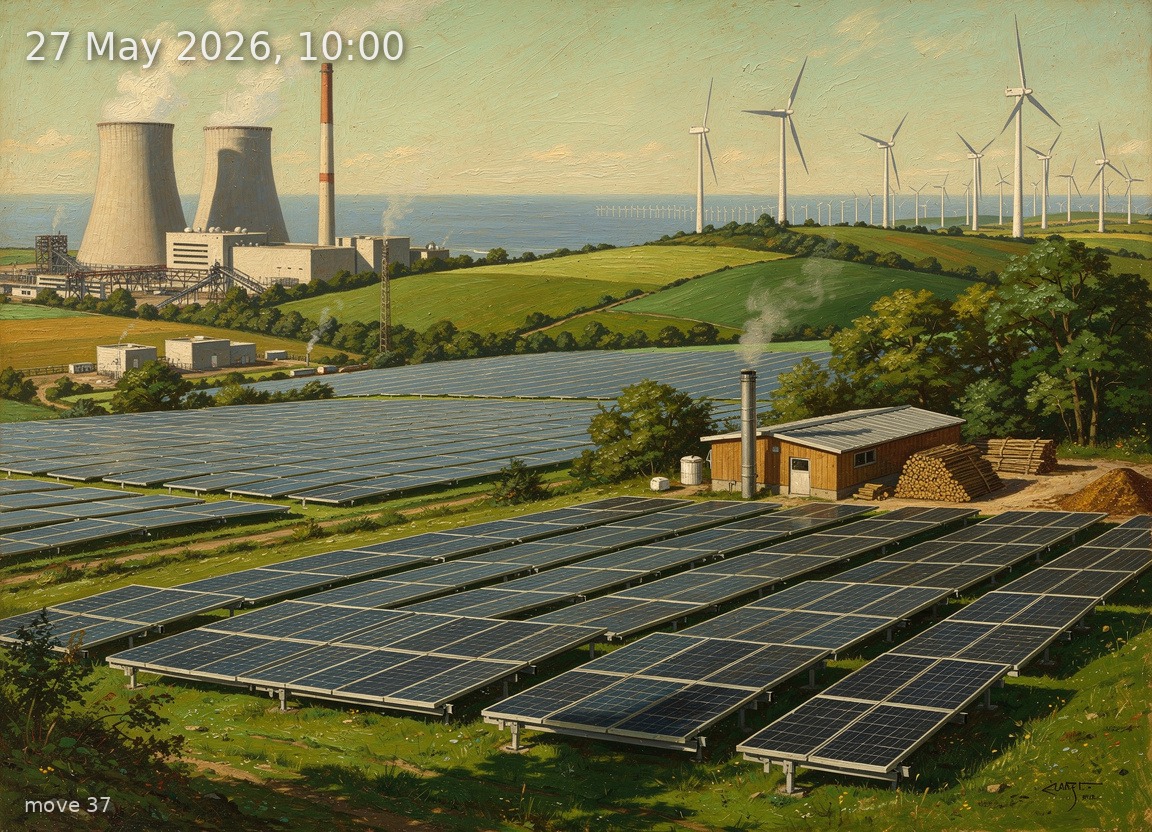
Solar at 45 GW drives 91% renewable share, yielding 4.5 GW net export and near-zero prices.
Back
Generation mix
Wind onshore 10%
Wind offshore 4%
Solar 68%
Biomass 6%
Hydro 3%
Natural gas 3%
Hard coal 1%
Brown coal 5%
91%
Renewable share
9.6 GW
Wind (on + offshore)
45.0 GW
Solar
66.2 GW
Total generation
+4.5 GW
Net export
3.4 €/MWh
Day-ahead price
19.2°C / 14 km/h
Temp / Wind speed
Open-Meteo, Kassel (51.3°N 9.5°E)
17.0% / 413.0 W/m²
Cloud cover / Radiation
64
gCO₂/kWh
Image prompt
Solar 45.0 GW dominates the scene as an immense landscape of crystalline silicon PV panels stretching across rolling green hills and farmland, covering roughly two-thirds of the composition, their aluminium frames glinting in bright late-morning sunlight. Wind onshore 6.9 GW appears as clusters of tall three-blade turbines with white tubular towers on ridgelines in the middle distance, blades turning gently in moderate breeze. Wind offshore 2.7 GW is glimpsed as a distant line of turbines on the hazy horizon where land meets sea. Brown coal 3.5 GW occupies the far left as a pair of massive hyperbolic cooling towers with thin wisps of steam rising, connected to a blocky power station. Biomass 3.9 GW sits as a modest wood-clad industrial facility with a short stack and a pile of timber beside it, nestled among trees. Natural gas 1.8 GW appears as a compact CCGT plant with a single tall exhaust stack and minimal exhaust plume. Hydro 1.7 GW is depicted as a small concrete dam with water spilling over a weir into a green valley stream. Hard coal 0.7 GW is a small, partially idle plant with a single smokestack barely active, tucked behind the brown coal facility. The time is 10:00 AM in late May: full bright daylight, a high sun casting short shadows, sky is vast and nearly clear with only a thin scattering of fair-weather cumulus clouds (17% cover), warm spring atmosphere at 19°C with lush green deciduous trees in full leaf, wildflowers dotting meadow edges. The mood is calm, serene, and expansive — an open sky suggesting abundance and low tension. Rendered as a highly detailed oil painting in the tradition of 19th-century German Romantic landscape painters such as Caspar David Friedrich and Carl Blechen — rich saturated colour, visible impasto brushwork, luminous atmospheric depth, golden-green palette — but with meticulous engineering accuracy for every technology: correct nacelle shapes, lattice vs tubular towers, panel wiring, cooling tower geometry. No text, no labels.