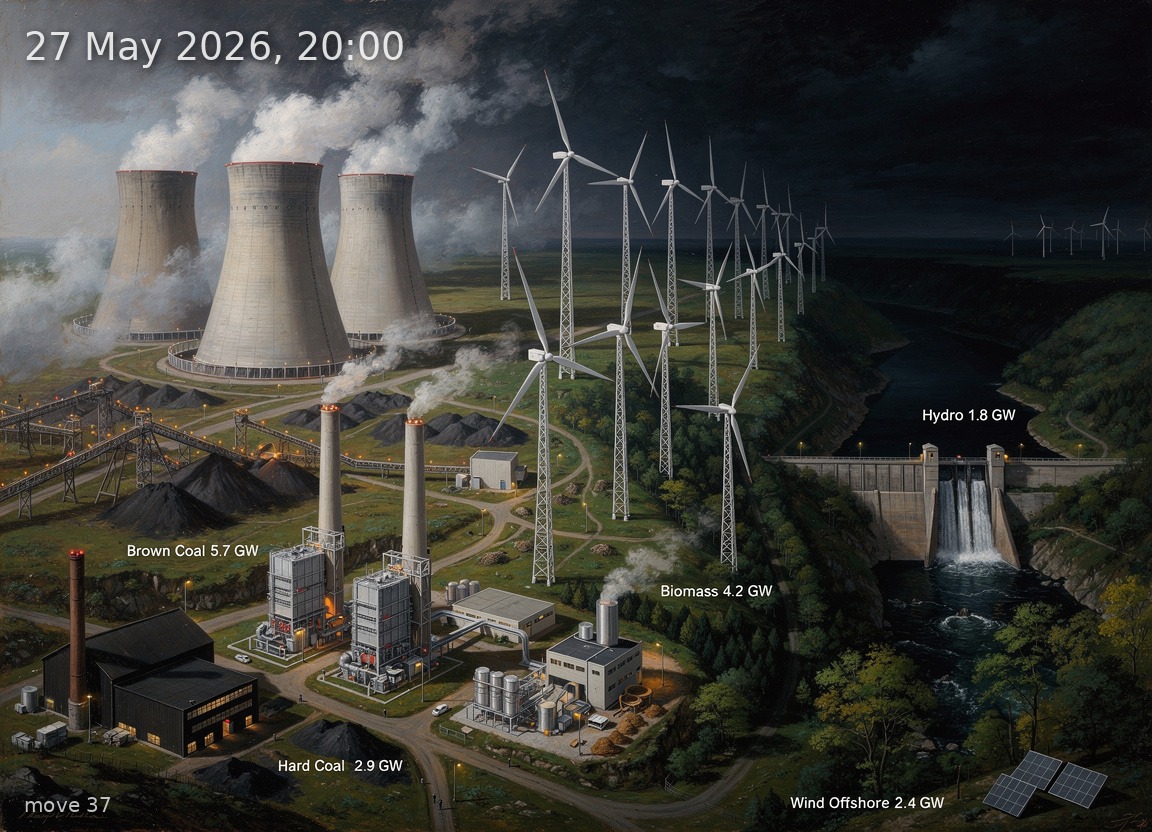
Wind leads generation at 16.4 GW but a 17.4 GW net import gap and thermal dispatch drive prices to 157 EUR/MWh.
Back
Generation mix
Wind onshore 36%
Wind offshore 6%
Solar 6%
Biomass 11%
Hydro 5%
Natural gas 15%
Hard coal 7%
Brown coal 15%
63%
Renewable share
16.4 GW
Wind (on + offshore)
2.2 GW
Solar
38.9 GW
Total generation
-17.4 GW
Net import
156.7 €/MWh
Day-ahead price
20.4°C / 17 km/h
Temp / Wind speed
Open-Meteo, Kassel (51.3°N 9.5°E)
0.0% / 117.0 W/m²
Cloud cover / Radiation
249
gCO₂/kWh
Image prompt
Wind onshore 14.0 GW dominates the right half of the canvas as dozens of tall three-blade turbines with white lattice towers stretching across rolling green hills, blades caught mid-rotation in moderate wind; wind offshore 2.4 GW appears as a distant cluster of turbines on a dark horizon line at far right. Brown coal 5.7 GW occupies the left foreground as three massive hyperbolic cooling towers emitting thick white-grey steam plumes, flanked by conveyor belts and lignite stockpiles. Natural gas 5.7 GW sits centre-left as two compact CCGT power blocks with tall slender exhaust stacks venting thin heat shimmer. Hard coal 2.9 GW appears as a single large industrial hall with a shorter chimney stack and coal bunkers to the left of the gas units. Biomass 4.2 GW is rendered as a mid-ground wood-chip-fired plant with a squat rectangular boiler building and a modest smokestack emitting pale vapour. Hydro 1.8 GW is depicted as a concrete dam and spillway set into a forested valley in the centre-right middle distance. Solar 2.2 GW appears as a small field of aluminium-framed crystalline silicon panels in the foreground right, their surfaces dark and unreflective, catching no sunlight. The sky is completely dark—deep navy to black, no twilight glow, no sunset remnants—it is full nighttime at 20:00 in late May after a clear day. The atmosphere feels heavy and oppressive, reflecting the high electricity price: low haze hangs between the cooling towers, and the air appears dense and warm at 20°C. Sodium-orange streetlights line an access road in the foreground. The cooling towers and plant buildings glow with harsh industrial floodlights. Windows of a distant town emit warm amber light on the horizon. Late-spring vegetation is lush—deciduous trees in full green leaf, tall grass swaying in moderate wind. The scene is rendered as a highly detailed oil painting in the tradition of 19th-century German Romantic landscape painters—rich, saturated colour with visible impasto brushwork, dramatic atmospheric depth, chiaroscuro contrasts between the glowing industrial facilities and the enveloping darkness. Each technology is painted with meticulous engineering accuracy: turbine nacelles, rotor hubs, PV cell grid patterns, cooling tower parabolic profiles, CCGT heat recovery sections. No text, no labels.