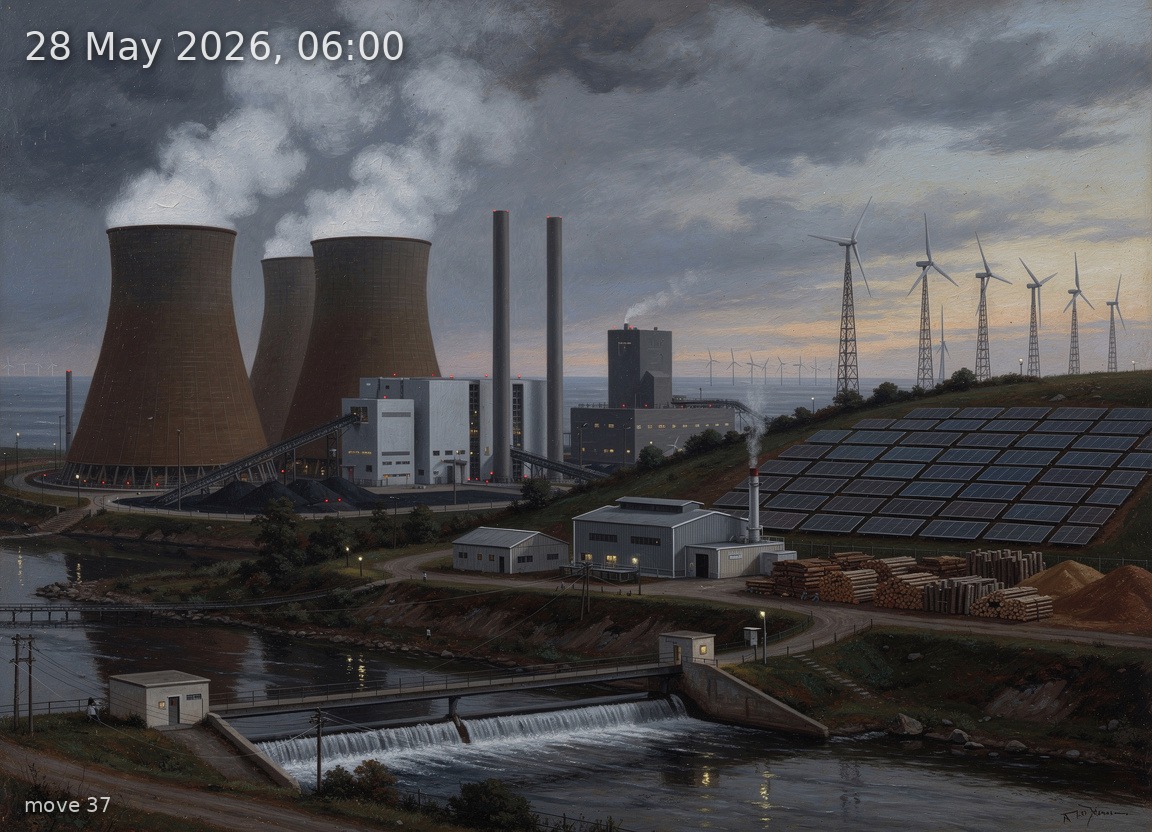
Brown coal and gas anchor a 29.1 GW domestic supply against 50.3 GW demand, with 21.2 GW net imports at dawn.
Back
Generation mix
Wind onshore 15%
Wind offshore 3%
Solar 16%
Biomass 13%
Hydro 6%
Natural gas 17%
Hard coal 10%
Brown coal 20%
53%
Renewable share
5.0 GW
Wind (on + offshore)
4.8 GW
Solar
29.1 GW
Total generation
-21.2 GW
Net import
148.5 €/MWh
Day-ahead price
7.2°C / 5 km/h
Temp / Wind speed
Open-Meteo, Kassel (51.3°N 9.5°E)
55.0% / 1.0 W/m²
Cloud cover / Radiation
325
gCO₂/kWh
Image prompt
Brown coal 5.9 GW dominates the left quarter as a massive lignite power station with three hyperbolic cooling towers trailing thick white steam plumes into the grey pre-dawn sky; natural gas 5.0 GW occupies the left-centre as two compact CCGT units with slender single exhaust stacks emitting thin heat shimmer; hard coal 2.9 GW appears behind them as a smaller conventional plant with a single square chimney and conveyor belts; solar 4.8 GW fills the centre-right as rows of aluminium-framed crystalline silicon panels on a gentle hillside, their surfaces dark and barely reflecting the faint pre-dawn light; onshore wind 4.2 GW stands across the right as a line of eight three-blade turbines on lattice towers, rotors almost motionless in the still air; biomass 3.9 GW appears as a medium-sized wood-chip facility with a modest smokestack and timber storage yard in the mid-ground right; hydro 1.7 GW is a small run-of-river weir with a concrete powerhouse visible at a river in the foreground; offshore wind 0.7 GW is suggested as tiny turbines on a distant grey horizon line at far right. The sky is deep blue-grey pre-dawn, no direct sunlight, only a faint pale luminescence along the eastern horizon suggesting the sun is still below the hilltops. Temperature is cool at 7 °C—spring vegetation is fresh green but dew-covered, trees in full leaf but with a chill mist hovering over the river. Cloud cover at 55% creates broken stratocumulus in muted steel-grey tones. The atmosphere is heavy and oppressive, reflecting the high 148.5 EUR/MWh electricity price—a brooding, weighty sky pressing down on the industrial landscape. Style: highly detailed oil painting in the tradition of 19th-century German Romantic landscape painters such as Caspar David Friedrich and Carl Blechen, with rich impasto brushwork, atmospheric aerial perspective, dramatic chiaroscuro between the glowing industrial facilities and the dark pre-dawn sky, meticulous engineering accuracy on every turbine nacelle, cooling tower curvature, and panel frame. No text, no labels.